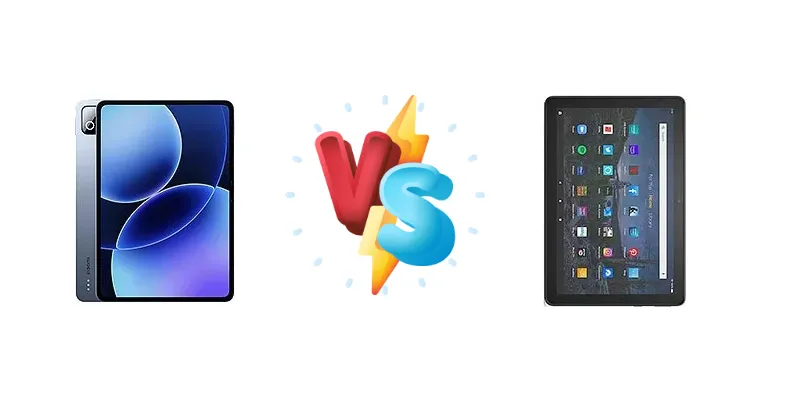
The tablet market offers a wide spectrum of choices, from budget-friendly media consumption devices to powerful productivity tools. The Xiaomi Pad 8 and Amazon Fire HD 10 Plus (2021) represent opposite ends of this spectrum, with the Xiaomi Pad 8 boasting a modern chipset and the Fire HD 10 Plus prioritizing affordability and Amazon’s ecosystem. This comparison dissects their key differences to help you determine which tablet best suits your needs.
🏆 Quick Verdict
For users prioritizing performance and a versatile Android experience, the Xiaomi Pad 8 is the clear winner. Its Snapdragon 8s Gen 4 chipset delivers significantly faster processing speeds and smoother multitasking. However, the Amazon Fire HD 10 Plus remains a compelling option for those deeply invested in the Amazon ecosystem and seeking a basic tablet for media consumption at a lower price point.
| Network |
|---|
| 2G bands | N/A | N/A |
| 3G bands | N/A | - |
| EDGE | N/A | No |
| GPRS | N/A | No |
| Technology | No cellular connectivity | No cellular connectivity |
| Launch |
|---|
| Announced | 2025, September 25 | 2021, April 27. Released 2021, May 26 |
| Status | Available. Released 2025, September 25 | Discontinued |
| Body |
|---|
| Build | Glass front, aluminum frame, aluminum back | - |
| Dimensions | 251.2 x 173.4 x 5.8 mm (9.89 x 6.83 x 0.23 in) | 247 x 166 x 9.2 mm (9.72 x 6.54 x 0.36 in) |
| SIM | No | No |
| Weight | 485 g or 494 g (1.07 lb) | 468 g (1.03 lb) |
| Display |
|---|
| Protection | - | Aluminosilicate glass |
| Resolution | 2136 x 3200 pixels, 3:2 ratio (~344 ppi density) | 1920 x 1200 pixels, 16:10 ratio (~224 ppi density) |
| Size | 11.2 inches, 373.7 cm2 (~85.8% screen-to-body ratio) | 10.1 inches, 295.8 cm2 (~72.1% screen-to-body ratio) |
| Type | IPS LCD, 68B colors, 144Hz, HDR10, Dolby Vision, HDR Vivid, 800 nits (peak) | IPS LCD |
| Platform |
|---|
| CPU | Octa-core (1x3.21 GHz Cortex-X4 & 3x3.0 GHz Cortex-A720 & 2x2.8 GHz Cortex-A720 & 2x2.0 GHz Cortex-A720) | Octa-core (4x2.0 GHz Cortex-A73 & 4x2.0 GHz Cortex-A53) |
| Chipset | Qualcomm SM8735 Snapdragon 8s Gen 4 (4 nm) | Mediatek MT8183 Helio P60T (12 nm) |
| GPU | Adreno 825 | Mali-G72 MP3 |
| OS | Android 16, HyperOS 3 | Android 9.0 (Pie), Fire OS 7 |
| Memory |
|---|
| Card slot | No | microSDXC (dedicated slot) |
| Internal | 128GB 8GB RAM, 256GB 8GB RAM, 256GB 12GB RAM | 32GB 4GB RAM, 64GB 4GB RAM |
| | - | eMMC 5.1 |
| Main Camera |
|---|
| Features | LED flash, HDR | - |
| Single | 13 MP, f/2.2, (wide), 1/3.06", 1.12µm, PDAF | 5 MP |
| Video | 4K@30fps, 1080p@30/60fps | 720p |
| Selfie camera |
|---|
| Features | HDR | - |
| Single | 8 MP, f/2.3, (wide), 1/4.0", 1.12µm | 2 MP |
| Video | 1080p@30fps | 720p |
| Sound |
|---|
| 3.5mm jack | - | Yes |
| 35mm jack | No | Yes |
| Loudspeaker | Yes, with stereo speakers, Dolby Atmos (4 speakers) | Yes, with stereo speakers |
| Comms |
|---|
| Bluetooth | 5.4, LHDC 5 | 5.0, A2DP, LE |
| Infrared port | Yes | - |
| NFC | No | No |
| Positioning | No | No |
| Radio | No | No |
| USB | USB Type-C 3.2, accessory connector | USB Type-C 2.0, OTG |
| WLAN | Wi-Fi 802.11 a/b/g/n/ac/6/7, dual-band, Wi-Fi Direct | Wi-Fi 802.11 a/b/g/n/ac, dual-band |
| Features |
|---|
| Sensors | Accelerometer, gyro, proximity, compass | Accelerometer |
| | - | Text-to-Speech English-language content reader |
| Battery |
|---|
| Charging | 45W wired, PD3.0, QC3+
22.5 reverse wireless charging | Wireless |
| Type | 9200 mAh | Li-Ion |
| Misc |
|---|
| Colors | Black, Blue, Green | Slate |
| Models | - | T76N2P |
| Price | About 260 EUR | About 150 EUR |
| SAR EU | 0.99 W/kg (body) | - |
Xiaomi Pad 8
- Significantly faster processor for demanding tasks
- 45W fast charging with PD3.0/QC3+ support
- Reverse wireless charging capability
- Likely higher price point
- May require additional purchase of Google Play services if not pre-installed
Amazon Fire HD 10 Plus (2021)
- Lower price point
- Seamless integration with Amazon services
- Wireless charging convenience
- Significantly slower processor
- Limited app ecosystem compared to Android
- Fire OS can feel restrictive for some users
Display Comparison
While both tablets likely feature IPS LCD panels (data not provided), the core difference lies in processing power impacting UI responsiveness. The Xiaomi Pad 8’s Snapdragon 8s Gen 4 will ensure smoother animations and faster app loading times on the display. The Fire HD 10 Plus, with its older Helio P60T, will exhibit noticeable lag in comparison. We expect the Fire HD 10 Plus to have a 10.1-inch display, typical of the line, while the Xiaomi Pad 8 is slightly smaller at 11 inches, potentially offering a higher pixel density for sharper visuals. Bezels are likely larger on the Fire HD 10 Plus due to its lower price point.
Camera Comparison
Camera performance is unlikely to be a primary consideration for either tablet. However, the Xiaomi Pad 8 likely benefits from a more modern image signal processor (ISP) integrated within the Snapdragon 8s Gen 4, potentially resulting in better image quality in favorable lighting conditions. The Fire HD 10 Plus’s camera system is likely basic, focused on video calls rather than photography. Without specific sensor details, it’s difficult to make a precise comparison, but the Xiaomi Pad 8’s chipset provides a foundation for superior image processing.
Performance
The performance gap is substantial. The Xiaomi Pad 8’s Qualcomm SM8735 Snapdragon 8s Gen 4 (4nm) is a significant leap forward from the Amazon Fire HD 10 Plus’s MediaTek MT8183 Helio P60T (12nm). The Snapdragon 8s Gen 4’s octa-core configuration, featuring a Cortex-X4 prime core clocked at 3.21 GHz, provides a substantial performance advantage in CPU-intensive tasks. The 4nm process node also translates to improved thermal efficiency, reducing throttling during sustained workloads. The Helio P60T’s Cortex-A73/A53 cores, while capable, are several generations older and less efficient. The Xiaomi Pad 8 likely utilizes faster LPDDR5x RAM, further enhancing performance compared to the Fire HD 10 Plus’s likely LPDDR4X configuration.
Battery Life
Battery life will depend heavily on usage patterns. The Xiaomi Pad 8’s 45W wired charging with PD3.0 and QC3+ support is a significant advantage, allowing for much faster charging times compared to the Fire HD 10 Plus’s wireless charging. While wireless charging offers convenience, it’s generally slower than wired charging. The Xiaomi Pad 8 also offers 22.5W reverse wireless charging, a feature absent on the Fire HD 10 Plus. The actual battery capacity of both devices isn't provided, but the Snapdragon 8s Gen 4’s efficiency could offset a potentially smaller battery size in the Xiaomi Pad 8.
Buying Guide
Buy the Xiaomi Pad 8 if you need a tablet capable of handling demanding tasks like gaming, video editing, or running multiple apps simultaneously. Its faster processor and support for PD3.0/QC3+ 45W charging make it ideal for power users. Buy the Amazon Fire HD 10 Plus (2021) if you prefer a simple, affordable tablet primarily for reading, streaming Amazon Prime Video, and accessing Amazon services. Its wireless charging is a convenience, but its performance is geared towards lighter workloads.
Frequently Asked Questions
❓ Will the Snapdragon 8s Gen 4 in the Xiaomi Pad 8 handle demanding games like Genshin Impact?
Yes, the Snapdragon 8s Gen 4 is a capable chipset that should handle Genshin Impact and other graphically intensive games at medium to high settings. The 4nm process and improved thermal management will help mitigate throttling during extended gaming sessions, providing a smoother experience than the Fire HD 10 Plus.
❓ Is Fire OS on the Amazon Fire HD 10 Plus difficult to use for someone accustomed to standard Android?
Fire OS is a heavily customized version of Android. While it shares a similar foundation, the user interface is significantly different and emphasizes Amazon’s services. Users accustomed to stock Android may find the learning curve steeper, and accessing the full Google Play Store requires sideloading.
❓ Can I use Google Play Store on the Xiaomi Pad 8?
The Xiaomi Pad 8 ships with MIUI for Pad, which includes the Google Play Store. You won't need to sideload anything to access your favorite Android apps.
❓ How long does it take to fully charge the Xiaomi Pad 8 with the 45W charger?
With the included 45W charger and support for PD3.0/QC3+, the Xiaomi Pad 8 should fully charge from 0% to 100% in approximately 1 hour to 1 hour and 30 minutes, depending on usage during charging.