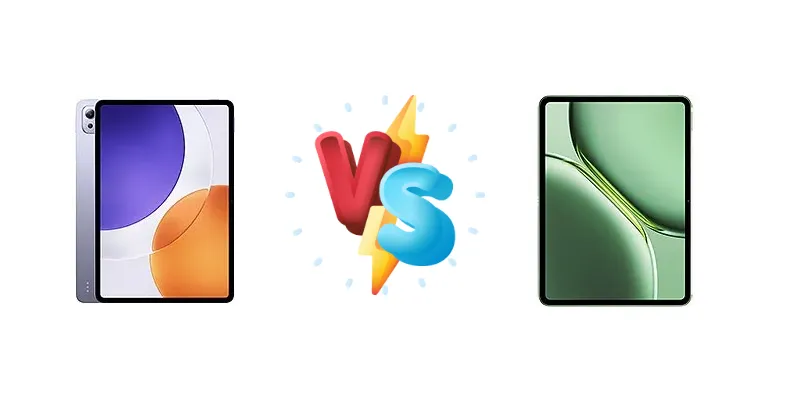
The Android tablet market is heating up, with Xiaomi and OnePlus delivering compelling options. The Xiaomi Pad 7S Pro 12.5 boasts a cutting-edge Xring O1 chipset and blazing-fast 120W charging, while the OnePlus Pad Pro counters with the established power of the Snapdragon 8 Gen 3. This comparison dissects the key differences to determine which tablet reigns supreme.
🏆 Quick Verdict
For users prioritizing raw processing power and a proven track record, the OnePlus Pad Pro emerges as the winner. Its Snapdragon 8 Gen 3, built on a 4nm process, offers a more mature and thermally efficient platform than the Xiaomi’s Xring O1. However, the Xiaomi Pad 7S Pro’s 120W charging is a significant advantage for those constantly on the move.
| Network |
|---|
| 2G bands | N/A | N/A |
| 3G bands | N/A | N/A |
| 4G bands | - | N/A |
| EDGE | N/A | No |
| GPRS | N/A | No |
| Technology | No cellular connectivity | No cellular connectivity |
| Launch |
|---|
| Announced | 2025, June 26 | 2024, June 27 |
| Status | Available. Released 2025, June 26 | Available. Released 2024, June 29 |
| Body |
|---|
| Build | Glass front, aluminum frame, aluminum back | Glass front, aluminum back, aluminum frame |
| Dimensions | 279.1 x 192 x 5.8 mm (10.99 x 7.56 x 0.23 in) | 268.7 x 195.1 x 6.5 mm (10.58 x 7.68 x 0.26 in) |
| SIM | No | No |
| Weight | 576 g or 585 g (1.27 lb) | 584 g (1.29 lb) |
| Display |
|---|
| Protection | Corning Gorilla Glass 5 or Panda-X | - |
| Resolution | 2136 x 3200 pixels, 3:2 ratio (~308 ppi density) | 2120 x 3000 pixels (~304 ppi density) |
| Size | 12.5 inches, 465.5 cm2 (~86.9% screen-to-body ratio) | 12.1 inches, 445.2 cm2 (~84.9% screen-to-body ratio) |
| Type | IPS LCD, 68B colors, 144Hz, HDR10, HDR Vivid, Dolby Vision, 1000 nits (peak) | IPS LCD, 68B colors, Dolby Vision, HDR10+, 144Hz, 600 nits (typ), 900 nits (peak) |
| Platform |
|---|
| CPU | 10-core (2x3.4GHz Cortex-X925 & 4x3.4GHz Cortex-A725 & 2x1.9GHz Cortex-A725 & 2x1.8GHz Cortex-A520) | Octa-core (1x3.3 GHz Cortex-X4 & 3x3.2 GHz Cortex-A720 & 2x3.0 GHz Cortex-A720 & 2x2.3 GHz Cortex-A520) |
| Chipset | Xring O1 (3 nm) | Qualcomm SM8650-AB Snapdragon 8 Gen 3 (4 nm) |
| GPU | Immortalis-G925 MP16 | Adreno 750 |
| OS | Android 15, HyperOS 2 | Android 14, OxygenOS 14.1 |
| Memory |
|---|
| Card slot | No | No |
| Internal | 256GB 8GB RAM, 256GB 12GB RAM, 512GB 12GB RAM, 512GB 16GB RAM, 1TB 16GB RAM | 128GB 8GB RAM, 256GB 8GB RAM, 256GB 12GB RAM, 512GB 16GB RAM |
| Main Camera |
|---|
| Features | LED flash, HDR | LED flash |
| Single | 50 MP, f/1.8, (wide), 1/2.76", 0.64µm, PDAF | 13 MP, f/2.2, 23mm (wide) |
| Video | 4K@30/60fps, 1080p@30/60fps | 4K@30fps, 1080p@30ps, gyro-EIS |
| Selfie camera |
|---|
| Features | HDR | - |
| Single | 32 MP, f/2.2, 19mm (ultrawide), 1/3.6", 0.61µm | 8 MP, f/2.3, (wide), 1/4.0", 1.12µm |
| Video | 1080p@30fps | 1080p@30fps |
| Sound |
|---|
| 35mm jack | No | No |
| Loudspeaker | Yes, with stereo speakers (6 speakers, with Dolby Atmos) | Yes, with stereo speakers (4 speakers) |
| Comms |
|---|
| Bluetooth | 5.4, A2DP, LE, LHDC 5 | 5.4, A2DP, LE, aptX HD, LHDC |
| Infrared port | Yes | - |
| NFC | No | NFC (data sharing only) |
| Positioning | No | No |
| Radio | No | No |
| USB | USB Type-C 3.2, OTG, magnetic accessory connector | USB Type-C 3.2, OTG, accessory connector |
| WLAN | Wi-Fi 802.11 a/b/g/n/ac/6e/7, dual-band, Wi-Fi Direct | Wi-Fi 802.11 a/b/g/n/ac/6/7, dual-band |
| Features |
|---|
| Sensors | Fingerprint (side-mounted), accelerometer, gyro, proximity, compass | Accelerometer, gyro, proximity (accessories only), compass |
| Battery |
|---|
| Charging | 120W wired, PD3.0, QC3+
7.5W reverse wired | 67W wired, PD, QC |
| Type | 10610 mAh | Li-Po 9510 mAh |
| Misc |
|---|
| Colors | Black, Purple, Titanium Silver, Basalt Gray | Gray, Green |
| Models | - | OPD2404 |
| Price | About 400 EUR | About 370 EUR |
Xiaomi Pad 7S Pro 12.5
- Blazing-fast 120W wired charging
- Potentially strong multi-core performance with Xring O1
- 3nm chipset offers potential efficiency gains
- Xring O1 is a newer, less-tested chipset
- Thermal management could be a concern with the Xring O1
- Limited information on display and camera specs
OnePlus Pad Pro
- Proven Snapdragon 8 Gen 3 performance
- 4nm process for improved thermal efficiency
- Reliable and mature platform
- Slower 67W charging compared to Xiaomi
- May be more expensive than the Xiaomi Pad 7S Pro
- Less aggressive CPU clock speeds compared to Xiaomi
Display Comparison
While both tablets likely feature high-resolution displays (data not provided), the core difference lies in the underlying processing power impacting display responsiveness. The Xring O1’s 10-core CPU could potentially drive a smoother UI experience, but the Snapdragon 8 Gen 3’s Adreno GPU will likely offer superior graphics rendering for gaming and video playback. The absence of display specs like refresh rate and panel type makes a direct comparison difficult, but the Snapdragon’s optimized power efficiency could translate to better battery life while viewing content.
Camera Comparison
Without camera specifications, a detailed comparison is impossible. However, given the tablet form factor, camera quality is often secondary to performance and display. Both manufacturers likely prioritize a functional camera setup for video calls and casual photography. The absence of information regarding sensor size, aperture, or optical image stabilization (OIS) prevents a meaningful assessment.
Performance
The chipset battle is central here. The OnePlus Pad Pro’s Snapdragon 8 Gen 3 (4nm) utilizes a 1+3+2+2 core configuration, prioritizing a single high-performance Cortex-X4 core for peak tasks. The Xiaomi Pad 7S Pro’s Xring O1 (3nm) employs a more complex 2+4+2+2 core layout, potentially offering better multi-threaded performance. However, the 3nm process doesn’t automatically guarantee superiority; the Snapdragon 8 Gen 3’s mature architecture and optimized thermal design are likely to provide more consistent performance under sustained load. The Xiaomi’s CPU clock speeds are slightly higher on some cores, but the Snapdragon’s architectural advantages are likely to offset this.
Battery Life
The Xiaomi Pad 7S Pro’s 120W wired charging is a game-changer, significantly reducing recharge times compared to the OnePlus Pad Pro’s 67W charging. While battery capacity isn’t specified, the faster charging speed allows the Xiaomi to recover quickly from heavy use. The OnePlus Pad Pro’s support for PD and QC standards ensures compatibility with a wider range of chargers, but it can’t match the sheer speed of the Xiaomi’s proprietary 120W solution. The Snapdragon 8 Gen 3’s 4nm process should contribute to better power efficiency, potentially offsetting the Xiaomi’s charging advantage in some scenarios.
Buying Guide
Buy the Xiaomi Pad 7S Pro 12.5 if you absolutely need the fastest possible charging speeds and are comfortable with a newer, less-tested chipset architecture. This tablet is ideal for power users who frequently drain their battery and value convenience. Buy the OnePlus Pad Pro if you prioritize sustained performance, thermal management, and the reliability of Qualcomm’s Snapdragon platform. This is the better choice for demanding tasks like video editing, gaming, and multitasking.
Frequently Asked Questions
❓ Is the Xring O1 chipset likely to overheat during extended gaming sessions?
The Xring O1’s thermal performance is currently unknown. While the 3nm process *should* improve efficiency, the 10-core design and higher clock speeds could generate significant heat. The OnePlus Pad Pro’s Snapdragon 8 Gen 3, built on a 4nm process, is likely to offer better sustained performance due to its more mature thermal design.
❓ How much faster is the 120W charging on the Xiaomi Pad 7S Pro compared to the 67W charging on the OnePlus Pad Pro?
The 120W charging on the Xiaomi Pad 7S Pro will significantly reduce charging times. While exact figures depend on battery capacity, expect a 0-100% charge in approximately 30-45 minutes with the Xiaomi, compared to 60-90 minutes with the OnePlus Pad Pro. This is a substantial difference for users who frequently need to top up their battery.
❓ Does the Snapdragon 8 Gen 3 in the OnePlus Pad Pro support advanced gaming features like ray tracing?
Yes, the Snapdragon 8 Gen 3’s Adreno GPU supports hardware-accelerated ray tracing, offering more realistic lighting and reflections in compatible games. This feature is not explicitly mentioned for the Xring O1, suggesting the Xiaomi Pad 7S Pro may rely on software-based ray tracing, which is less efficient.