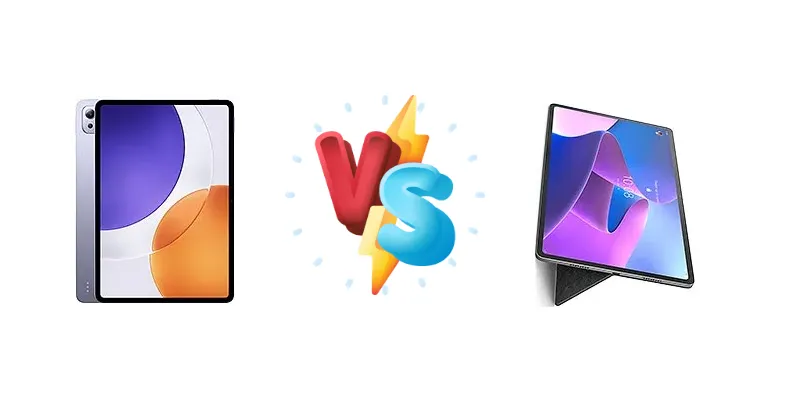
The Android tablet market is heating up, with Xiaomi aggressively challenging established players like Lenovo. We’re comparing the newly released Xiaomi Pad 7S Pro 12.5, boasting the cutting-edge Xring O1 chipset, against the well-regarded Lenovo Tab P12 Pro, powered by the Snapdragon 870 5G. This isn’t just a spec sheet comparison; it’s a look at how architectural differences translate into real-world performance and user experience.
🏆 Quick Verdict
For users prioritizing raw processing power and future-proofing, the Xiaomi Pad 7S Pro 12.5 emerges as the winner. Its Xring O1 chipset, built on a 3nm process, offers a significant architectural advantage over the Lenovo Tab P12 Pro’s 7nm Snapdragon 870. However, the Lenovo Tab P12 Pro remains a strong contender for those valuing a proven track record and potentially better software optimization.
| Network |
|---|
| 2G bands | N/A | GSM 850 / 900 / 1800 / 1900 |
| 3G bands | N/A | HSDPA 850 / 900 / 1900 / 2100 |
| 4G bands | - | 1, 2, 3, 4, 5, 7, 8, 19, 20, 26, 28, 34, 38, 39, 40, 41 |
| 5G bands | - | 1, 3, 7, 8, 20, 28, 38, 41, 77, 78 SA/NSA/Sub6 |
| EDGE | N/A | - |
| GPRS | N/A | - |
| Speed | - | HSPA, LTE, 5G - cellular model only |
| Technology | No cellular connectivity | GSM / HSPA / LTE / 5G |
| Launch |
|---|
| Announced | 2025, June 26 | 2021, September 08 |
| Status | Available. Released 2025, June 26 | Available. Released 2021, November 19 |
| Body |
|---|
| Build | Glass front, aluminum frame, aluminum back | - |
| Dimensions | 279.1 x 192 x 5.8 mm (10.99 x 7.56 x 0.23 in) | 285.6 x 184.5 x 5.6 mm (11.24 x 7.26 x 0.22 in) |
| SIM | No | Nano-SIM (cellular model only) |
| Weight | 576 g or 585 g (1.27 lb) | 565 g (1.25 lb) |
| | - | Stylus support |
| Display |
|---|
| Protection | Corning Gorilla Glass 5 or Panda-X | - |
| Resolution | 2136 x 3200 pixels, 3:2 ratio (~308 ppi density) | 1600 x 2560 pixels, 16:10 ratio (~240 ppi density) |
| Size | 12.5 inches, 465.5 cm2 (~86.9% screen-to-body ratio) | 12.6 inches, 460.3 cm2 (~87.4% screen-to-body ratio) |
| Type | IPS LCD, 68B colors, 144Hz, HDR10, HDR Vivid, Dolby Vision, 1000 nits (peak) | AMOLED, 120Hz, HDR10+, Dolby Vision, 600 nits (HBM) |
| Platform |
|---|
| CPU | 10-core (2x3.4GHz Cortex-X925 & 4x3.4GHz Cortex-A725 & 2x1.9GHz Cortex-A725 & 2x1.8GHz Cortex-A520) | Octa-core (1x3.2 GHz Kryo 585 & 3x2.42 GHz Kryo 585 & 4x1.80 GHz Kryo 585) |
| Chipset | Xring O1 (3 nm) | Qualcomm SM8250-AC Snapdragon 870 5G (7 nm) |
| GPU | Immortalis-G925 MP16 | Adreno 650 |
| OS | Android 15, HyperOS 2 | Android 11 |
| Memory |
|---|
| Card slot | No | microSDXC (dedicated slot) |
| Internal | 256GB 8GB RAM, 256GB 12GB RAM, 512GB 12GB RAM, 512GB 16GB RAM, 1TB 16GB RAM | 128GB 6GB RAM, 256GB 8GB RAM |
| Main Camera |
|---|
| Dual | - | 13 MP, (wide), AF
5 MP, (ultrawide) |
| Features | LED flash, HDR | - |
| Single | 50 MP, f/1.8, (wide), 1/2.76", 0.64µm, PDAF | - |
| Video | 4K@30/60fps, 1080p@30/60fps | 4K@30fps, 1080p@30fps |
| Selfie camera |
|---|
| Features | HDR | - |
| Single | 32 MP, f/2.2, 19mm (ultrawide), 1/3.6", 0.61µm | 8 MP, (wide)
8 MP, IR TOF 3D, (biometrics sensor only) |
| Video | 1080p@30fps | 1080p@30fps |
| Sound |
|---|
| 3.5mm jack | - | No |
| 35mm jack | No | No |
| Loudspeaker | Yes, with stereo speakers (6 speakers, with Dolby Atmos) | Yes, with stereo speakers (4 speakers) |
| | - | JBL speakers |
| Comms |
|---|
| Bluetooth | 5.4, A2DP, LE, LHDC 5 | 5.2, A2DP, LE |
| Infrared port | Yes | - |
| NFC | No | Yes (wireless charging and data transfer only) |
| Positioning | No | GPS, GLONASS, BDS - cellular model only |
| Radio | No | Unspecified |
| USB | USB Type-C 3.2, OTG, magnetic accessory connector | USB Type-C 3.1 |
| WLAN | Wi-Fi 802.11 a/b/g/n/ac/6e/7, dual-band, Wi-Fi Direct | Wi-Fi 802.11 a/b/g/n/ac/6, dual-band, Wi-Fi Direct |
| Features |
|---|
| Sensors | Fingerprint (side-mounted), accelerometer, gyro, proximity, compass | Fingerprint (side-mounted), accelerometer, gyro, proximity |
| Battery |
|---|
| Charging | 120W wired, PD3.0, QC3+
7.5W reverse wired | 45W wired, QC4 |
| Type | 10610 mAh | Li-Po 10200 mAh |
| Misc |
|---|
| Colors | Black, Purple, Titanium Silver, Basalt Gray | Storm Grey |
| Models | - | TB-Q706Z, TB-Q706F |
| Price | About 400 EUR | About 520 EUR |
Xiaomi Pad 7S Pro 12.5
- Significantly faster 120W charging
- More powerful and efficient Xring O1 chipset (3nm)
- Potentially better thermal management
- Reverse wired charging capability
- Software optimization may be less mature
- Newer chipset – potential for unforeseen bugs
Lenovo Tab P12 Pro
- Proven Snapdragon 870 performance
- Mature and stable software experience
- Well-established accessory ecosystem
- QC4 fast charging support
- Slower 45W charging
- Less efficient 7nm chipset
- Lower peak processing power compared to Xring O1
Display Comparison
While both tablets likely feature high-quality LCD panels (specific panel tech is not provided), the focus here is on processing power. Display specs like resolution and refresh rate are likely similar, but the Xring O1’s increased processing capability could enable more advanced display features in the future, such as improved HDR processing. The Lenovo Tab P12 Pro’s display benefits from the Snapdragon 870’s ISP for image processing, but the Xiaomi Pad 7S Pro’s newer architecture could potentially offer similar or better results.
Camera Comparison
Given the tablet form factor, camera performance isn't a primary concern. However, the Xring O1’s integrated ISP (Image Signal Processor) likely offers advancements in image processing compared to the Snapdragon 870’s ISP. Without specific camera sensor details, it’s difficult to make a definitive judgment, but the newer chipset has the potential for improved dynamic range and low-light performance. The Lenovo Tab P12 Pro benefits from Qualcomm’s well-established camera algorithms.
Performance
The core of this comparison lies in the chipsets. The Xiaomi Pad 7S Pro’s Xring O1, fabricated on a 3nm process, represents a significant leap in transistor density compared to the Lenovo Tab P12 Pro’s 7nm Snapdragon 870. The Xring O1’s 10-core configuration (2x3.4GHz Cortex-X925, 4x3.4GHz Cortex-A725, 2x1.9GHz Cortex-A725, 2x1.8GHz Cortex-A520) is more complex than the Snapdragon 870’s octa-core setup (1x3.2 GHz Kryo 585, 3x2.42 GHz Kryo 585, 4x1.80 GHz Kryo 585). This translates to potentially higher multi-core performance for demanding tasks. The 3nm process also implies better thermal efficiency, reducing the likelihood of throttling during sustained workloads. However, software optimization will play a crucial role in realizing the Xring O1’s full potential.
Battery Life
The Xiaomi Pad 7S Pro 12.5’s 120W wired charging is a clear advantage over the Lenovo Tab P12 Pro’s 45W charging. This means significantly faster charging times, potentially going from 0-100% in under 30 minutes. While battery capacity isn’t specified, the Xring O1’s 3nm process should contribute to improved power efficiency, potentially offsetting any capacity differences. The Xiaomi Pad 7S Pro also offers 7.5W reverse wired charging, a feature absent on the Lenovo Tab P12 Pro.
Buying Guide
Buy the Xiaomi Pad 7S Pro 12.5 if you need uncompromising performance for demanding tasks like video editing, 3D rendering, or high-end gaming, and are comfortable with a potentially newer, less-refined software experience. Buy the Lenovo Tab P12 Pro if you prefer a more polished, mature software experience, reliable performance for everyday tasks, and a well-established ecosystem of accessories, even if it means sacrificing some raw processing power.
Frequently Asked Questions
❓ Will the Xring O1 chipset in the Xiaomi Pad 7S Pro 12.5 overheat during extended gaming sessions?
The Xring O1’s 3nm fabrication process is designed for improved thermal efficiency. While sustained workloads will generate heat, the smaller process node should result in less throttling compared to the Lenovo Tab P12 Pro’s 7nm Snapdragon 870. However, real-world thermal performance will depend on the tablet’s cooling solution and software optimization.
❓ Does the Xiaomi Pad 7S Pro 12.5 support all the same codecs and streaming services as the Lenovo Tab P12 Pro?
While both tablets support common codecs like H.264 and H.265, compatibility with specific streaming services (Netflix, Amazon Prime Video, etc.) can vary based on DRM licensing. It’s recommended to check the official specifications for each tablet to confirm support for your preferred streaming platforms. The Xring O1’s newer architecture may offer improved support for newer codecs like AV1.
❓ How does the software experience differ between Xiaomi's MIUI Pad and Lenovo's Android implementation?
Xiaomi’s MIUI Pad is known for its feature-rich interface and customization options, but it can also be more resource-intensive than Lenovo’s closer-to-stock Android implementation. Lenovo generally prioritizes a cleaner, more streamlined experience. Users who prefer a minimalist approach may prefer the Lenovo Tab P12 Pro, while those who enjoy extensive customization options may lean towards the Xiaomi Pad 7S Pro 12.5.