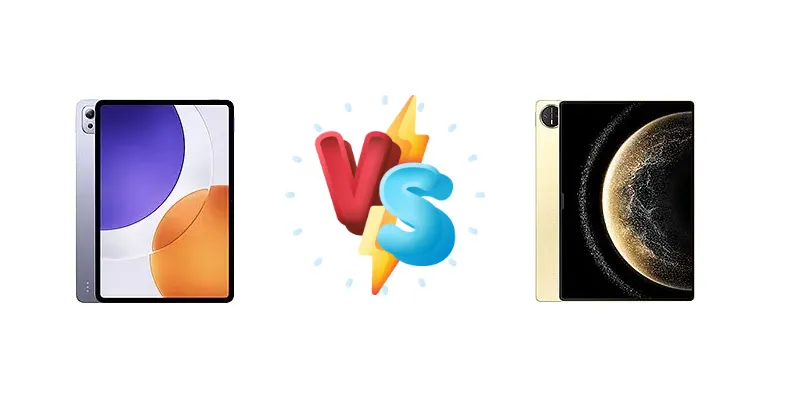
The large-screen Android tablet market is heating up, with Xiaomi and Huawei both releasing compelling contenders. The Xiaomi Pad 7S Pro 12.5 boasts a cutting-edge 3nm Xring O1 chipset and blazing-fast 120W charging, while the Huawei MatePad Pro 13.2 (2025) counters with its Kirin T92 and a focus on a premium user experience. This comparison dissects the key differences to help you choose the right tablet for your workflow.
🏆 Quick Verdict
For users prioritizing raw performance and charging speed, the Xiaomi Pad 7S Pro 12.5 emerges as the winner. Its 3nm Xring O1 chipset offers a significant architectural advantage, and the 120W charging is unmatched. However, the Huawei MatePad Pro 13.2 (2025) may appeal to those valuing software integration and a potentially more refined ecosystem.
| Network |
|---|
| 2G bands | N/A | GSM 850 / 900 / 1800 / 1900 |
| 3G bands | N/A | HSDPA 850 / 900 / 1900 / 2100 |
| 4G bands | - | LTE |
| EDGE | N/A | - |
| GPRS | N/A | - |
| Speed | - | HSPA, LTE - cellular model only |
| Technology | No cellular connectivity | GSM / HSPA / LTE |
| Launch |
|---|
| Announced | 2025, June 26 | 2024, November 26 |
| Status | Available. Released 2025, June 26 | Available. Released 2024, December 12 |
| Body |
|---|
| Build | Glass front, aluminum frame, aluminum back | Glass front, nylon fiber back, magnesium alloy frame |
| Dimensions | 279.1 x 192 x 5.8 mm (10.99 x 7.56 x 0.23 in) | 289.1 x 196.1 x 5.5 mm (11.38 x 7.72 x 0.22 in) |
| SIM | No | Nano-SIM (cellular model only) |
| Weight | 576 g or 585 g (1.27 lb) | 580 g (Wi-FI) or 590 g (LTE) (1.28 lb) |
| Display |
|---|
| Protection | Corning Gorilla Glass 5 or Panda-X | - |
| Resolution | 2136 x 3200 pixels, 3:2 ratio (~308 ppi density) | 2880 x 1920 pixels, 3:2 ratio (~262 ppi density) |
| Size | 12.5 inches, 465.5 cm2 (~86.9% screen-to-body ratio) | 13.2 inches, 518.8 cm2 (~91.5% screen-to-body ratio) |
| Type | IPS LCD, 68B colors, 144Hz, HDR10, HDR Vivid, Dolby Vision, 1000 nits (peak) | OLED, 1B colors, 144Hz, HDR Vivid, 1000 nits (peak) |
| Platform |
|---|
| CPU | 10-core (2x3.4GHz Cortex-X925 & 4x3.4GHz Cortex-A725 & 2x1.9GHz Cortex-A725 & 2x1.8GHz Cortex-A520) | Octa-core |
| Chipset | Xring O1 (3 nm) | Kirin T92 |
| GPU | Immortalis-G925 MP16 | - |
| OS | Android 15, HyperOS 2 | Harmony OS 4.3 |
| Memory |
|---|
| Card slot | No | No |
| Internal | 256GB 8GB RAM, 256GB 12GB RAM, 512GB 12GB RAM, 512GB 16GB RAM, 1TB 16GB RAM | 256GB 12GB RAM, 512GB 12GB RAM, 1TB 16GB RAM |
| Main Camera |
|---|
| Dual | - | 50 MP, f/1.8, (wide), PDAF
8 MP, f/2.2, (ultrawide) |
| Features | LED flash, HDR | LED flash |
| Single | 50 MP, f/1.8, (wide), 1/2.76", 0.64µm, PDAF | - |
| Video | 4K@30/60fps, 1080p@30/60fps | 4K@30fps, 1080p@30fps |
| Selfie camera |
|---|
| Features | HDR | - |
| Single | 32 MP, f/2.2, 19mm (ultrawide), 1/3.6", 0.61µm | 16 MP, f/2.2 |
| Video | 1080p@30fps | 1080p@30fps |
| Sound |
|---|
| 35mm jack | No | No |
| Loudspeaker | Yes, with stereo speakers (6 speakers, with Dolby Atmos) | Yes, with stereo speakers (6 speakers) |
| Comms |
|---|
| Bluetooth | 5.4, A2DP, LE, LHDC 5 | 5.2, A2DP, LE, L2HC |
| Infrared port | Yes | - |
| NFC | No | No |
| Positioning | No | GPS, GALILEO, GLONASS, BDS |
| Radio | No | No |
| USB | USB Type-C 3.2, OTG, magnetic accessory connector | USB Type-C 3.1, OTG, DisplayPort 1.2, accessory connector pins |
| WLAN | Wi-Fi 802.11 a/b/g/n/ac/6e/7, dual-band, Wi-Fi Direct | Wi-Fi 802.11 a/b/g/n/ac/6, dual-band |
| Features |
|---|
| Sensors | Fingerprint (side-mounted), accelerometer, gyro, proximity, compass | Fingerprint (side-mounted), accelerometer, gyro, compass, proximity (accessories only) |
| Battery |
|---|
| Charging | 120W wired, PD3.0, QC3+
7.5W reverse wired | 100W wired
7.5W reverse wired |
| Type | 10610 mAh | Li-Po 10100 mAh |
| Misc |
|---|
| Colors | Black, Purple, Titanium Silver, Basalt Gray | Black, White, Gold |
| Models | - | WEB-W00, PCE-W29 |
| Price | About 400 EUR | About 680 EUR |
Xiaomi Pad 7S Pro 12.5
- Significantly faster 120W charging
- More powerful 3nm Xring O1 chipset
- Potentially better battery life due to chip efficiency
- Software ecosystem may not be as refined as Huawei's
- Camera specs currently unknown
Huawei MatePad Pro 13.2 (2025)
- Potentially better software integration within Huawei ecosystem
- Larger display size (13.2 inches)
- Premium build quality expected from Huawei
- Slower 100W charging
- Kirin T92 chipset likely less powerful than Xring O1
- Chipset architecture is less advanced
Display Comparison
While both tablets feature large displays, specific details like panel technology (LTPO, OLED) and resolution are missing for the Huawei. The Xiaomi Pad 7S Pro 12.5’s 12.5-inch display benefits from the power efficiency of the Xring O1, potentially allowing for higher sustained brightness. Bezels are likely to be minimal on both, given the current design trends. Color accuracy will be a key differentiator, and independent testing will be needed to determine which tablet offers a more color-accurate display for professional work.
Camera Comparison
Without specific camera specs for either tablet, it’s difficult to make a definitive comparison. However, given the tablet form factor, camera quality is often secondary to other features. Both manufacturers likely prioritize a decent front-facing camera for video conferencing. The presence or absence of OIS (Optical Image Stabilization) on the main sensor will be a key differentiator, impacting image clarity in low-light conditions. We anticipate both tablets will offer standard camera features like HDR and portrait mode.
Performance
The core of the difference lies in the chipsets. The Xiaomi Pad 7S Pro 12.5’s Xring O1, built on a 3nm process, represents a significant leap in transistor density compared to the Kirin T92. The Xring O1’s 10-core configuration (2x3.4GHz Cortex-X925, 4x3.4GHz Cortex-A725, 2x1.9GHz Cortex-A725, 2x1.8GHz Cortex-A520) suggests a focus on both peak performance and sustained multi-core workloads. The Kirin T92’s octa-core design, while capable, likely won’t match the Xring O1’s sheer processing power. The Xiaomi’s LPDDR5x RAM, coupled with the efficient 3nm chip, should translate to smoother multitasking and faster application loading times. Thermal management will be crucial; the Xring O1’s efficiency should help mitigate throttling under sustained load.
Battery Life
The Xiaomi Pad 7S Pro 12.5’s 120W wired charging is a clear advantage, significantly reducing charging times compared to the Huawei MatePad Pro 13.2 (2025)’s 100W charging. While battery capacity isn’t specified, the faster charging speed allows the Xiaomi to recover quickly from heavy use. Both tablets support PD3.0, QC3+, and 7.5W reverse wired charging, offering versatility in charging options. The 3nm Xring O1’s efficiency should also contribute to better battery life on the Xiaomi, despite potentially having a similar or smaller battery capacity.
Buying Guide
Buy the Xiaomi Pad 7S Pro 12.5 if you need uncompromising processing power for demanding tasks like video editing, gaming, or running multiple applications simultaneously, and if minimizing charging downtime is critical. Buy the Huawei MatePad Pro 13.2 (2025) if you prefer a seamless experience within the Huawei ecosystem, prioritize software features, and are willing to trade some raw performance for potentially better optimization and integration with other Huawei devices.
Frequently Asked Questions
❓ Will the Xring O1 chipset in the Xiaomi Pad 7S Pro 12.5 overheat during extended gaming sessions?
The 3nm manufacturing process of the Xring O1 is designed for improved thermal efficiency. While sustained high loads will generate heat, the chip's architecture and Xiaomi's thermal management system should mitigate significant throttling, allowing for longer gaming sessions with consistent performance. However, real-world testing is needed to confirm this.
❓ Does the Huawei MatePad Pro 13.2 (2025) support stylus input and keyboard accessories, and how well are they integrated?
Huawei has a strong track record of stylus and keyboard accessory support for its MatePad Pro series. It's highly likely the 2025 model will support these accessories, with a focus on low latency and pressure sensitivity for the stylus. Integration with Huawei's software features, such as note-taking and drawing apps, is expected to be seamless.
❓ What kind of storage options are available on the Xiaomi Pad 7S Pro 12.5, and is it expandable?
While specific storage configurations aren't confirmed, Xiaomi typically offers multiple storage options (e.g., 256GB, 512GB, 1TB). Expandability via microSD card is unlikely, given the trend towards sealed tablet designs. Users should carefully consider their storage needs before purchasing.