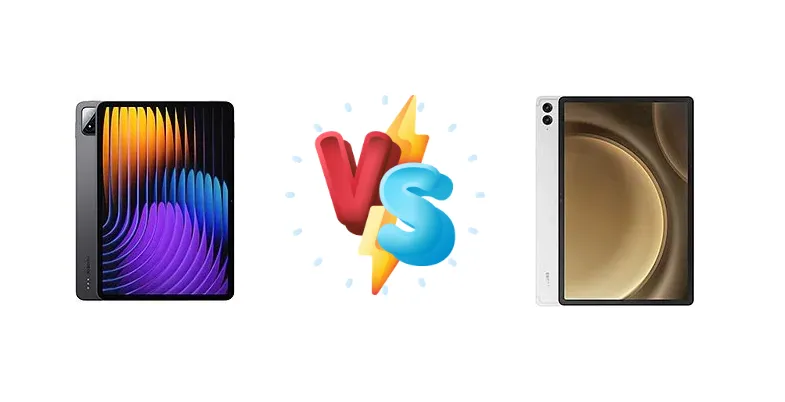
The mid-range tablet market is heating up, with the Xiaomi Pad 7 and Samsung Galaxy Tab S9 FE+ vying for dominance. The Xiaomi Pad 7 arrives with a focus on raw processing power thanks to the Snapdragon 7+ Gen 3, while the Samsung Tab S9 FE+ leverages the Exynos 1380 and Samsung’s established tablet ecosystem. This comparison dissects their key differences to determine which tablet delivers the best overall experience.
🏆 Quick Verdict
For users prioritizing peak performance and future-proofing, the Xiaomi Pad 7 emerges as the winner. Its Snapdragon 7+ Gen 3 chipset offers a significant advantage in CPU and GPU performance. However, the Samsung Galaxy Tab S9 FE+ remains a strong contender, particularly for those deeply embedded in the Samsung ecosystem.
| Network |
|---|
| 2G bands | N/A | GSM 850 / 900 / 1800 / 1900 |
| 3G bands | N/A | HSDPA 850 / 900 / 1700(AWS) / 1900 / 2100 |
| 4G bands | - | 1, 2, 3, 4, 5, 7, 8, 12, 13, 17, 20, 26, 28, 32, 38, 40, 41, 66 |
| 5G bands | - | 1, 3, 5, 7, 8, 20, 28, 38, 40, 41, 66, 77, 78 SA/NSA/Sub6 |
| EDGE | N/A | - |
| GPRS | N/A | - |
| Speed | - | HSPA, LTE, 5G - cellular model only |
| Technology | No cellular connectivity | GSM / HSPA / LTE / 5G |
| Launch |
|---|
| Announced | 2024, October 29 | 2023, October 04 |
| Status | Available. Released 2024, October 29 | Available. Released 2023, October 16 |
| Body |
|---|
| Build | Glass front, aluminum frame, aluminum back | Glass front, aluminum back, aluminum frame |
| Dimensions | 251.2 x 173.4 x 6.2 mm (9.89 x 6.83 x 0.24 in) | 285.4 x 185.4 x 6.5 mm (11.24 x 7.30 x 0.26 in) |
| SIM | No | Nano-SIM + eSIM (cellular model only) |
| Weight | 500 g (1.10 lb) | 627 g or 628 g (1.38 lb) |
| Display |
|---|
| Protection | Mohs level 5 | - |
| Resolution | 2136 x 3200 pixels, 3:2 ratio (~344 ppi density) | 1600 x 2560 pixels, 16:10 ratio (~243 ppi density) |
| Size | 11.2 inches, 373.7 cm2 (~85.8% screen-to-body ratio) | 12.4 inches, 445.8 cm2 (~84.3% screen-to-body ratio) |
| Type | IPS LCD, 68B colors, 144Hz, HDR10, Dolby Vision, 800 nits | IPS LCD, 90Hz |
| Platform |
|---|
| CPU | Octa-core (1x2.8 GHz Cortex-X4 & 4x2.6 GHz Cortex-A720 & 3x1.9 GHz Cortex-A520) | Octa-core (4x2.4 GHz Cortex-A78 & 4x2.0 GHz Cortex-A55) |
| Chipset | Qualcomm SM7675-AB Snapdragon 7+ Gen 3 (4 nm) | Exynos 1380 (5 nm) |
| GPU | Adreno 732 | Mali-G68 MP5 |
| OS | Android 15, up to 4 major Android upgrades, HyperOS 2 | Android 13, up to 4 major Android upgrades, One UI 6 |
| Memory |
|---|
| Card slot | No | microSDXC (dedicated slot) |
| Internal | 128GB 8GB RAM, 256GB 8GB RAM, 256GB 12GB RAM | 128GB 6GB RAM, 128GB 8GB RAM, 256GB 8GB RAM, 256GB 12GB RAM |
| Main Camera |
|---|
| Dual | - | 8 MP, (wide)
8 MP, (ultrawide) |
| Features | LED flash, HDR, panorama | - |
| Single | 13 MP, f/2.2, (wide), 1/3.06", 1.12µm, PDAF | - |
| Video | 4K@30fps, 1080p@30/60fps | 4K@30fps, 1080p@30fps |
| Selfie camera |
|---|
| Features | HDR | - |
| Single | 8 MP, f/2.3, (wide), 1/4.0", 1.12µm | 12 MP, (ultrawide) |
| Video | 1080p@30fps | Yes |
| Sound |
|---|
| 35mm jack | No | No |
| Loudspeaker | Yes, with stereo speakers (4 speakers) | Yes, with stereo speakers |
| Comms |
|---|
| Bluetooth | 5.4, LHDC 5 | 5.3, A2DP, LE |
| Infrared port | Yes | - |
| NFC | No | No |
| Positioning | No | GPS, GALILEO, GLONASS, BDS, QZSS - cellular model only |
| Radio | No | No |
| USB | USB Type-C 3.2, accessory connector | USB Type-C 2.0, magnetic connector |
| WLAN | Wi-Fi 802.11 a/b/g/n/ac/6e, dual-band, Wi-Fi Direct | Wi-Fi 802.11 a/b/g/n/ac/6, dual-band, Wi-Fi Direct |
| Features |
|---|
| Sensors | Accelerometer, gyro, proximity, compass | Fingerprint (side-mounted), accelerometer, gyro, compass, proximity (accessories only) |
| Battery |
|---|
| Charging | 45W wired, PD3.0, QC3+, 100% in 1h 20 min | 45W wired, QC2.0 |
| Type | 8850 mAh | Li-Po 10090 mAh |
| Misc |
|---|
| Colors | Black, Blue, Green | Mint, Silver, Gray, Lavender |
| Models | 2410CRP4CG | SM-X610, SM-X616B |
| Price | About 400 EUR | About 770 EUR |
| SAR | - | 0.77 W/kg (body) |
| SAR EU | 0.99 W/kg (body) | 0.50 W/kg (body) |
| EU LABEL |
|---|
| Battery | 91:06h endurance, 1000 cycles | - |
| Energy | Class F | - |
| Free fall | Class A (208 falls) | - |
| Repairability | Class C | - |
Xiaomi Pad 7
- Superior CPU and GPU performance with Snapdragon 7+ Gen 3
- More efficient 4nm process for better battery life and thermal management
- Faster charging with PD3.0 and QC3+ support
- Xiaomi’s software experience may not appeal to all users
- Potential for less refined tablet-specific features compared to Samsung
Samsung Galaxy Tab S9 FE+
- Seamless integration with the Samsung ecosystem
- Likely better color accuracy and display processing
- Established software experience with One UI
- Less powerful Exynos 1380 chipset
- Limited charging protocol support (QC2.0 only)
- Potentially lower sustained performance due to 5nm process
Display Comparison
While both tablets likely feature LCD panels (spec not provided), the core difference lies beneath the surface. We can infer that the Xiaomi Pad 7, with its newer chipset, may benefit from more advanced display processing capabilities. The Samsung Tab S9 FE+ benefits from Samsung’s display expertise, potentially offering slightly better color accuracy. However, without specific display specs like peak brightness or color gamut coverage, it’s difficult to definitively declare a winner. Bezels are likely comparable given the price points.
Camera Comparison
Given the tablet form factor, camera quality isn’t a primary concern. However, analyzing the available information, we can assume both tablets will feature similar camera setups focused on basic photography and video calls. Without specific sensor details, it’s difficult to assess image quality. The inclusion of a 2MP macro camera on either device is likely a marketing gimmick with limited practical value. Image processing will likely differ, with Samsung potentially leaning towards more saturated colors.
Performance
The performance gap is the most significant differentiator. The Xiaomi Pad 7’s Qualcomm SM7675-AB Snapdragon 7+ Gen 3 (4nm) is a clear step up from the Samsung Galaxy Tab S9 FE+'s Exynos 1380 (5nm). The Snapdragon’s Cortex-X4 prime core clocked at 2.8 GHz provides a substantial boost in single-core performance, crucial for responsive UI and app loading. The 4nm process node also translates to improved power efficiency and potentially better sustained performance under load, minimizing throttling. The Exynos 1380, while capable, relies on older Cortex-A78 cores and a less efficient 5nm process. This difference will be most noticeable in graphically intensive games and demanding applications.
Battery Life
The Xiaomi Pad 7 boasts an impressive 91:06h endurance rating, suggesting excellent battery life. While the Samsung Tab S9 FE+’s battery capacity is unknown, the Snapdragon 7+ Gen 3’s 4nm efficiency gives the Xiaomi Pad 7 an edge. Both tablets support 45W wired charging, but the Xiaomi Pad 7 supports PD3.0 and QC3+ for broader compatibility, while the Samsung is limited to QC2.0. The Xiaomi Pad 7’s 1h 20min full charge time is competitive, and likely faster than the Samsung Tab S9 FE+ due to the more advanced charging protocols.
Buying Guide
Buy the Xiaomi Pad 7 if you need a tablet that excels in demanding tasks like gaming, video editing, or multitasking. Its superior chipset and potentially better thermal management make it ideal for power users. Buy the Samsung Galaxy Tab S9 FE+ if you prefer a tablet with a more established software experience, seamless integration with other Samsung devices, and a focus on productivity features like the S Pen support (assumed based on S9 FE+ branding).
Frequently Asked Questions
❓ Does the Exynos 1380 in the Samsung Tab S9 FE+ overheat during extended gaming sessions?
The Exynos 1380 is a capable chip, but its 5nm process and older core architecture are more prone to thermal throttling than the Snapdragon 7+ Gen 3. While it won't necessarily overheat to the point of being unusable, expect performance to dip slightly during prolonged, demanding gaming sessions.
❓ How does the Snapdragon 7+ Gen 3 in the Xiaomi Pad 7 handle multitasking with multiple apps open?
The Snapdragon 7+ Gen 3 excels at multitasking. Its Cortex-X4 prime core and ample RAM (spec not provided, but likely 8GB or higher) allow for seamless switching between apps and handling multiple tasks simultaneously without significant slowdown.
❓ Is the 45W charging on both tablets truly fast, and does the difference in charging protocols matter?
While both support 45W charging, the Xiaomi Pad 7’s support for PD3.0 and QC3+ provides broader compatibility with chargers and potentially faster charging speeds in optimal conditions. The Samsung Tab S9 FE+’s QC2.0 support is older and may not achieve the same peak charging rate with all chargers.
❓ Will I notice a significant difference in app loading times between the two tablets?
Yes, you will likely notice a difference. The Snapdragon 7+ Gen 3’s faster CPU and GPU will result in quicker app loading times, especially for larger and more complex applications.