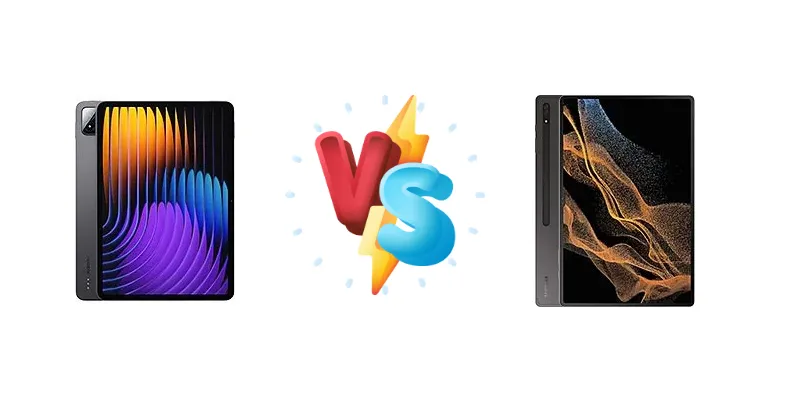
The Android tablet market is heating up. The Xiaomi Pad 7 arrives as a compelling mid-range contender, challenging Samsung’s established dominance with the premium Galaxy Tab S8 Ultra. This comparison dissects the core differences – from chipset architecture to battery endurance – to determine which tablet delivers the best experience for your needs and budget.
🏆 Quick Verdict
For the average user prioritizing value and all-day battery life, the Xiaomi Pad 7 emerges as the winner. While the Samsung Galaxy Tab S8 Ultra boasts a more powerful processor, the Pad 7’s efficient Snapdragon 7+ Gen 3 and impressive 91:06h endurance offer a superior balance of performance and usability for everyday tasks and entertainment.
| Network |
|---|
| 2G bands | N/A | GSM 850 / 900 / 1800 / 1900 |
| 3G bands | N/A | HSDPA 850 / 900 / 1700(AWS) / 1900 / 2100 |
| 4G bands | - | LTE |
| 5G bands | - | SA/NSA |
| EDGE | N/A | - |
| GPRS | N/A | - |
| Speed | - | HSPA, LTE, 5G - cellular model only |
| Technology | No cellular connectivity | GSM / HSPA / LTE / 5G |
| Launch |
|---|
| Announced | 2024, October 29 | 2022, February 09 |
| Status | Available. Released 2024, October 29 | Available. Released 2022, April 30 |
| Body |
|---|
| Build | Glass front, aluminum frame, aluminum back | - |
| Dimensions | 251.2 x 173.4 x 6.2 mm (9.89 x 6.83 x 0.24 in) | 326.4 x 208.6 x 5.5 mm (12.85 x 8.21 x 0.22 in) |
| SIM | No | Nano-SIM (cellular model only) |
| Weight | 500 g (1.10 lb) | 726 g (Wi-Fi), 728 g (5G) (1.60 lb) |
| | - | Stylus, 2.8ms latency (Bluetooth integration, accelerometer, gyro) |
| Display |
|---|
| Protection | Mohs level 5 | Corning Gorilla Glass 5 |
| Resolution | 2136 x 3200 pixels, 3:2 ratio (~344 ppi density) | 1848 x 2960 pixels, 16:10 ratio (~240 ppi density) |
| Size | 11.2 inches, 373.7 cm2 (~85.8% screen-to-body ratio) | 14.6 inches, 612.6 cm2 (~90.0% screen-to-body ratio) |
| Type | IPS LCD, 68B colors, 144Hz, HDR10, Dolby Vision, 800 nits | Super AMOLED, 120Hz, HDR10+ |
| Platform |
|---|
| CPU | Octa-core (1x2.8 GHz Cortex-X4 & 4x2.6 GHz Cortex-A720 & 3x1.9 GHz Cortex-A520) | Octa-core (1x3.00 GHz Cortex-X2 & 3x2.50 GHz Cortex-A710 & 4x1.80 GHz Cortex-A510) |
| Chipset | Qualcomm SM7675-AB Snapdragon 7+ Gen 3 (4 nm) | Qualcomm SM8450 Snapdragon 8 Gen 1 (4 nm) |
| GPU | Adreno 732 | Adreno 730 |
| OS | Android 15, up to 4 major Android upgrades, HyperOS 2 | Android 12, up to 4 major Android upgrades, One UI 6.1.1 |
| Memory |
|---|
| Card slot | No | microSDXC (dedicated slot) |
| Internal | 128GB 8GB RAM, 256GB 8GB RAM, 256GB 12GB RAM | 128GB 8GB RAM, 256GB 8GB RAM, 256GB 12GB RAM, 256GB 16GB RAM, 512GB 12GB RAM, 512GB 16GB RAM |
| | - | UFS |
| Main Camera |
|---|
| Dual | - | 13 MP, f/2.0, 26mm (wide), 1/3.4", 1.0µm, AF
6 MP, f/2.2, (ultrawide) |
| Features | LED flash, HDR, panorama | LED flash, HDR, panorama |
| Single | 13 MP, f/2.2, (wide), 1/3.06", 1.12µm, PDAF | - |
| Video | 4K@30fps, 1080p@30/60fps | 4K@30/60fps, 1080p@30fps |
| Selfie camera |
|---|
| Dual | - | 12 MP, f/2.2, 26mm (wide)
12 MP, f/2.4, 120˚ (ultrawide) |
| Features | HDR | HDR |
| Single | 8 MP, f/2.3, (wide), 1/4.0", 1.12µm | - |
| Video | 1080p@30fps | 4K@30/60fps, 1080p@30fps |
| Sound |
|---|
| 3.5mm jack | - | No |
| 35mm jack | No | No |
| Loudspeaker | Yes, with stereo speakers (4 speakers) | Yes, with stereo speakers (4 speakers) |
| | - | Tuned by AKG |
| Comms |
|---|
| Bluetooth | 5.4, LHDC 5 | 5.2, A2DP, LE |
| Infrared port | Yes | - |
| NFC | No | No |
| Positioning | No | GPS, GLONASS, BDS, GALILEO - cellular model only |
| Radio | No | No |
| USB | USB Type-C 3.2, accessory connector | USB Type-C 3.2, magnetic connector |
| WLAN | Wi-Fi 802.11 a/b/g/n/ac/6e, dual-band, Wi-Fi Direct | Wi-Fi 802.11 a/b/g/n/ac/6e, dual-band, Wi-Fi Direct |
| Features |
|---|
| Sensors | Accelerometer, gyro, proximity, compass | Fingerprint (under display, optical), accelerometer, gyro, proximity, compass |
| | - | Wireless Samsung DeX |
| Battery |
|---|
| Charging | 45W wired, PD3.0, QC3+, 100% in 1h 20 min | 45W wired, 100% in 82 min |
| Type | 8850 mAh | Li-Po 11200 mAh |
| Misc |
|---|
| Colors | Black, Blue, Green | Graphite |
| Models | 2410CRP4CG | SM-X900, SM-X906, SM-X906B, SM-X906U, SM-X906N |
| Price | About 400 EUR | About 1150 EUR |
| SAR EU | 0.99 W/kg (body) | 0.69 W/kg (body) |
| EU LABEL |
|---|
| Battery | 91:06h endurance, 1000 cycles | - |
| Energy | Class F | - |
| Free fall | Class A (208 falls) | - |
| Repairability | Class C | - |
Xiaomi Pad 7
- Exceptional battery life (91:06h endurance)
- Modern Snapdragon 7+ Gen 3 chipset offers excellent efficiency
- Potentially more affordable price point
- Less raw processing power than the Tab S8 Ultra
- Display specifications currently unknown
Samsung Galaxy Tab S8 Ultra
- Powerful Snapdragon 8 Gen 1 processor for demanding tasks
- Large 14.6-inch display ideal for multitasking
- Faster charging speed (82 minutes)
- Higher price tag
- Potentially shorter battery life
- More prone to thermal throttling under sustained load
Display Comparison
While display specs are missing for the Xiaomi Pad 7, the Samsung Galaxy Tab S8 Ultra features a massive 14.6-inch display. Both tablets support 45W charging, but the Tab S8 Ultra reaches 100% in 82 minutes, while the Pad 7 takes 1 hour 20 minutes. This suggests a larger battery capacity on the Samsung device, despite the Pad 7’s impressive endurance. The Tab S8 Ultra’s larger screen is beneficial for multitasking and creative work, but the Pad 7’s potentially more compact form factor enhances portability.
Camera Comparison
Camera details are limited for both devices. Given the tablet form factor, camera quality is rarely a primary concern. However, the Tab S8 Ultra, being a flagship, likely features a more sophisticated camera system with potentially larger sensors and improved image processing. The Xiaomi Pad 7 will likely focus on adequate performance for video calls and casual snapshots.
Performance
The core difference lies in the chipsets. The Samsung Galaxy Tab S8 Ultra utilizes the Qualcomm Snapdragon 8 Gen 1 (4nm), featuring a Cortex-X2 prime core clocked at 3.00 GHz. This is a generation ahead of the Xiaomi Pad 7’s Snapdragon 7+ Gen 3 (4nm), which employs a Cortex-X4 prime core at 2.8 GHz. While the 8 Gen 1 offers raw power, the 7+ Gen 3’s newer architecture and efficiency improvements mean it can deliver excellent performance with less thermal throttling. The Tab S8 Ultra’s CPU configuration (1x Cortex-X2, 3x Cortex-A710, 4x Cortex-A510) prioritizes peak performance, while the Pad 7’s (1x Cortex-X4, 4x Cortex-A720, 3x Cortex-A520) balances performance and power efficiency. The Pad 7’s architecture is more modern, potentially closing the performance gap.
Battery Life
The Xiaomi Pad 7 boasts an exceptional 91:06h endurance, suggesting optimized power management despite a potentially smaller battery capacity. The Samsung Galaxy Tab S8 Ultra, while charging slightly faster (82 minutes vs 1h 20m), likely requires more frequent charging due to its more power-hungry chipset and larger display. The Pad 7’s 1000 cycle battery lifespan also indicates long-term reliability.
Buying Guide
Buy the Xiaomi Pad 7 if you need a versatile tablet for media consumption, productivity, and light gaming, all without breaking the bank. Its long battery life and efficient processor make it ideal for students, commuters, and anyone who values portability. Buy the Samsung Galaxy Tab S8 Ultra if you demand uncompromising performance for demanding tasks like video editing, graphic design, or intensive gaming, and are willing to pay a premium for the larger display and more powerful chipset.
Frequently Asked Questions
❓ Will the Snapdragon 7+ Gen 3 in the Xiaomi Pad 7 struggle with graphically intensive games?
While not as powerful as the Snapdragon 8 Gen 1, the Snapdragon 7+ Gen 3 is a capable chipset. It should handle most mobile games at high settings, though you might need to lower the graphics settings for the most demanding titles to maintain a consistently smooth frame rate. The efficient architecture also minimizes thermal throttling, ensuring sustained performance.
❓ Is the 45W charging on both tablets truly fast, considering their battery capacities?
45W charging is considered fast for tablets, but the actual charging time depends on the battery capacity. The Samsung Galaxy Tab S8 Ultra reaches 100% in 82 minutes, while the Xiaomi Pad 7 takes 1 hour 20 minutes. This suggests the Tab S8 Ultra has a larger battery, and the 45W charging is effectively managing that capacity. The Pad 7’s longer charge time is acceptable given its exceptional battery endurance.
❓ How does the thermal management differ between the two tablets during prolonged gaming sessions?
The Snapdragon 8 Gen 1 in the Tab S8 Ultra is known to generate more heat under sustained load, potentially leading to thermal throttling and reduced performance. The Snapdragon 7+ Gen 3 in the Pad 7, with its more efficient architecture, is less prone to overheating, offering more consistent performance during extended gaming sessions.