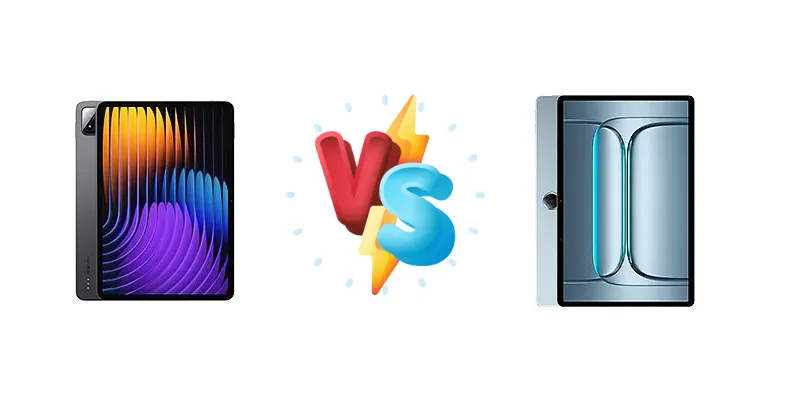
The Android tablet market is heating up, with Xiaomi and OnePlus offering compelling options at competitive price points. The Xiaomi Pad 7, powered by the Snapdragon 7+ Gen 3, aims for a balance of power and efficiency. Meanwhile, the OnePlus Pad Lite leverages the MediaTek Helio G100 to deliver affordability. This comparison dissects their key differences to help you choose the right tablet for your needs.
🏆 Quick Verdict
For users prioritizing performance and longevity, the Xiaomi Pad 7 is the clear winner. Its Snapdragon 7+ Gen 3 chipset offers a significant performance advantage, coupled with faster 45W charging and a projected 1000-cycle battery lifespan. However, the OnePlus Pad Lite remains a viable option for casual users on a tighter budget.
| Network |
|---|
| 2G bands | N/A | GSM 850 / 900 / 1800 / 1900 - cellular model only |
| 3G bands | N/A | HSDPA 850 / 900 / 2100 - cellular model only |
| 4G bands | - | LTE - cellular model only |
| EDGE | N/A | - |
| GPRS | N/A | - |
| Speed | - | HSPA, LTE - cellular model only |
| Technology | No cellular connectivity | GSM / HSPA / LTE |
| Launch |
|---|
| Announced | 2024, October 29 | 2025, July 08 |
| Status | Available. Released 2024, October 29 | Available. Released 2025, August 14 |
| Body |
|---|
| Build | Glass front, aluminum frame, aluminum back | - |
| Dimensions | 251.2 x 173.4 x 6.2 mm (9.89 x 6.83 x 0.24 in) | 254.9 x 166.5 x 7.4 mm (10.04 x 6.56 x 0.29 in) |
| SIM | No | Yes - cellular model only |
| Weight | 500 g (1.10 lb) | 530 g (1.17 lb) |
| Display |
|---|
| Protection | Mohs level 5 | - |
| Resolution | 2136 x 3200 pixels, 3:2 ratio (~344 ppi density) | 1200 x 1920 pixels, 16:10 ratio (~207 ppi density) |
| Size | 11.2 inches, 373.7 cm2 (~85.8% screen-to-body ratio) | 11.0 inches, 347.5 cm2 (~81.9% screen-to-body ratio) |
| Type | IPS LCD, 68B colors, 144Hz, HDR10, Dolby Vision, 800 nits | IPS LCD, 1B colors, 90Hz, 500 nits |
| Platform |
|---|
| CPU | Octa-core (1x2.8 GHz Cortex-X4 & 4x2.6 GHz Cortex-A720 & 3x1.9 GHz Cortex-A520) | Octa-core (2x2.2 GHz Cortex-A76 & 6x2.0 GHz Cortex-A55) |
| Chipset | Qualcomm SM7675-AB Snapdragon 7+ Gen 3 (4 nm) | Mediatek Helio G100 (6 nm) |
| GPU | Adreno 732 | Mali-G57 MC2 |
| OS | Android 15, up to 4 major Android upgrades, HyperOS 2 | Android 15, OxygenOS 15 |
| Memory |
|---|
| Card slot | No | Unspecified |
| Internal | 128GB 8GB RAM, 256GB 8GB RAM, 256GB 12GB RAM | 128GB 6GB RAM, 128GB 8GB RAM |
| Main Camera |
|---|
| Features | LED flash, HDR, panorama | - |
| Single | 13 MP, f/2.2, (wide), 1/3.06", 1.12µm, PDAF | 5 MP |
| Video | 4K@30fps, 1080p@30/60fps | 1080p@30fps |
| Selfie camera |
|---|
| Features | HDR | - |
| Single | 8 MP, f/2.3, (wide), 1/4.0", 1.12µm | 5 MP |
| Video | 1080p@30fps | 1080p@30fps |
| Sound |
|---|
| 35mm jack | No | No |
| Loudspeaker | Yes, with stereo speakers (4 speakers) | Yes, with stereo speakers (4 speakers, Hi-Res audio) |
| Comms |
|---|
| Bluetooth | 5.4, LHDC 5 | 5.2, A2DP, LE, aptX HD |
| Infrared port | Yes | - |
| NFC | No | No |
| Positioning | No | GPS, (cellular model only) - unconfirmed |
| Radio | No | No |
| USB | USB Type-C 3.2, accessory connector | USB Type-C 2.0 |
| WLAN | Wi-Fi 802.11 a/b/g/n/ac/6e, dual-band, Wi-Fi Direct | Wi-Fi 802.11 a/b/g/n/ac, dual-band |
| Features |
|---|
| Sensors | Accelerometer, gyro, proximity, compass | Unspecified |
| Battery |
|---|
| Charging | 45W wired, PD3.0, QC3+, 100% in 1h 20 min | 33W wired |
| Type | 8850 mAh | Li-Po 9340 mAh |
| Misc |
|---|
| Colors | Black, Blue, Green | Aero Blue |
| Models | 2410CRP4CG | OPD2480 |
| Price | About 400 EUR | About 200 EUR |
| SAR EU | 0.99 W/kg (body) | - |
| EU LABEL |
|---|
| Battery | 91:06h endurance, 1000 cycles | - |
| Energy | Class F | - |
| Free fall | Class A (208 falls) | - |
| Repairability | Class C | - |
Xiaomi Pad 7
- Significantly faster processor (Snapdragon 7+ Gen 3)
- Faster 45W charging with multiple protocols
- Projected long battery lifespan (1000 cycles)
- Likely higher price point
- Specific display details (resolution, refresh rate) unknown
OnePlus Pad Lite
- More affordable price
- Decent performance for everyday tasks
- Acceptable charging speed for casual users
- Slower processor (Helio G100)
- Slower 33W charging
- Potentially shorter battery lifespan
Display Comparison
While both tablets likely feature LCD panels (data not provided), the core difference lies in the processing power driving them. Display quality details like resolution and refresh rate are missing, but the chipset's ability to smoothly render graphics will impact perceived visual fluidity. The Xiaomi Pad 7’s Snapdragon 7+ Gen 3 will handle graphically intensive applications with greater ease, potentially resulting in a more responsive user experience even if the panels are similar.
Camera Comparison
Camera specifications are absent for both devices, making a direct comparison impossible. However, given the price points, it’s reasonable to expect both tablets to feature modest camera setups primarily intended for video calls and casual snapshots. Focusing on the chipset, the Snapdragon 7+ Gen 3 includes a more advanced ISP (Image Signal Processor) which could potentially deliver better image quality, even with similar sensors. This is due to improved noise reduction and dynamic range processing.
Performance
The Xiaomi Pad 7’s Qualcomm SM7675-AB Snapdragon 7+ Gen 3 (4nm) is a substantial upgrade over the OnePlus Pad Lite’s MediaTek Helio G100 (6nm). The Snapdragon’s Cortex-X4 prime core, clocked at 2.8 GHz, provides a significant performance boost for demanding tasks. The 4nm process node also translates to improved thermal efficiency, reducing the likelihood of throttling during extended gaming sessions. The Helio G100, with its Cortex-A76 cores, is adequate for everyday tasks, but will struggle with more intensive applications. The Snapdragon’s architecture is also more modern, offering better AI capabilities and overall system responsiveness.
Battery Life
The Xiaomi Pad 7 boasts a projected 91:06h endurance and a 1000-cycle battery lifespan, suggesting a focus on long-term reliability. While the exact battery capacity isn’t specified, the 45W wired charging with PD3.0 and QC3+ support allows for a full charge in just 1 hour and 20 minutes. The OnePlus Pad Lite’s 33W charging is slower, meaning longer downtime between uses. Although the Pad Lite might have a larger battery capacity, the Xiaomi Pad 7’s faster charging and projected longevity give it an edge for users who rely heavily on their tablets.
Buying Guide
Buy the Xiaomi Pad 7 if you need a tablet capable of handling demanding tasks like gaming, video editing, or multitasking. Its superior processor and faster charging will prove invaluable for power users. Buy the OnePlus Pad Lite if you prioritize affordability and primarily use your tablet for media consumption, web browsing, and light productivity. It’s a solid choice for students or families seeking a budget-friendly option.
Frequently Asked Questions
❓ Will the Snapdragon 7+ Gen 3 in the Xiaomi Pad 7 handle demanding games like Genshin Impact at high settings?
Yes, the Snapdragon 7+ Gen 3 is a capable chipset that should handle Genshin Impact and similar titles at medium to high settings, depending on the game's optimization. The 4nm process and efficient core architecture will help mitigate thermal throttling during extended gaming sessions, providing a smoother experience than the Helio G100.
❓ Is the 33W charging on the OnePlus Pad Lite slow compared to the Xiaomi Pad 7's 45W? How much of a difference will I notice?
Yes, 33W charging is noticeably slower than 45W. The Xiaomi Pad 7 can fully charge in 1 hour and 20 minutes, while the OnePlus Pad Lite will take considerably longer. This difference is most impactful for users who frequently need to quickly top up their tablet's battery.
❓ Given the lack of detailed camera specs, should I expect significant differences in photo quality between these two tablets?
While specific camera specs are missing, the Xiaomi Pad 7 likely has an advantage due to the Snapdragon 7+ Gen 3’s more advanced Image Signal Processor (ISP). This ISP can improve image quality through better noise reduction, dynamic range, and overall processing, even if the sensors themselves are similar.