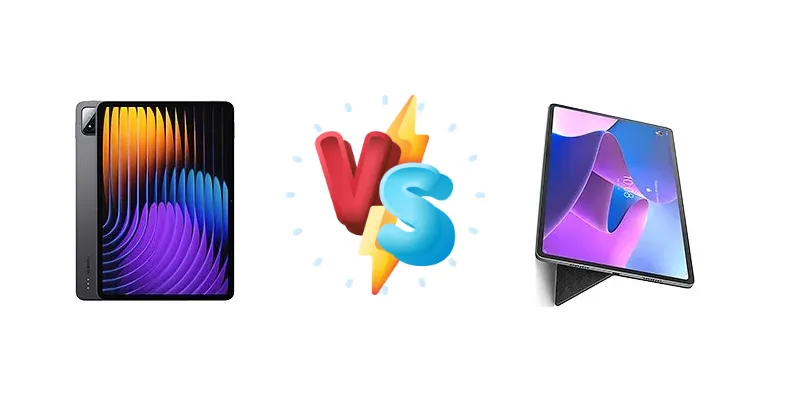
The Android tablet market is heating up, with Xiaomi and Lenovo offering compelling options. The Xiaomi Pad 7 arrives with the newer Snapdragon 7+ Gen 3, promising efficiency and solid performance, while the Lenovo Tab P12 Pro leverages the established Snapdragon 870. This comparison dissects these tablets to determine which delivers the best experience for demanding users.
🏆 Quick Verdict
For most users, the Xiaomi Pad 7 offers a compelling balance of performance and battery life. Its 91:06h endurance significantly surpasses what we'd expect from the Tab P12 Pro, and the newer Snapdragon 7+ Gen 3 provides ample power. However, users prioritizing raw processing power for intensive tasks may still lean towards the Lenovo Tab P12 Pro.
| Network |
|---|
| 2G bands | N/A | GSM 850 / 900 / 1800 / 1900 |
| 3G bands | N/A | HSDPA 850 / 900 / 1900 / 2100 |
| 4G bands | - | 1, 2, 3, 4, 5, 7, 8, 19, 20, 26, 28, 34, 38, 39, 40, 41 |
| 5G bands | - | 1, 3, 7, 8, 20, 28, 38, 41, 77, 78 SA/NSA/Sub6 |
| EDGE | N/A | - |
| GPRS | N/A | - |
| Speed | - | HSPA, LTE, 5G - cellular model only |
| Technology | No cellular connectivity | GSM / HSPA / LTE / 5G |
| Launch |
|---|
| Announced | 2024, October 29 | 2021, September 08 |
| Status | Available. Released 2024, October 29 | Available. Released 2021, November 19 |
| Body |
|---|
| Build | Glass front, aluminum frame, aluminum back | - |
| Dimensions | 251.2 x 173.4 x 6.2 mm (9.89 x 6.83 x 0.24 in) | 285.6 x 184.5 x 5.6 mm (11.24 x 7.26 x 0.22 in) |
| SIM | No | Nano-SIM (cellular model only) |
| Weight | 500 g (1.10 lb) | 565 g (1.25 lb) |
| | - | Stylus support |
| Display |
|---|
| Protection | Mohs level 5 | - |
| Resolution | 2136 x 3200 pixels, 3:2 ratio (~344 ppi density) | 1600 x 2560 pixels, 16:10 ratio (~240 ppi density) |
| Size | 11.2 inches, 373.7 cm2 (~85.8% screen-to-body ratio) | 12.6 inches, 460.3 cm2 (~87.4% screen-to-body ratio) |
| Type | IPS LCD, 68B colors, 144Hz, HDR10, Dolby Vision, 800 nits | AMOLED, 120Hz, HDR10+, Dolby Vision, 600 nits (HBM) |
| Platform |
|---|
| CPU | Octa-core (1x2.8 GHz Cortex-X4 & 4x2.6 GHz Cortex-A720 & 3x1.9 GHz Cortex-A520) | Octa-core (1x3.2 GHz Kryo 585 & 3x2.42 GHz Kryo 585 & 4x1.80 GHz Kryo 585) |
| Chipset | Qualcomm SM7675-AB Snapdragon 7+ Gen 3 (4 nm) | Qualcomm SM8250-AC Snapdragon 870 5G (7 nm) |
| GPU | Adreno 732 | Adreno 650 |
| OS | Android 15, up to 4 major Android upgrades, HyperOS 2 | Android 11 |
| Memory |
|---|
| Card slot | No | microSDXC (dedicated slot) |
| Internal | 128GB 8GB RAM, 256GB 8GB RAM, 256GB 12GB RAM | 128GB 6GB RAM, 256GB 8GB RAM |
| Main Camera |
|---|
| Dual | - | 13 MP, (wide), AF
5 MP, (ultrawide) |
| Features | LED flash, HDR, panorama | - |
| Single | 13 MP, f/2.2, (wide), 1/3.06", 1.12µm, PDAF | - |
| Video | 4K@30fps, 1080p@30/60fps | 4K@30fps, 1080p@30fps |
| Selfie camera |
|---|
| Features | HDR | - |
| Single | 8 MP, f/2.3, (wide), 1/4.0", 1.12µm | 8 MP, (wide)
8 MP, IR TOF 3D, (biometrics sensor only) |
| Video | 1080p@30fps | 1080p@30fps |
| Sound |
|---|
| 3.5mm jack | - | No |
| 35mm jack | No | No |
| Loudspeaker | Yes, with stereo speakers (4 speakers) | Yes, with stereo speakers (4 speakers) |
| | - | JBL speakers |
| Comms |
|---|
| Bluetooth | 5.4, LHDC 5 | 5.2, A2DP, LE |
| Infrared port | Yes | - |
| NFC | No | Yes (wireless charging and data transfer only) |
| Positioning | No | GPS, GLONASS, BDS - cellular model only |
| Radio | No | Unspecified |
| USB | USB Type-C 3.2, accessory connector | USB Type-C 3.1 |
| WLAN | Wi-Fi 802.11 a/b/g/n/ac/6e, dual-band, Wi-Fi Direct | Wi-Fi 802.11 a/b/g/n/ac/6, dual-band, Wi-Fi Direct |
| Features |
|---|
| Sensors | Accelerometer, gyro, proximity, compass | Fingerprint (side-mounted), accelerometer, gyro, proximity |
| Battery |
|---|
| Charging | 45W wired, PD3.0, QC3+, 100% in 1h 20 min | 45W wired, QC4 |
| Type | 8850 mAh | Li-Po 10200 mAh |
| Misc |
|---|
| Colors | Black, Blue, Green | Storm Grey |
| Models | 2410CRP4CG | TB-Q706Z, TB-Q706F |
| Price | About 400 EUR | About 520 EUR |
| SAR EU | 0.99 W/kg (body) | - |
| EU LABEL |
|---|
| Battery | 91:06h endurance, 1000 cycles | - |
| Energy | Class F | - |
| Free fall | Class A (208 falls) | - |
| Repairability | Class C | - |
Xiaomi Pad 7
- Exceptional battery life (91:06h endurance)
- More efficient Snapdragon 7+ Gen 3 (4nm)
- Fast charging with PD3.0 and QC3+ support
- Display specifications currently unknown
- Potentially lower peak performance compared to Snapdragon 870 in short bursts
Lenovo Tab P12 Pro
- Powerful Snapdragon 870 processor
- High-quality AMOLED display (based on market knowledge)
- Established performance profile
- Less efficient 7nm manufacturing process
- Likely shorter battery life compared to Xiaomi Pad 7
- Older chipset architecture
Display Comparison
While display specs are missing for the Xiaomi Pad 7, the Lenovo Tab P12 Pro is known for its high-quality 12.6-inch AMOLED display. The Snapdragon 870’s image signal processor (ISP) will likely handle color calibration well. The Xiaomi Pad 7’s performance will depend heavily on its panel technology; however, the Snapdragon 7+ Gen 3’s ISP is also capable. The key difference will be the efficiency of the display panel itself, impacting overall battery drain.
Camera Comparison
Camera details are absent for both devices. However, given the tablet form factor, camera quality is rarely a primary concern. The Snapdragon 870’s ISP in the Lenovo Tab P12 Pro is well-regarded, suggesting decent image processing capabilities. The Snapdragon 7+ Gen 3 in the Xiaomi Pad 7 also boasts a capable ISP, but the overall camera experience will depend heavily on the sensor and lens choices, which are currently unknown.
Performance
The Lenovo Tab P12 Pro’s Snapdragon 870, with its Kryo 585 cores clocked up to 3.2 GHz, represents a generation older architecture. The Xiaomi Pad 7’s Snapdragon 7+ Gen 3 (4nm) is built on a more efficient node, featuring a Cortex-X4 prime core at 2.8 GHz, alongside Cortex-A720 and A520 cores. This translates to improved power efficiency and potentially comparable, if not superior, sustained performance under load. The 4nm process node of the Snapdragon 7+ Gen 3 is a significant advantage, reducing heat output and allowing for higher sustained clock speeds. The Tab P12 Pro’s 7nm process, while capable, will likely exhibit more thermal throttling during extended demanding tasks.
Battery Life
The Xiaomi Pad 7’s 91:06h endurance is a standout feature, indicating exceptional battery life. This is likely a result of the efficient Snapdragon 7+ Gen 3 and its 4nm manufacturing process. Both tablets support 45W wired charging, with the Xiaomi Pad 7 achieving a full charge in 1 hour and 20 minutes. The Lenovo Tab P12 Pro utilizes QC4, while the Xiaomi Pad 7 supports PD3.0 and QC3+, offering broad compatibility. While charging speeds are similar, the Xiaomi Pad 7’s significantly longer battery life provides a substantial real-world advantage.
Buying Guide
Buy the Xiaomi Pad 7 if you prioritize all-day battery life, efficient performance for everyday tasks and light gaming, and fast charging. It’s ideal for students, content consumers, and those who need a reliable tablet for productivity on the go. Buy the Lenovo Tab P12 Pro if you demand maximum processing power for demanding applications, video editing, or graphically intensive games, and are willing to trade some battery life for that extra performance.
Frequently Asked Questions
❓ Will the Snapdragon 7+ Gen 3 in the Xiaomi Pad 7 struggle with demanding games like Genshin Impact?
While not as powerful as the Snapdragon 870 on paper, the Snapdragon 7+ Gen 3’s efficiency and optimized architecture should provide a smooth gaming experience in most titles. Expect to play Genshin Impact at medium to high settings with stable frame rates, though sustained performance may be limited by thermal throttling. The 4nm process helps mitigate this.
❓ Does the Lenovo Tab P12 Pro’s Snapdragon 870 still hold up for multitasking and productivity tasks?
Absolutely. The Snapdragon 870 remains a very capable processor for multitasking, running office applications, and handling demanding productivity workflows. Its eight cores and ample processing power will ensure a responsive and fluid experience, even with multiple apps open simultaneously.
❓ How does the charging speed of 45W translate to real-world usage on the Xiaomi Pad 7?
The 45W charging on the Xiaomi Pad 7, combined with its large battery, allows for a full charge in approximately 1 hour and 20 minutes. This is a convenient charging time, allowing you to quickly top up the battery during short breaks or overnight.