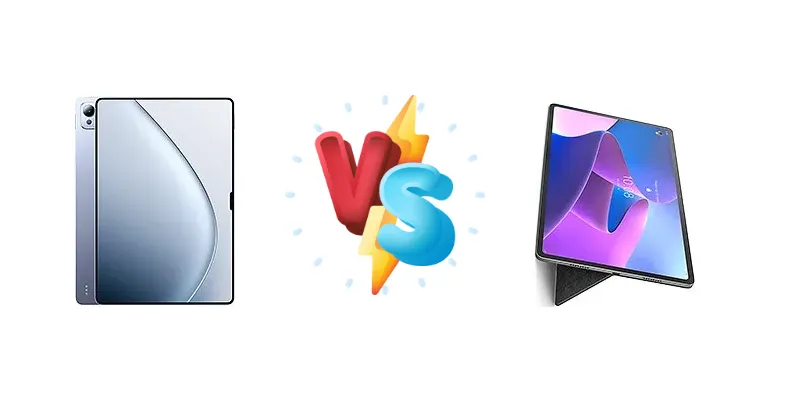
The Android tablet market is heating up, with Xiaomi and Lenovo offering compelling options at different price points and with distinct philosophies. The Xiaomi Pad 7 Ultra arrives with a brand-new, cutting-edge Xring O1 chipset promising unparalleled performance, while the Lenovo Tab P12 Pro leverages the well-established Snapdragon 870 5G. This comparison dissects these tablets to determine which one best suits your needs.
🏆 Quick Verdict
For users prioritizing raw processing power and future-proofing, the Xiaomi Pad 7 Ultra is the clear winner thanks to its Xring O1 chipset. However, the Lenovo Tab P12 Pro offers a more balanced experience with a proven platform and faster charging, making it ideal for everyday use and those less concerned with absolute peak performance.
| Network |
|---|
| 2G bands | N/A | GSM 850 / 900 / 1800 / 1900 |
| 3G bands | N/A | HSDPA 850 / 900 / 1900 / 2100 |
| 4G bands | - | 1, 2, 3, 4, 5, 7, 8, 19, 20, 26, 28, 34, 38, 39, 40, 41 |
| 5G bands | - | 1, 3, 7, 8, 20, 28, 38, 41, 77, 78 SA/NSA/Sub6 |
| EDGE | N/A | - |
| GPRS | N/A | - |
| Speed | - | HSPA, LTE, 5G - cellular model only |
| Technology | No cellular connectivity | GSM / HSPA / LTE / 5G |
| Launch |
|---|
| Announced | 2025, May 22 | 2021, September 08 |
| Status | Available. Released 2025, May 22 | Available. Released 2021, November 19 |
| Body |
|---|
| Build | Glass front (Gorilla Glass 5), aluminum frame, aluminum back | - |
| Dimensions | 305.8 x 207.5 x 5.1 mm (12.04 x 8.17 x 0.20 in) | 285.6 x 184.5 x 5.6 mm (11.24 x 7.26 x 0.22 in) |
| SIM | No | Nano-SIM (cellular model only) |
| Weight | 609 g or 619 g (1.34 lb) | 565 g (1.25 lb) |
| | - | Stylus support |
| Display |
|---|
| Protection | Corning Gorilla Glass 5 | - |
| Resolution | 2136 x 3200 pixels, 3:2 ratio (~275 ppi density) | 1600 x 2560 pixels, 16:10 ratio (~240 ppi density) |
| Size | 14.0 inches, 583.9 cm2 (~92.0% screen-to-body ratio) | 12.6 inches, 460.3 cm2 (~87.4% screen-to-body ratio) |
| Type | AMOLED, 68B colors, 120Hz, 4800Hz PWM, Dolby Vision, HDR10+, HDR Vivid, 1600 nits (peak) | AMOLED, 120Hz, HDR10+, Dolby Vision, 600 nits (HBM) |
| Platform |
|---|
| CPU | 10-core (2x3.7GHz Cortex-X925 & 4x3.4GHz Cortex-A725 & 2x1.9GHz Cortex-A725 & 2x1.8GHz Cortex-A520) | Octa-core (1x3.2 GHz Kryo 585 & 3x2.42 GHz Kryo 585 & 4x1.80 GHz Kryo 585) |
| Chipset | Xring O1 (3 nm) | Qualcomm SM8250-AC Snapdragon 870 5G (7 nm) |
| GPU | Immortalis-G925 MP16 | Adreno 650 |
| OS | Android 15, HyperOS 2 | Android 11 |
| Memory |
|---|
| Card slot | No | microSDXC (dedicated slot) |
| Internal | 256GB 12GB RAM, 512GB 12GB RAM, 1TB 16GB RAM | 128GB 6GB RAM, 256GB 8GB RAM |
| Main Camera |
|---|
| Dual | - | 13 MP, (wide), AF
5 MP, (ultrawide) |
| Features | LED flash, HDR, panorama | - |
| Single | 50 MP, f/1.8, (wide), 1/2.76", 0.64µm, PDAF | - |
| Video | 4K@30/60fps, 1080p@30/60fps | 4K@30fps, 1080p@30fps |
| Selfie camera |
|---|
| Features | HDR | - |
| Single | 32 MP, f/2.2, 19mm (ultrawide), 1/3.6", 0.61µm | 8 MP, (wide)
8 MP, IR TOF 3D, (biometrics sensor only) |
| Video | 1080p@30fps | 1080p@30fps |
| Sound |
|---|
| 3.5mm jack | - | No |
| 35mm jack | No | No |
| Loudspeaker | Yes, with stereo speakers (8 speakers) | Yes, with stereo speakers (4 speakers) |
| | - | JBL speakers |
| Comms |
|---|
| Bluetooth | 5.4, A2DP, LE, LHDC 5 | 5.2, A2DP, LE |
| Infrared port | Yes | - |
| NFC | Yes (data transfer only) | Yes (wireless charging and data transfer only) |
| Positioning | No | GPS, GLONASS, BDS - cellular model only |
| Radio | No | Unspecified |
| USB | USB Type-C 3.2 Gen2, OTG, accessory connector pins | USB Type-C 3.1 |
| WLAN | Wi-Fi 802.11 a/b/g/n/a/6/7, dual-band, Wi-Fi Direct | Wi-Fi 802.11 a/b/g/n/ac/6, dual-band, Wi-Fi Direct |
| Features |
|---|
| Sensors | Fingerprint (side-mounted), accelerometer, gyro, proximity, compass | Fingerprint (side-mounted), accelerometer, gyro, proximity |
| Battery |
|---|
| Charging | 120W wired, PD3.0
7.5W reverse wired | 45W wired, QC4 |
| Type | 12000 mAh | Li-Po 10200 mAh |
| Misc |
|---|
| Colors | Gray, Blue | Storm Grey |
| Models | - | TB-Q706Z, TB-Q706F |
| Price | About 700 EUR | About 520 EUR |
Xiaomi Pad 7 Ultra
- Significantly faster charging (120W)
- More powerful processor (Xring O1 3nm)
- Potentially better thermal management due to 3nm process
- Battery capacity unknown – potential for shorter runtime
- New chipset – potential for software optimization issues
Lenovo Tab P12 Pro
- Proven Snapdragon 870 platform – reliable performance
- Faster charging than many competitors (45W)
- Established software support and optimization
- Older 7nm process – less efficient than 3nm
- Less powerful processor compared to Xring O1
Display Comparison
While display specifications aren't provided, the Lenovo Tab P12 Pro is known for its high-quality 12.6-inch AMOLED display. The Xiaomi Pad 7 Ultra, given its 'Ultra' designation, likely features a similarly premium panel, potentially with LTPO technology for variable refresh rates and improved power efficiency. The key difference will likely be peak brightness and color accuracy; the Xiaomi, being newer, may have an edge in these areas. Bezels are expected to be minimal on both, reflecting current design trends.
Camera Comparison
Camera details are absent, but given the tablet form factor, image quality isn't a primary concern for most users. Both devices likely feature capable main sensors for document scanning and casual photography. The Xiaomi Pad 7 Ultra, as an 'Ultra' model, might include a more sophisticated camera system with features like OIS, but without specific sensor details, it's difficult to assess the actual difference. We can assume both will have ultrawide lenses, but the quality will vary.
Performance
The core of this comparison lies in the chipsets. The Xiaomi Pad 7 Ultra’s Xring O1, built on a 3nm process, represents a significant leap forward compared to the Lenovo Tab P12 Pro’s 7nm Snapdragon 870. The Xring O1’s 10-core configuration (2x3.7GHz Cortex-X925, 4x3.4GHz Cortex-A725, 2x1.9GHz Cortex-A725, 2x1.8GHz Cortex-A520) promises substantially higher multi-core performance than the Snapdragon 870’s octa-core setup (1x3.2 GHz Kryo 585, 3x2.42 GHz Kryo 585, 4x1.80 GHz Kryo 585). The 3nm node also translates to improved thermal efficiency, potentially allowing the Xiaomi to sustain peak performance for longer periods. However, real-world performance will depend on software optimization and cooling solutions.
Battery Life
The Xiaomi Pad 7 Ultra boasts a significant advantage in charging speed with its 120W wired charging, utilizing PD3.0. This will result in dramatically faster 0-100% charge times compared to the Lenovo Tab P12 Pro’s 45W QC4 charging. However, battery capacity isn't specified. If the Xiaomi Pad 7 Ultra has a smaller battery, the Lenovo Tab P12 Pro might offer longer overall runtime despite the slower charging. The 7.5W reverse wired charging on the Xiaomi is a useful addition for topping up accessories.
Buying Guide
Buy the Xiaomi Pad 7 Ultra if you demand the highest possible Android tablet performance for demanding tasks like video editing, 3D rendering, or high-end gaming. Its 10-core Xring O1 processor and advanced architecture are geared towards power users. Buy the Lenovo Tab P12 Pro if you prioritize a refined, reliable experience with a focus on media consumption, productivity, and longer battery life, coupled with the convenience of faster 45W charging.
Frequently Asked Questions
❓ Will the Xring O1 chipset in the Xiaomi Pad 7 Ultra overheat during extended gaming sessions?
The Xring O1's 3nm process is designed for improved thermal efficiency, reducing the likelihood of overheating. However, sustained peak performance will still generate heat. Xiaomi's cooling solution will be crucial in managing this, and real-world testing will determine its effectiveness. The Snapdragon 870 in the Lenovo Tab P12 Pro is known for its stable thermal performance, but it won't match the raw power of the Xring O1.
❓ How much faster is the 120W charging on the Xiaomi Pad 7 Ultra compared to the Lenovo Tab P12 Pro's 45W charging?
The 120W charging on the Xiaomi Pad 7 Ultra will significantly reduce charging times. While exact figures depend on battery capacity, expect a full charge in under an hour, potentially as low as 30-45 minutes. The Lenovo Tab P12 Pro's 45W charging will likely take around 1.5 to 2 hours for a full charge. This difference is substantial for users who frequently need to quickly replenish their tablet's battery.
❓ Does the Snapdragon 870 in the Lenovo Tab P12 Pro still hold up for demanding tasks like video editing?
Yes, the Snapdragon 870 remains a capable processor for video editing and other demanding tasks, especially for 1080p or even some 4K workflows. While it won't match the Xring O1's performance, it provides a smooth and responsive experience for most users. The Lenovo Tab P12 Pro's optimized software and ample RAM contribute to its overall performance.