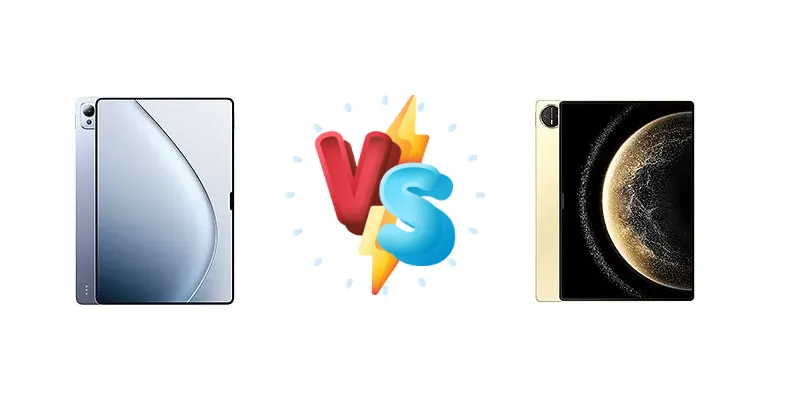
The high-end Android tablet space is heating up, with Xiaomi and Huawei both vying for dominance. The Xiaomi Pad 7 Ultra arrives with a brand-new Xring O1 chipset and blazing-fast 120W charging, while Huawei counters with its Kirin T92-powered MatePad Pro 13.2 (2025). This comparison dissects the core differences, helping you determine which tablet best suits your needs.
🏆 Quick Verdict
For users prioritizing raw performance and the fastest possible charging speeds, the Xiaomi Pad 7 Ultra emerges as the winner. Its Xring O1 chipset, with its 10-core configuration, offers a significant advantage over the Kirin T92. However, the MatePad Pro 13.2 (2025) remains a strong contender, particularly for those within the Huawei ecosystem.
| Network |
|---|
| 2G bands | N/A | GSM 850 / 900 / 1800 / 1900 |
| 3G bands | N/A | HSDPA 850 / 900 / 1900 / 2100 |
| 4G bands | - | LTE |
| EDGE | N/A | - |
| GPRS | N/A | - |
| Speed | - | HSPA, LTE - cellular model only |
| Technology | No cellular connectivity | GSM / HSPA / LTE |
| Launch |
|---|
| Announced | 2025, May 22 | 2024, November 26 |
| Status | Available. Released 2025, May 22 | Available. Released 2024, December 12 |
| Body |
|---|
| Build | Glass front (Gorilla Glass 5), aluminum frame, aluminum back | Glass front, nylon fiber back, magnesium alloy frame |
| Dimensions | 305.8 x 207.5 x 5.1 mm (12.04 x 8.17 x 0.20 in) | 289.1 x 196.1 x 5.5 mm (11.38 x 7.72 x 0.22 in) |
| SIM | No | Nano-SIM (cellular model only) |
| Weight | 609 g or 619 g (1.34 lb) | 580 g (Wi-FI) or 590 g (LTE) (1.28 lb) |
| Display |
|---|
| Protection | Corning Gorilla Glass 5 | - |
| Resolution | 2136 x 3200 pixels, 3:2 ratio (~275 ppi density) | 2880 x 1920 pixels, 3:2 ratio (~262 ppi density) |
| Size | 14.0 inches, 583.9 cm2 (~92.0% screen-to-body ratio) | 13.2 inches, 518.8 cm2 (~91.5% screen-to-body ratio) |
| Type | AMOLED, 68B colors, 120Hz, 4800Hz PWM, Dolby Vision, HDR10+, HDR Vivid, 1600 nits (peak) | OLED, 1B colors, 144Hz, HDR Vivid, 1000 nits (peak) |
| Platform |
|---|
| CPU | 10-core (2x3.7GHz Cortex-X925 & 4x3.4GHz Cortex-A725 & 2x1.9GHz Cortex-A725 & 2x1.8GHz Cortex-A520) | Octa-core |
| Chipset | Xring O1 (3 nm) | Kirin T92 |
| GPU | Immortalis-G925 MP16 | - |
| OS | Android 15, HyperOS 2 | Harmony OS 4.3 |
| Memory |
|---|
| Card slot | No | No |
| Internal | 256GB 12GB RAM, 512GB 12GB RAM, 1TB 16GB RAM | 256GB 12GB RAM, 512GB 12GB RAM, 1TB 16GB RAM |
| Main Camera |
|---|
| Dual | - | 50 MP, f/1.8, (wide), PDAF
8 MP, f/2.2, (ultrawide) |
| Features | LED flash, HDR, panorama | LED flash |
| Single | 50 MP, f/1.8, (wide), 1/2.76", 0.64µm, PDAF | - |
| Video | 4K@30/60fps, 1080p@30/60fps | 4K@30fps, 1080p@30fps |
| Selfie camera |
|---|
| Features | HDR | - |
| Single | 32 MP, f/2.2, 19mm (ultrawide), 1/3.6", 0.61µm | 16 MP, f/2.2 |
| Video | 1080p@30fps | 1080p@30fps |
| Sound |
|---|
| 35mm jack | No | No |
| Loudspeaker | Yes, with stereo speakers (8 speakers) | Yes, with stereo speakers (6 speakers) |
| Comms |
|---|
| Bluetooth | 5.4, A2DP, LE, LHDC 5 | 5.2, A2DP, LE, L2HC |
| Infrared port | Yes | - |
| NFC | Yes (data transfer only) | No |
| Positioning | No | GPS, GALILEO, GLONASS, BDS |
| Radio | No | No |
| USB | USB Type-C 3.2 Gen2, OTG, accessory connector pins | USB Type-C 3.1, OTG, DisplayPort 1.2, accessory connector pins |
| WLAN | Wi-Fi 802.11 a/b/g/n/a/6/7, dual-band, Wi-Fi Direct | Wi-Fi 802.11 a/b/g/n/ac/6, dual-band |
| Features |
|---|
| Sensors | Fingerprint (side-mounted), accelerometer, gyro, proximity, compass | Fingerprint (side-mounted), accelerometer, gyro, compass, proximity (accessories only) |
| Battery |
|---|
| Charging | 120W wired, PD3.0
7.5W reverse wired | 100W wired
7.5W reverse wired |
| Type | 12000 mAh | Li-Po 10100 mAh |
| Misc |
|---|
| Colors | Gray, Blue | Black, White, Gold |
| Models | - | WEB-W00, PCE-W29 |
| Price | About 700 EUR | About 680 EUR |
Xiaomi Pad 7 Ultra
- Superior processing power with the Xring O1 chipset.
- Ultra-fast 120W wired charging.
- Potentially better thermal management due to 3nm process.
- Lack of detailed display specifications.
- Potential software optimization issues with a new chipset.
Huawei MatePad Pro 13.2 (2025)
- Likely larger display for enhanced productivity.
- Potential for seamless integration within the Huawei ecosystem.
- Established software experience.
- Less powerful Kirin T92 chipset compared to the Xring O1.
- Slower 100W charging.
- Dependence on Huawei’s app ecosystem.
Display Comparison
While display specifications are missing for both devices, the MatePad Pro 13.2’s name suggests a larger screen, potentially benefiting multi-tasking. The Xiaomi Pad 7 Ultra, lacking specific display details, will likely target a high refresh rate to complement its powerful processor. The absence of LTPO information for either device means we can’t assess power efficiency gains from variable refresh rates. Color accuracy and peak brightness will be key differentiators once confirmed.
Camera Comparison
Without camera specifications, a direct comparison is impossible. However, given the tablet form factor, camera quality is typically less of a priority than on smartphones. Both manufacturers likely focus on adequate sensors for video conferencing and casual photography. The inclusion of features like OIS would be a welcome addition, but is not guaranteed.
Performance
The Xiaomi Pad 7 Ultra’s Xring O1 chipset, built on a 3nm process, is the clear performance leader on paper. Its 10-core configuration – 2x3.7GHz Cortex-X925, 4x3.4GHz Cortex-A725, 2x1.9GHz Cortex-A725, and 2x1.8GHz Cortex-A520 – provides a diverse range of cores optimized for different workloads. This contrasts with the Huawei MatePad Pro 13.2’s Kirin T92, an octa-core processor. The 3nm node of the Xring O1 promises superior power efficiency and thermal performance, potentially allowing for sustained peak performance during intensive tasks. The Xiaomi’s more complex core arrangement suggests a greater ability to handle background processes without impacting foreground application responsiveness.
Battery Life
The Xiaomi Pad 7 Ultra’s 120W wired charging is a significant advantage over the Huawei MatePad Pro 13.2’s 100W charging. This translates to substantially faster charging times, allowing users to quickly top up their device. Both tablets offer 7.5W reverse wired charging, useful for charging smaller accessories. The actual battery life will depend on the capacity of each device’s battery, which remains unknown. However, the Xring O1’s 3nm efficiency could offset a potentially smaller battery capacity in the Xiaomi Pad 7 Ultra.
Buying Guide
Buy the Xiaomi Pad 7 Ultra if you demand the absolute best performance for demanding tasks like video editing, gaming, or running multiple applications simultaneously, and if minimizing charging time is critical. Buy the Huawei MatePad Pro 13.2 (2025) if you prioritize seamless integration with other Huawei devices, a potentially more refined software experience, and a larger screen real estate for productivity.
Frequently Asked Questions
❓ Will the Xring O1 chipset in the Xiaomi Pad 7 Ultra experience thermal throttling during extended gaming sessions?
The Xring O1’s 3nm process is designed to mitigate thermal throttling. However, sustained peak performance will ultimately depend on the tablet’s cooling solution. We’ll need to conduct thorough testing to determine the extent of any throttling under heavy load.
❓ Does the Huawei MatePad Pro 13.2 (2025) support Huawei’s M-Pencil and keyboard accessories?
Given Huawei’s history with the MatePad Pro series, it’s highly likely that the 2025 model will support the M-Pencil (2nd generation) and a dedicated keyboard accessory, enhancing its productivity capabilities. However, compatibility with older accessories remains unconfirmed.
❓ How does the software experience differ between the Xiaomi Pad 7 Ultra and the Huawei MatePad Pro 13.2 (2025)?
The Xiaomi Pad 7 Ultra runs on Xiaomi’s MIUI for Pad, based on Android. The Huawei MatePad Pro 13.2 (2025) runs on HarmonyOS, Huawei’s proprietary operating system. HarmonyOS offers a different user interface and app ecosystem, potentially lacking full Google Mobile Services support, which could impact app availability.