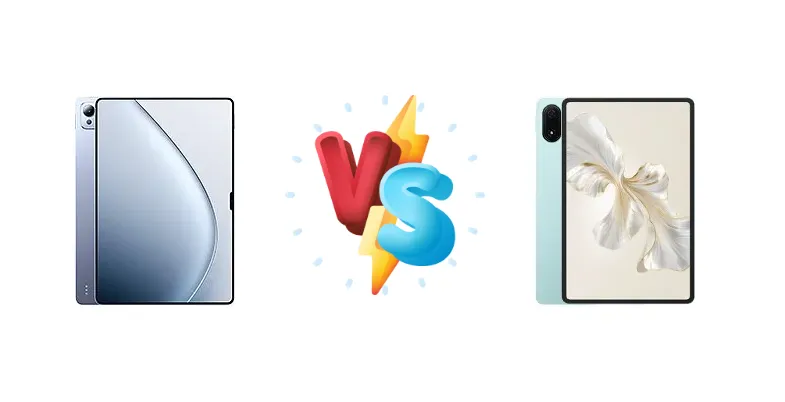
The Android tablet market is heating up, with Xiaomi and Honor both vying for dominance. The Xiaomi Pad 7 Ultra arrives with a brand-new, high-end Xring O1 chipset and blazing-fast 120W charging, while the Honor Pad 9 Pro leverages the established Mediatek Dimensity 8100. This comparison dissects the core differences to help you choose the right tablet for your needs.
🏆 Quick Verdict
For users prioritizing raw performance and future-proofing, the Xiaomi Pad 7 Ultra is the clear winner. Its Xring O1 chipset, built on a 3nm process, offers a significant architectural advantage. However, the Honor Pad 9 Pro remains a compelling option for those seeking a balanced experience at a potentially lower price point.
| Network |
|---|
| 2G bands | N/A | N/A |
| 3G bands | N/A | N/A |
| EDGE | N/A | No |
| GPRS | N/A | No |
| Technology | No cellular connectivity | No cellular connectivity |
| Launch |
|---|
| Announced | 2025, May 22 | 2024, July 12 |
| Status | Available. Released 2025, May 22 | Available. Released 2024, July 12 |
| Body |
|---|
| Build | Glass front (Gorilla Glass 5), aluminum frame, aluminum back | Glass front, aluminum frame, aluminum back |
| Dimensions | 305.8 x 207.5 x 5.1 mm (12.04 x 8.17 x 0.20 in) | 277 x 179.9 x 6.6 mm (10.91 x 7.08 x 0.26 in) |
| SIM | No | No |
| Weight | 609 g or 619 g (1.34 lb) | 589 g (1.30 lb) |
| Display |
|---|
| Protection | Corning Gorilla Glass 5 | - |
| Resolution | 2136 x 3200 pixels, 3:2 ratio (~275 ppi density) | 1600 x 2560 pixels, 16:10 ratio (~249 ppi density) |
| Size | 14.0 inches, 583.9 cm2 (~92.0% screen-to-body ratio) | 12.1 inches, 424.5 cm2 (~85.2% screen-to-body ratio) |
| Type | AMOLED, 68B colors, 120Hz, 4800Hz PWM, Dolby Vision, HDR10+, HDR Vivid, 1600 nits (peak) | IPS LCD, 1B colors, 144Hz |
| Platform |
|---|
| CPU | 10-core (2x3.7GHz Cortex-X925 & 4x3.4GHz Cortex-A725 & 2x1.9GHz Cortex-A725 & 2x1.8GHz Cortex-A520) | Octa-core (4x2.85 GHz Cortex-A78 & 4x2.0 GHz Cortex-A55) |
| Chipset | Xring O1 (3 nm) | Mediatek Dimensity 8100 (5 nm) |
| GPU | Immortalis-G925 MP16 | Mali-G610 MC6 |
| OS | Android 15, HyperOS 2 | Android 14, Magic OS 8.1 |
| Memory |
|---|
| Card slot | No | No |
| Internal | 256GB 12GB RAM, 512GB 12GB RAM, 1TB 16GB RAM | 256GB 12GB RAM, 256GB 8GB RAM |
| Main Camera |
|---|
| Features | LED flash, HDR, panorama | HDR |
| Single | 50 MP, f/1.8, (wide), 1/2.76", 0.64µm, PDAF | 13 MP, f/2.0, (wide), AF |
| Video | 4K@30/60fps, 1080p@30/60fps | 4K@30fps, 1080p@30fps |
| Selfie camera |
|---|
| Features | HDR | - |
| Single | 32 MP, f/2.2, 19mm (ultrawide), 1/3.6", 0.61µm | 5 MP, f/2.2, (wide) |
| Video | 1080p@30fps | 1080p@30fps |
| Sound |
|---|
| 35mm jack | No | No |
| Loudspeaker | Yes, with stereo speakers (8 speakers) | Yes, with stereo speakers (8 speakers) |
| Comms |
|---|
| Bluetooth | 5.4, A2DP, LE, LHDC 5 | 5.2, A2DP, LE |
| Infrared port | Yes | - |
| NFC | Yes (data transfer only) | No |
| Positioning | No | No |
| Radio | No | No |
| USB | USB Type-C 3.2 Gen2, OTG, accessory connector pins | USB Type-C 2.0, OTG |
| WLAN | Wi-Fi 802.11 a/b/g/n/a/6/7, dual-band, Wi-Fi Direct | Wi-Fi 802.11 a/b/g/n/ac/6, dual-band, Wi-Fi Direct |
| Features |
|---|
| Sensors | Fingerprint (side-mounted), accelerometer, gyro, proximity, compass | Accelerometer |
| Battery |
|---|
| Charging | 120W wired, PD3.0
7.5W reverse wired | 35W wired |
| Type | 12000 mAh | Li-Po 10050 mAh |
| Misc |
|---|
| Colors | Gray, Blue | Sky Blue, Star Gray |
| Price | About 700 EUR | About 290 EUR |
Xiaomi Pad 7 Ultra
- Significantly faster charging (120W)
- More powerful processor (Xring O1 3nm)
- Potentially better thermal management
- Likely higher price point
- Potential for software bugs with a new chipset
Honor Pad 9 Pro
- Established Dimensity 8100 platform
- Potentially more affordable
- Refined software experience
- Slower charging (35W)
- Less powerful processor
Display Comparison
While both tablets likely feature high-resolution displays (data not provided), the core difference lies in the processing power driving them. Display quality will be crucial, but the chipset will dictate how smoothly animations and demanding apps run on the screen. We anticipate both will offer vibrant colors, but the Xiaomi Pad 7 Ultra's processing power could enable features like higher refresh rates or more advanced image processing for improved visual fidelity.
Camera Comparison
Without specific camera specs, it’s difficult to make a definitive comparison. However, given the focus on performance in the Xiaomi Pad 7 Ultra, it’s reasonable to expect a more advanced camera system with larger sensors and more sophisticated image processing capabilities. The Honor Pad 9 Pro will likely offer a competent camera for casual use, but the Xiaomi Pad 7 Ultra is positioned to appeal to users who prioritize photography and videography.
Performance
The Xiaomi Pad 7 Ultra’s Xring O1 chipset, fabricated on a 3nm process, represents a substantial leap forward compared to the Honor Pad 9 Pro’s 5nm Mediatek Dimensity 8100. The Xring O1’s 10-core configuration (2x3.7GHz Cortex-X925, 4x3.4GHz Cortex-A725, 2x1.9GHz Cortex-A725, 2x1.8GHz Cortex-A520) provides a wider range of processing capabilities and higher clock speeds than the Dimensity 8100’s octa-core setup (4x2.85 GHz Cortex-A78 & 4x2.0 GHz Cortex-A55). This translates to faster app loading times, smoother multitasking, and superior performance in graphically intensive games. The 3nm process also promises improved thermal efficiency, potentially reducing throttling during sustained workloads.
Battery Life
The Xiaomi Pad 7 Ultra’s 120W wired charging is a game-changer, significantly faster than the Honor Pad 9 Pro’s 35W charging. While battery capacity isn’t specified, the faster charging speed allows the Pad 7 Ultra to replenish its battery much more quickly, minimizing downtime. The Honor Pad 9 Pro’s slower charging will require a longer time to reach a full charge, potentially impacting usability for users who frequently need to top up their battery.
Buying Guide
Buy the Xiaomi Pad 7 Ultra if you demand the absolute best performance for demanding tasks like video editing, 3D rendering, or high-end gaming, and value the convenience of incredibly fast charging. Buy the Honor Pad 9 Pro if you prioritize a refined user experience, solid performance for everyday tasks, and potentially a more accessible price, without sacrificing key features like a large display and capable processor.
Frequently Asked Questions
❓ Will the Xring O1 chipset in the Xiaomi Pad 7 Ultra overheat during extended gaming sessions?
The Xring O1’s 3nm fabrication process is designed to improve thermal efficiency compared to the 5nm Dimensity 8100. While sustained workloads will inevitably generate heat, the Pad 7 Ultra should be better equipped to manage it, potentially reducing throttling and maintaining consistent performance for longer periods. However, real-world testing is needed to confirm this.
❓ Is the 35W charging on the Honor Pad 9 Pro slow compared to the competition?
While 35W is considerably slower than the Xiaomi Pad 7 Ultra’s 120W, it’s still a respectable charging speed for a tablet. It will take longer to fully charge, but it’s unlikely to be a major inconvenience for most users. The slower charging speed may also contribute to better long-term battery health.
❓ Does the Mediatek Dimensity 8100 in the Honor Pad 9 Pro still offer sufficient performance for demanding apps?
Absolutely. The Dimensity 8100 is a powerful chipset that can handle most Android apps and games with ease. While it doesn’t match the raw power of the Xring O1, it provides a smooth and responsive experience for everyday tasks and even some demanding workloads.