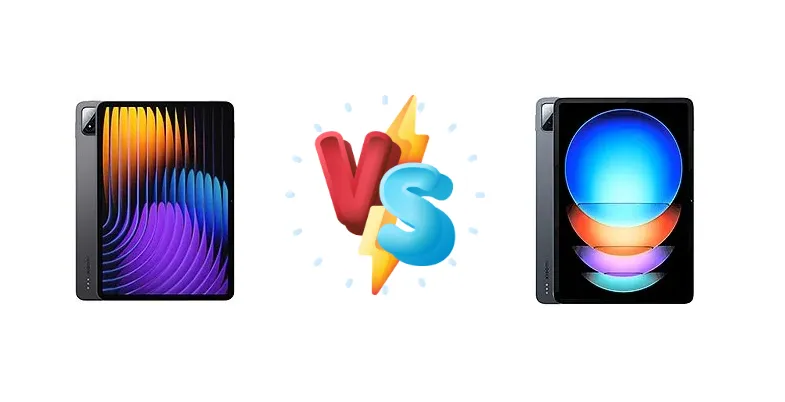
Xiaomi has doubled down on the premium tablet space with the Pad 7 Pro and the larger 12.4-inch Pad 6S Pro. While both aim for a high-end experience, they diverge in key areas – chipset choice, display size, and charging speed. This comparison dissects these differences to determine which tablet best suits your needs.
🏆 Quick Verdict
For most users, the Xiaomi Pad 6S Pro 12.4 emerges as the stronger choice. Its Snapdragon 8 Gen 2 chipset provides a performance edge, and the larger 12.4-inch display enhances productivity and media consumption. While the Pad 7 Pro offers faster active use battery life, the 6S Pro’s superior charging mitigates this difference.
| Network |
|---|
| 2G bands | N/A | N/A |
| 3G bands | N/A | N/A |
| EDGE | N/A | N/A |
| GPRS | N/A | N/A |
| Technology | No cellular connectivity | No cellular connectivity |
| Launch |
|---|
| Announced | 2024, October 29 | 2024, February 22 |
| Status | Available. Released 2024, October 29 | Available. Released 2024, February 22 |
| Body |
|---|
| Build | Glass front, aluminum frame, aluminum back | Glass front (Gorilla Glass 5), aluminum frame, aluminum back |
| Dimensions | 251.2 x 173.4 x 6.2 mm (9.89 x 6.83 x 0.24 in) | 278.7 x 191.6 x 6.3 mm (10.97 x 7.54 x 0.25 in) |
| SIM | No | No |
| Weight | 500 g (1.10 lb) | 590 g (1.30 lb) |
| Display |
|---|
| Protection | - | Corning Gorilla Glass 5 |
| Resolution | 2136 x 3200 pixels, 3:2 ratio (~345 ppi density) | 2032 x 3048 pixels, 3:2 ratio (~295 ppi density) |
| Size | 11.2 inches, 371.5 cm2 (~85.3% screen-to-body ratio) | 12.4 inches, 457.8 cm2 (~85.7% screen-to-body ratio) |
| Type | IPS LCD, 68B colors, 144Hz, HDR10, Dolby Vision, 800 nits (peak) | IPS LCD, 68B colors, 144Hz, HDR10, Dolby Vision, 900 nits (peak) |
| Platform |
|---|
| CPU | Octa-core (1x3.0 GHz Cortex-X4 & 4x2.8 GHz Cortex-A720 & 3x2.0 GHz Cortex-A520) | Octa-core (1x3.2 GHz Cortex-X3 & 2x2.8 GHz Cortex-A715 & 2x2.8 GHz Cortex-A710 & 3x2.0 GHz Cortex-A510) |
| Chipset | Qualcomm SM8635 Snapdragon 8s Gen 3 (4 nm) | Qualcomm SM8550-AB Snapdragon 8 Gen 2 (4 nm) |
| GPU | Adreno 735 | Adreno 740 |
| OS | Android 15, HyperOS 2 | Android 14, up to 3 major Android upgrades, HyperOS |
| Memory |
|---|
| Card slot | No | No |
| Internal | 128GB 8GB RAM, 256GB 8GB RAM, 256GB 12GB RAM, 512GB 12GB RAM | 256GB 8GB RAM, 256GB 12GB RAM, 512GB 12GB RAM, 1TB 16GB RAM |
| Main Camera |
|---|
| Dual | 50 MP, f/1.8, (wide), 1/2.76", 0.64µm, PDAF
Auxiliary lens | 50 MP, f/1.8, (wide), 1/2.76", 0.64µm, PDAF
Auxiliary lens |
| Features | LED flash, HDR, panorama | LED flash, HDR, panorama |
| Video | 4K@30/60fps, 1080p@30/60fps | 4K@30/60fps, 1080p@30/60fps |
| Selfie camera |
|---|
| Features | HDR | - |
| Single | 32 MP, f/2.2, 19mm (ultrawide), 1/3.6", 0.61µm | 32 MP, f/2.2, (wide), 1/3.6", 0.61µm |
| Video | 1080p@30fps | 1080p@30fps |
| Sound |
|---|
| 35mm jack | No | No |
| Loudspeaker | Yes, with stereo speakers (4 speakers) | Yes, with stereo speakers (6 speakers) |
| Comms |
|---|
| Bluetooth | 5.4, A2DP, LE, LHDC 5 | 5.3, A2DP, LE, LHDC |
| Infrared port | Yes | - |
| NFC | No | Yes (file transfer only) |
| Positioning | No | No |
| Radio | No | No |
| USB | USB Type-C 3.2, accessory connector | USB Type-C 3.2, accessory connector |
| WLAN | Wi-Fi 802.11 a/b/g/n/ac/6e/7, dual-band, Wi-Fi Direct | Wi-Fi 802.11 a/b/g/n/a/6/7, dual-band, Wi-Fi Direct |
| Features |
|---|
| Sensors | Fingerprint (side-mounted), accelerometer, gyro, proximity, compass | Fingerprint (side-mounted), accelerometer, gyro, proximity (accessories only), compass |
| Battery |
|---|
| Charging | 67W wired, PD3.0, QC3+, 40% in 20 min | 120W wired, PD3.0, QC4, 45% in 10 min, 100% in 35 min |
| Type | 8850 mAh | 10000 mAh |
| Misc |
|---|
| Colors | Gray, Blue, Green | Black, Blue, Green |
| Models | 24091RPADG | 24018RPACG |
| Price | About 500 EUR | About 700 EUR |
| SAR EU | 0.99 W/kg (body) | 0.99 W/kg (body) |
Xiaomi Pad 7 Pro
- Slightly longer active use battery life.
- More compact and portable design.
- Potentially lower price point (depending on configuration).
- Less powerful Snapdragon 8s Gen 3 chipset.
- Slower 67W charging.
- Smaller display size.
Xiaomi Pad 6S Pro 12.4
- More powerful Snapdragon 8 Gen 2 chipset.
- Significantly faster 120W charging.
- Larger, brighter, and higher contrast 12.4-inch display.
- Slightly shorter active use battery life.
- Larger and less portable form factor.
- Potentially higher price point.
Display Comparison
The Xiaomi Pad 6S Pro 12.4 boasts a larger 12.4-inch display, offering a more expansive canvas for multitasking and media. Crucially, it achieves a measured peak brightness of 848 nits and a 1378:1 contrast ratio, providing a vibrant and detailed visual experience. While the Pad 7 Pro’s display specs aren’t provided, the larger screen size and superior contrast of the 6S Pro are immediately noticeable. The 6S Pro’s larger size is a boon for split-screen multitasking, while the higher brightness makes it more usable outdoors.
Camera Comparison
Neither tablet is positioned as a photography powerhouse, but the camera systems are worth noting. Without detailed camera specs for the Pad 7 Pro, it’s difficult to make a direct comparison. However, the focus should be on video conferencing and occasional document scanning, where both tablets will likely perform adequately. The absence of detailed camera information for the Pad 7 Pro suggests Xiaomi isn’t prioritizing this aspect.
Performance
The core difference lies in the chipsets. The Pad 6S Pro 12.4 utilizes the Qualcomm Snapdragon 8 Gen 2 (4nm), featuring a Cortex-X3 prime core clocked at 3.2 GHz. This is a step up from the Pad 7 Pro’s Snapdragon 8s Gen 3 (4nm) with its 3.0 GHz Cortex-X4 core. While both are 4nm chips, the Gen 2’s architecture offers a performance advantage, particularly in sustained workloads. The 6S Pro’s CPU configuration (1x3.2GHz Cortex-X3, 2x2.8GHz Cortex-A715, 2x2.8GHz Cortex-A710, 3x2.0GHz Cortex-A510) is optimized for both peak performance and efficiency, contrasting with the Pad 7 Pro’s (1x3.0 GHz Cortex-X4 & 4x2.8 GHz Cortex-A720 & 3x2.0 GHz Cortex-A520). This translates to smoother gaming and faster rendering times on the 6S Pro.
Battery Life
The Xiaomi Pad 6S Pro 12.4 delivers 11:14 hours of active use, slightly less than the Pad 7 Pro’s 10:12 hours. However, this difference is largely offset by the 6S Pro’s significantly faster 120W charging. Reaching 45% charge in just 10 minutes and 100% in 35 minutes is a game-changer for users who need to quickly top up their device. The Pad 7 Pro’s 67W charging, while respectable, is considerably slower. The 6S Pro’s charging speed effectively mitigates the slightly shorter battery life, making it more convenient for on-the-go users.
Buying Guide
Buy the Xiaomi Pad 7 Pro if you prioritize a slightly longer active use battery life and a more compact form factor for increased portability. Buy the Xiaomi Pad 6S Pro 12.4 if you value raw performance from the Snapdragon 8 Gen 2, a larger, brighter display for immersive content, and significantly faster charging speeds, making it ideal for power users and creative professionals.
Frequently Asked Questions
❓ Does the Snapdragon 8 Gen 2 in the Pad 6S Pro 12.4 get hot during extended gaming sessions?
The Snapdragon 8 Gen 2 is a thermally efficient chip, and Xiaomi likely employs adequate cooling solutions within the Pad 6S Pro 12.4. While some heat generation is inevitable during demanding tasks, the 4nm process and optimized architecture should prevent significant throttling, allowing for sustained performance.
❓ How much does the 120W charging of the Pad 6S Pro 12.4 actually improve the user experience?
The 120W charging is a significant convenience factor. Being able to reach 45% charge in 10 minutes and 100% in 35 minutes drastically reduces downtime, especially for users who rely on their tablet throughout the day. It eliminates the need to charge overnight and allows for quick top-ups before meetings or travel.
❓ Is the larger screen size of the Pad 6S Pro 12.4 cumbersome for reading ebooks or browsing the web?
While the 12.4-inch display is larger, Xiaomi’s software optimizations and the tablet’s relatively slim bezels make it comfortable to hold and use for reading and browsing. The increased screen real estate is particularly beneficial for displaying ebooks with complex formatting or for viewing web pages with multiple tabs.