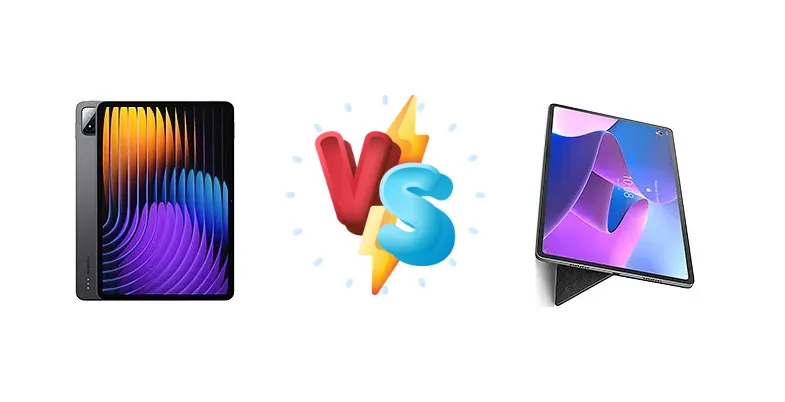
The Android tablet market is heating up, with the Xiaomi Pad 7 Pro and Lenovo Tab P12 Pro representing compelling options at different price points. The Pad 7 Pro brings a newer chipset and faster charging, while the Tab P12 Pro leverages the established Snapdragon 870. This comparison dissects their key differences to help you choose the right tablet for your workflow.
🏆 Quick Verdict
For most users, the Xiaomi Pad 7 Pro emerges as the superior choice. Its Snapdragon 8s Gen 3 offers a noticeable performance uplift over the Snapdragon 870 in the Lenovo Tab P12 Pro, coupled with significantly faster 67W charging. While the Tab P12 Pro remains a capable device, the Pad 7 Pro delivers a more future-proof experience.
| Network |
|---|
| 2G bands | N/A | GSM 850 / 900 / 1800 / 1900 |
| 3G bands | N/A | HSDPA 850 / 900 / 1900 / 2100 |
| 4G bands | - | 1, 2, 3, 4, 5, 7, 8, 19, 20, 26, 28, 34, 38, 39, 40, 41 |
| 5G bands | - | 1, 3, 7, 8, 20, 28, 38, 41, 77, 78 SA/NSA/Sub6 |
| EDGE | N/A | - |
| GPRS | N/A | - |
| Speed | - | HSPA, LTE, 5G - cellular model only |
| Technology | No cellular connectivity | GSM / HSPA / LTE / 5G |
| Launch |
|---|
| Announced | 2024, October 29 | 2021, September 08 |
| Status | Available. Released 2024, October 29 | Available. Released 2021, November 19 |
| Body |
|---|
| Build | Glass front, aluminum frame, aluminum back | - |
| Dimensions | 251.2 x 173.4 x 6.2 mm (9.89 x 6.83 x 0.24 in) | 285.6 x 184.5 x 5.6 mm (11.24 x 7.26 x 0.22 in) |
| SIM | No | Nano-SIM (cellular model only) |
| Weight | 500 g (1.10 lb) | 565 g (1.25 lb) |
| | - | Stylus support |
| Display |
|---|
| Resolution | 2136 x 3200 pixels, 3:2 ratio (~345 ppi density) | 1600 x 2560 pixels, 16:10 ratio (~240 ppi density) |
| Size | 11.2 inches, 371.5 cm2 (~85.3% screen-to-body ratio) | 12.6 inches, 460.3 cm2 (~87.4% screen-to-body ratio) |
| Type | IPS LCD, 68B colors, 144Hz, HDR10, Dolby Vision, 800 nits (peak) | AMOLED, 120Hz, HDR10+, Dolby Vision, 600 nits (HBM) |
| Platform |
|---|
| CPU | Octa-core (1x3.0 GHz Cortex-X4 & 4x2.8 GHz Cortex-A720 & 3x2.0 GHz Cortex-A520) | Octa-core (1x3.2 GHz Kryo 585 & 3x2.42 GHz Kryo 585 & 4x1.80 GHz Kryo 585) |
| Chipset | Qualcomm SM8635 Snapdragon 8s Gen 3 (4 nm) | Qualcomm SM8250-AC Snapdragon 870 5G (7 nm) |
| GPU | Adreno 735 | Adreno 650 |
| OS | Android 15, HyperOS 2 | Android 11 |
| Memory |
|---|
| Card slot | No | microSDXC (dedicated slot) |
| Internal | 128GB 8GB RAM, 256GB 8GB RAM, 256GB 12GB RAM, 512GB 12GB RAM | 128GB 6GB RAM, 256GB 8GB RAM |
| Main Camera |
|---|
| Dual | 50 MP, f/1.8, (wide), 1/2.76", 0.64µm, PDAF
Auxiliary lens | 13 MP, (wide), AF
5 MP, (ultrawide) |
| Features | LED flash, HDR, panorama | - |
| Video | 4K@30/60fps, 1080p@30/60fps | 4K@30fps, 1080p@30fps |
| Selfie camera |
|---|
| Features | HDR | - |
| Single | 32 MP, f/2.2, 19mm (ultrawide), 1/3.6", 0.61µm | 8 MP, (wide)
8 MP, IR TOF 3D, (biometrics sensor only) |
| Video | 1080p@30fps | 1080p@30fps |
| Sound |
|---|
| 3.5mm jack | - | No |
| 35mm jack | No | No |
| Loudspeaker | Yes, with stereo speakers (4 speakers) | Yes, with stereo speakers (4 speakers) |
| | - | JBL speakers |
| Comms |
|---|
| Bluetooth | 5.4, A2DP, LE, LHDC 5 | 5.2, A2DP, LE |
| Infrared port | Yes | - |
| NFC | No | Yes (wireless charging and data transfer only) |
| Positioning | No | GPS, GLONASS, BDS - cellular model only |
| Radio | No | Unspecified |
| USB | USB Type-C 3.2, accessory connector | USB Type-C 3.1 |
| WLAN | Wi-Fi 802.11 a/b/g/n/ac/6e/7, dual-band, Wi-Fi Direct | Wi-Fi 802.11 a/b/g/n/ac/6, dual-band, Wi-Fi Direct |
| Features |
|---|
| Sensors | Fingerprint (side-mounted), accelerometer, gyro, proximity, compass | Fingerprint (side-mounted), accelerometer, gyro, proximity |
| Battery |
|---|
| Charging | 67W wired, PD3.0, QC3+, 40% in 20 min | 45W wired, QC4 |
| Type | 8850 mAh | Li-Po 10200 mAh |
| Misc |
|---|
| Colors | Gray, Blue, Green | Storm Grey |
| Models | 24091RPADG | TB-Q706Z, TB-Q706F |
| Price | About 500 EUR | About 520 EUR |
| SAR EU | 0.99 W/kg (body) | - |
Xiaomi Pad 7 Pro
- Superior performance with Snapdragon 8s Gen 3
- Significantly faster 67W charging
- More future-proof architecture
- Potential for higher price
- Display specs not provided for detailed comparison
Lenovo Tab P12 Pro
- Proven Snapdragon 870 performance
- Well-established reliability
- Potentially lower price point
- Slower 45W charging
- Older chipset architecture
Display Comparison
While display specs aren't provided, both tablets likely feature high-resolution LCD panels. However, the Xiaomi Pad 7 Pro’s newer chipset may allow for more advanced display features like variable refresh rate (VRR) for smoother scrolling and gaming. The Lenovo Tab P12 Pro, being an older model, may lack this feature. Bezels are likely comparable, but the Xiaomi Pad 7 Pro’s design language may prioritize a more modern, edge-to-edge aesthetic.
Camera Comparison
Camera performance is unlikely to be a primary concern for tablet buyers, but the Xiaomi Pad 7 Pro likely benefits from a newer image signal processor (ISP) integrated within the Snapdragon 8s Gen 3. This could result in improved image quality, particularly in low-light conditions. Without specific sensor details, it’s difficult to make a definitive comparison, but the newer chipset generally provides an edge in image processing capabilities. We'd expect both to have adequate cameras for video calls and casual snapshots.
Performance
The core difference lies in the chipsets. The Xiaomi Pad 7 Pro’s Qualcomm SM8635 Snapdragon 8s Gen 3 (4nm) represents a significant architectural leap over the Lenovo Tab P12 Pro’s Snapdragon 870 (7nm). The 8s Gen 3 utilizes newer Cortex-X4 and A720 cores, offering improved single-core and multi-core performance. The 4nm process node also translates to better power efficiency and reduced thermal throttling during sustained workloads. The Snapdragon 870 is still a capable performer, but the 8s Gen 3 provides a clear advantage for demanding applications and future-proofing.
Battery Life
The Xiaomi Pad 7 Pro boasts a 67W wired charging capability with support for PD3.0 and QC3+, achieving 40% charge in just 20 minutes. This is a substantial improvement over the Lenovo Tab P12 Pro’s 45W QC4 charging. While the Xiaomi Pad 7 Pro’s active use battery score is 10:12h, the faster charging mitigates any potential concerns about battery life. The Lenovo Tab P12 Pro’s charging speed is adequate, but the Xiaomi Pad 7 Pro offers a significantly more convenient charging experience.
Buying Guide
Buy the Xiaomi Pad 7 Pro if you prioritize raw performance for demanding tasks like gaming or video editing, and value the convenience of rapid charging. It’s ideal for power users and those who want a tablet that will remain responsive for years to come. Buy the Lenovo Tab P12 Pro if you’re seeking a well-rounded tablet with a proven track record, and are less concerned with having the absolute latest chipset. It’s a solid option for everyday productivity and media consumption, especially if found at a significant discount.
Frequently Asked Questions
❓ Will the Snapdragon 8s Gen 3 in the Xiaomi Pad 7 Pro handle demanding games like Genshin Impact at high settings?
Yes, the Snapdragon 8s Gen 3 is a powerful chipset capable of running demanding games like Genshin Impact at high settings with smooth frame rates. The newer CPU and GPU architecture provide a significant performance boost over the Snapdragon 870, minimizing frame drops and ensuring a more enjoyable gaming experience.
❓ How much faster is the 67W charging on the Xiaomi Pad 7 Pro compared to the 45W charging on the Lenovo Tab P12 Pro in real-world use?
The 67W charging on the Xiaomi Pad 7 Pro will significantly reduce charging times. While a full 0-100% time isn't provided, the stated 40% charge in 20 minutes demonstrates a substantial speed advantage. Expect a noticeably quicker top-up compared to the Lenovo Tab P12 Pro, making it more convenient for users who frequently need to recharge their tablet.
❓ Is the Snapdragon 870 in the Lenovo Tab P12 Pro still a viable option for everyday tasks like browsing, streaming, and email?
Absolutely. The Snapdragon 870 remains a very capable chipset for everyday tasks. It will handle browsing, streaming, email, and light productivity applications with ease. However, it won't offer the same level of responsiveness or future-proofing as the Snapdragon 8s Gen 3 in the Xiaomi Pad 7 Pro.