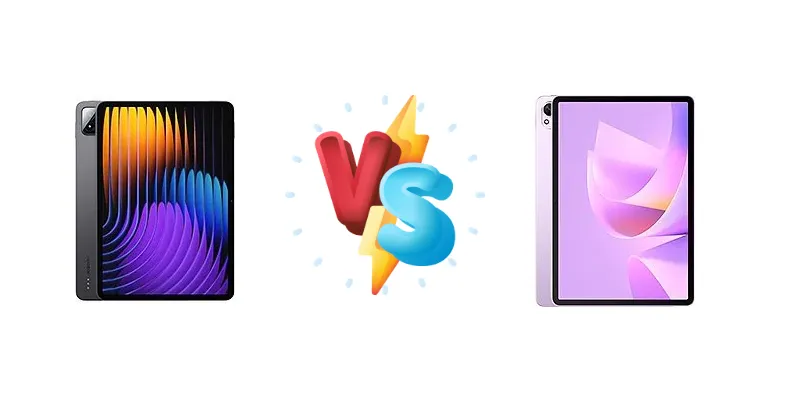
The Android tablet market is heating up, with Xiaomi and Huawei both vying for dominance. The Xiaomi Pad 7 Pro arrives with a powerful Snapdragon 8s Gen 3, promising flagship performance. Meanwhile, the Huawei MatePad 11.5 S (2025) aims to deliver a balanced experience. This comparison dissects their key differences, focusing on performance, battery, and charging to determine which tablet best suits your needs.
🏆 Quick Verdict
For users prioritizing raw performance and faster charging, the Xiaomi Pad 7 Pro is the clear winner. Its Snapdragon 8s Gen 3 chipset and 67W charging significantly outperform the MatePad 11.5 S. However, the MatePad 11.5 S may appeal to those seeking a more streamlined software experience and potentially a lower price point.
| Network |
|---|
| 2G bands | N/A | N/A |
| 3G bands | N/A | N/A |
| 4G bands | - | N/A |
| EDGE | N/A | No |
| GPRS | N/A | No |
| Technology | No cellular connectivity | No cellular connectivity |
| Launch |
|---|
| Announced | 2024, October 29 | 2025, August 15 |
| Status | Available. Released 2024, October 29 | Available. Released 2025, August 21 |
| Body |
|---|
| Build | Glass front, aluminum frame, aluminum back | - |
| Dimensions | 251.2 x 173.4 x 6.2 mm (9.89 x 6.83 x 0.24 in) | 261 x 177.3 x 6.1 mm (10.28 x 6.98 x 0.24 in) |
| SIM | No | No |
| Weight | 500 g (1.10 lb) | 515 g (1.14 lb) |
| Display |
|---|
| Resolution | 2136 x 3200 pixels, 3:2 ratio (~345 ppi density) | 1840 x 2800 pixels, 3:2 ratio (~291 ppi density) |
| Size | 11.2 inches, 371.5 cm2 (~85.3% screen-to-body ratio) | 11.5 inches, 391.6 cm2 (~84.6% screen-to-body ratio) |
| Type | IPS LCD, 68B colors, 144Hz, HDR10, Dolby Vision, 800 nits (peak) | TFT LCD, 144Hz, HDR Vivid |
| Platform |
|---|
| CPU | Octa-core (1x3.0 GHz Cortex-X4 & 4x2.8 GHz Cortex-A720 & 3x2.0 GHz Cortex-A520) | Octa-core |
| Chipset | Qualcomm SM8635 Snapdragon 8s Gen 3 (4 nm) | - |
| GPU | Adreno 735 | - |
| OS | Android 15, HyperOS 2 | Harmony OS 5.0 |
| Memory |
|---|
| Card slot | No | No |
| Internal | 128GB 8GB RAM, 256GB 8GB RAM, 256GB 12GB RAM, 512GB 12GB RAM | 256GB 8GB RAM, 256GB 12GB RAM, 512GB 12GB RAM |
| Main Camera |
|---|
| Dual | 50 MP, f/1.8, (wide), 1/2.76", 0.64µm, PDAF
Auxiliary lens | - |
| Features | LED flash, HDR, panorama | LED flash, panorama |
| Single | - | 13 MP, f/1.8, (wide), AF |
| Video | 4K@30/60fps, 1080p@30/60fps | 1080p@30fps |
| Selfie camera |
|---|
| Features | HDR | - |
| Single | 32 MP, f/2.2, 19mm (ultrawide), 1/3.6", 0.61µm | 8 MP, f/2.0 |
| Video | 1080p@30fps | 1080p@30fps |
| Sound |
|---|
| 35mm jack | No | No |
| Loudspeaker | Yes, with stereo speakers (4 speakers) | Yes, with stereo speakers (4 speakers) |
| Comms |
|---|
| Bluetooth | 5.4, A2DP, LE, LHDC 5 | 5.2, A2DP, LE, L2HC |
| Infrared port | Yes | - |
| NFC | No | No |
| Positioning | No | No |
| Radio | No | No |
| USB | USB Type-C 3.2, accessory connector | USB Type-C 3.1, OTG, magnetic accessory connector |
| WLAN | Wi-Fi 802.11 a/b/g/n/ac/6e/7, dual-band, Wi-Fi Direct | Wi-Fi 802.11 a/b/g/n/ac/6, dual-band |
| Features |
|---|
| Sensors | Fingerprint (side-mounted), accelerometer, gyro, proximity, compass | Accelerometer, proximity (accessories only), gyro |
| Battery |
|---|
| Charging | 67W wired, PD3.0, QC3+, 40% in 20 min | 40W wired
5W reverse wired |
| Type | 8850 mAh | 8800 mAh |
| Misc |
|---|
| Colors | Gray, Blue, Green | Gray, Silver, Mint, Purple |
| Models | 24091RPADG | SLG-W50, SLG-W10 |
| Price | About 500 EUR | About 250 EUR |
| SAR EU | 0.99 W/kg (body) | - |
Xiaomi Pad 7 Pro
- Significantly faster charging (67W vs 40W)
- More powerful Snapdragon 8s Gen 3 chipset
- Longer battery life in active use (10:12h)
- Potential for higher price
- Software experience may not appeal to all users
Huawei MatePad 11.5 S (2025)
- Potential for lower price point
- Reverse wired charging capability
- Streamlined Huawei software experience
- Less powerful processor
- Slower charging speed
Display Comparison
Display specifications are currently unavailable for the Huawei MatePad 11.5 S (2025). However, given its positioning, we anticipate a high-resolution LCD or IPS panel. The Xiaomi Pad 7 Pro’s display details are also missing, but the focus here is on internal power. Without knowing the panel technology or refresh rates of either device, a direct comparison is impossible. Future updates will be crucial to assess display quality.
Camera Comparison
Camera specifications are unavailable for both devices. Given the tablet form factor, camera quality is typically less of a priority than on smartphones. However, we can speculate that the Xiaomi Pad 7 Pro, positioned as a more premium device, may feature a more capable camera system. Without concrete details, it’s difficult to assess the imaging capabilities of either tablet.
Performance
The Xiaomi Pad 7 Pro boasts the Qualcomm SM8635 Snapdragon 8s Gen 3 (4 nm) chipset, an octa-core processor featuring a Cortex-X4 prime core clocked at 3.0 GHz. This architecture, built on a 4nm process, offers a significant performance advantage over the Huawei MatePad 11.5 S (2025), which only lists an octa-core CPU without specifying the architecture or manufacturing process. The Snapdragon 8s Gen 3’s combination of Cortex-A720 and A520 cores ensures efficient multitasking and responsiveness. The lack of detailed CPU information for the Huawei tablet suggests a mid-range processor, likely prioritizing efficiency over raw power. This translates to a smoother experience for demanding applications and games on the Xiaomi Pad 7 Pro.
Battery Life
The Xiaomi Pad 7 Pro delivers an active use battery score of 10:12 hours, coupled with 67W wired charging, supporting PD3.0 and QC3+, achieving 40% charge in just 20 minutes. In contrast, the Huawei MatePad 11.5 S (2025) offers 40W wired charging and 5W reverse wired charging. While the Huawei tablet’s reverse charging is a convenient feature, the Xiaomi Pad 7 Pro’s significantly faster charging speed and respectable battery life provide a more compelling user experience. The 67W charging allows for quicker top-ups, minimizing downtime, a crucial advantage for users on the go.
Buying Guide
Buy the Xiaomi Pad 7 Pro if you need a tablet capable of demanding tasks like gaming, video editing, or running multiple apps simultaneously. Its superior chipset and faster charging are ideal for power users. Buy the Huawei MatePad 11.5 S (2025) if you prefer a potentially more refined software experience within the Huawei ecosystem and prioritize a balance between features and cost, accepting a performance trade-off.
Frequently Asked Questions
❓ How much faster is the 67W charging on the Xiaomi Pad 7 Pro compared to the 40W charging on the Huawei MatePad 11.5 S?
The Xiaomi Pad 7 Pro's 67W charging allows it to reach 40% charge in just 20 minutes. While a precise 0-100% time for the Huawei MatePad 11.5 S (2025) is unknown, 40W charging will undoubtedly take considerably longer, potentially exceeding 1 hour and 30 minutes for a full charge. This difference is significant for users who need to quickly top up their tablet.
❓ Will the Snapdragon 8s Gen 3 in the Xiaomi Pad 7 Pro handle demanding games like Genshin Impact at high settings?
Yes, the Snapdragon 8s Gen 3 is a powerful chipset capable of running demanding games like Genshin Impact at high settings. Its Cortex-X4 prime core and efficient architecture ensure smooth gameplay and minimal throttling, providing a superior gaming experience compared to the Huawei MatePad 11.5 S (2025) which has a less specified processor.
❓ Does the Huawei MatePad 11.5 S (2025) support stylus input or keyboard accessories?
While not explicitly stated in the provided data, Huawei typically supports stylus and keyboard accessories for its MatePad series. It's highly likely the MatePad 11.5 S (2025) will offer these options, enhancing productivity. However, compatibility and performance will need to be verified through independent reviews.