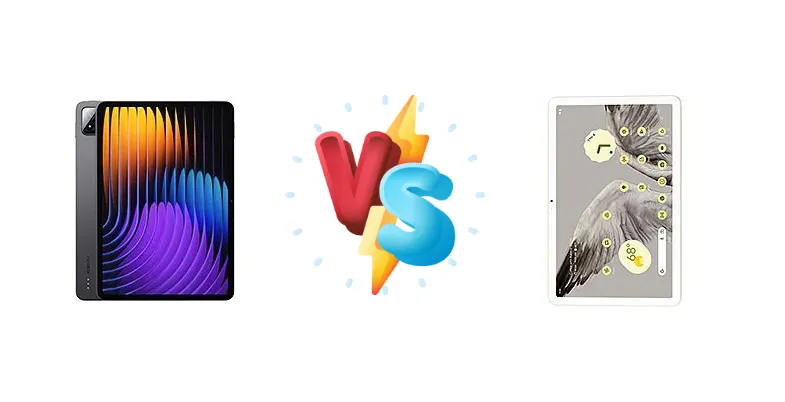
The Android tablet market is heating up, with the Xiaomi Pad 7 Pro and Google Pixel Tablet representing distinct approaches. The Xiaomi Pad 7 Pro prioritizes raw performance with its Snapdragon 8s Gen 3 chipset, while the Google Pixel Tablet focuses on a seamless software experience and smart home integration powered by the Tensor G2. This comparison dissects their strengths and weaknesses to help you choose the right tablet for your needs.
🏆 Quick Verdict
For users prioritizing performance and extended battery life, the Xiaomi Pad 7 Pro emerges as the winner. Its Snapdragon 8s Gen 3 delivers significantly more processing power, and its 10:12 active use battery score surpasses the Pixel Tablet. However, the Pixel Tablet’s software integration and dock functionality make it a compelling choice for Google ecosystem users.
| Network |
|---|
| 2G bands | N/A | N/A |
| 3G bands | N/A | N/A |
| 4G bands | - | N/A |
| EDGE | N/A | No |
| GPRS | N/A | No |
| Technology | No cellular connectivity | No cellular connectivity |
| Launch |
|---|
| Announced | 2024, October 29 | 2023, May 10 |
| Status | Available. Released 2024, October 29 | Available. Released 2023, June 20 |
| Body |
|---|
| Build | Glass front, aluminum frame, aluminum back | Glass front, aluminum frame, aluminum back |
| Dimensions | 251.2 x 173.4 x 6.2 mm (9.89 x 6.83 x 0.24 in) | 258 x 169 x 8.1 mm (10.16 x 6.65 x 0.32 in) |
| SIM | No | No |
| Weight | 500 g (1.10 lb) | 493 g (1.09 lb) |
| | - | Stylus support |
| Display |
|---|
| Resolution | 2136 x 3200 pixels, 3:2 ratio (~345 ppi density) | 1600 x 2560 pixels, 16:10 ratio (~276 ppi density) |
| Size | 11.2 inches, 371.5 cm2 (~85.3% screen-to-body ratio) | 10.95 inches, 347.7 cm2 (~79.7% screen-to-body ratio) |
| Type | IPS LCD, 68B colors, 144Hz, HDR10, Dolby Vision, 800 nits (peak) | IPS LCD |
| Platform |
|---|
| CPU | Octa-core (1x3.0 GHz Cortex-X4 & 4x2.8 GHz Cortex-A720 & 3x2.0 GHz Cortex-A520) | Octa-core (2x2.85 GHz Cortex-X1 & 2x2.35 GHz Cortex-A78 & 4x1.80 GHz Cortex-A55) |
| Chipset | Qualcomm SM8635 Snapdragon 8s Gen 3 (4 nm) | Google Tensor G2 (5 nm) |
| GPU | Adreno 735 | Mali-G710 MP7 |
| OS | Android 15, HyperOS 2 | Android 13, upgradable to Android 15 |
| Memory |
|---|
| Card slot | No | No |
| Internal | 128GB 8GB RAM, 256GB 8GB RAM, 256GB 12GB RAM, 512GB 12GB RAM | 128GB 8GB RAM, 256GB 8GB RAM |
| | - | UFS 3.1 |
| Main Camera |
|---|
| Dual | 50 MP, f/1.8, (wide), 1/2.76", 0.64µm, PDAF
Auxiliary lens | - |
| Features | LED flash, HDR, panorama | HDR, panorama |
| Single | - | 8 MP, f/2.0, 24mm (wide), 1/4.0", 1.12µm |
| Video | 4K@30/60fps, 1080p@30/60fps | 1080p@30fps |
| Selfie camera |
|---|
| Features | HDR | HDR, panorama |
| Single | 32 MP, f/2.2, 19mm (ultrawide), 1/3.6", 0.61µm | 8 MP, f/2.0, 24mm (wide), 1/4.0", 1.12µm |
| Video | 1080p@30fps | 1080p@30fps |
| Sound |
|---|
| 3.5mm jack | - | No |
| 35mm jack | No | No |
| Loudspeaker | Yes, with stereo speakers (4 speakers) | Yes, with stereo speakers (4 speakers) |
| Comms |
|---|
| Bluetooth | 5.4, A2DP, LE, LHDC 5 | 5.2, A2DP, LE |
| Infrared port | Yes | - |
| NFC | No | No |
| Positioning | No | No |
| Radio | No | No |
| USB | USB Type-C 3.2, accessory connector | USB Type-C 3.2 (Gen 1), magnetic connector |
| WLAN | Wi-Fi 802.11 a/b/g/n/ac/6e/7, dual-band, Wi-Fi Direct | Wi-Fi 802.11 a/b/g/n/ac/6, dual-band |
| Features |
|---|
| Sensors | Fingerprint (side-mounted), accelerometer, gyro, proximity, compass | Accelerometer, gyro, compass, proximity (accessories only) |
| | - | Ultra Wideband (UWB) support |
| Battery |
|---|
| Charging | 67W wired, PD3.0, QC3+, 40% in 20 min | 15W wired |
| Type | 8850 mAh | Li-Po 7020 mAh (27 Wh) |
| Misc |
|---|
| Colors | Gray, Blue, Green | Porcelain, Hazel, Rose |
| Models | 24091RPADG | GA06156-EU, GA06157-EU, GA06158-EU |
| Price | About 500 EUR | About 670 EUR |
| SAR EU | 0.99 W/kg (body) | - |
Xiaomi Pad 7 Pro
- Superior processing power with Snapdragon 8s Gen 3
- Faster 67W charging with PD3.0 and QC3+ support
- Longer battery life (10:12h active use)
- Software experience may not be as refined as Pixel Tablet
- Potential for more aggressive bloatware (typical of Xiaomi)
Google Pixel Tablet
- Seamless integration with Google ecosystem
- Clean and streamlined Android experience
- Included dock enhances functionality as a smart home hub
- Slower 15W charging
- Less powerful Tensor G2 chipset compared to Snapdragon 8s Gen 3
Display Comparison
While both tablets likely feature LCD panels (data not provided), the core difference lies in processing power impacting display responsiveness. The Xiaomi Pad 7 Pro’s Snapdragon 8s Gen 3 will ensure smoother animations and faster rendering, particularly noticeable in fast-paced games. The Pixel Tablet’s Tensor G2, while capable, is geared more towards AI tasks than raw graphical output. Without specific display specs like peak brightness or color gamut, it’s difficult to assess visual quality, but the chipset difference suggests a performance advantage for the Xiaomi Pad 7 Pro in display-intensive applications.
Camera Comparison
Given the tablet form factor, camera quality isn't a primary concern for most users. However, the Xiaomi Pad 7 Pro is likely to offer a more capable camera system due to its focus on overall hardware specifications. Without detailed camera specs, it's difficult to make a definitive statement, but Xiaomi generally prioritizes camera hardware in its devices. The Pixel Tablet’s Tensor G2 excels at computational photography, but this advantage is diminished without a strong base sensor. We anticipate the Xiaomi Pad 7 Pro will deliver sharper, more detailed images in good lighting conditions.
Performance
The Xiaomi Pad 7 Pro’s Qualcomm SM8635 Snapdragon 8s Gen 3 (4nm) is a clear winner in the chipset department. Its octa-core configuration, featuring a Cortex-X4 prime core clocked at 3.0 GHz, provides a substantial performance uplift compared to the Google Pixel Tablet’s Tensor G2 (5nm). The Tensor G2’s CPU, with its Cortex-X1 cores at 2.85 GHz, is still competent, but the Snapdragon 8s Gen 3 benefits from a newer architecture and a more aggressive clock speed. This translates to faster app loading times, smoother multitasking, and superior gaming performance for the Xiaomi Pad 7 Pro. The 4nm process node of the Snapdragon also contributes to better thermal efficiency, potentially reducing throttling during sustained workloads.
Battery Life
The Xiaomi Pad 7 Pro boasts a significant advantage in battery performance, achieving 10:12 hours of active use. While the Pixel Tablet’s battery capacity is unknown, its 15W charging is considerably slower than the Xiaomi Pad 7 Pro’s 67W wired charging, which can reach 40% charge in just 20 minutes. This faster charging is crucial for users who need to quickly top up their tablet on the go. The Snapdragon 8s Gen 3’s 4nm process also contributes to improved power efficiency, allowing the Xiaomi Pad 7 Pro to maintain longer runtimes despite potentially having a similar or smaller battery capacity.
Buying Guide
Buy the Xiaomi Pad 7 Pro if you need a tablet for demanding tasks like gaming, video editing, or running multiple apps simultaneously. Its superior chipset and faster charging are ideal for power users. Buy the Google Pixel Tablet if you prefer a tablet deeply integrated with the Google ecosystem, value smart home control, and appreciate a clean, streamlined software experience. The included dock adds significant value for those seeking a 'hub' style tablet experience.
Frequently Asked Questions
❓ Does the Snapdragon 8s Gen 3 in the Xiaomi Pad 7 Pro get hot during extended gaming sessions?
The Snapdragon 8s Gen 3’s 4nm process node and efficient thermal design should mitigate overheating during gaming. While some heat is inevitable, the Xiaomi Pad 7 Pro is expected to maintain stable performance for longer periods compared to devices with less efficient chipsets. However, sustained peak performance will likely still result in some thermal throttling.
❓ How useful is the Google Pixel Tablet's dock beyond just charging? Does it truly transform the tablet experience?
The Pixel Tablet’s dock is a key differentiator. It transforms the tablet into a smart home hub with hands-free Google Assistant access, and allows for convenient charging. It also enables a 'hub' mode, displaying widgets and controlling smart devices. For users heavily invested in the Google ecosystem, the dock significantly enhances the tablet’s functionality and justifies its inclusion.
❓ Can the Xiaomi Pad 7 Pro handle demanding games like Genshin Impact at high settings?
Yes, the Snapdragon 8s Gen 3 is more than capable of running Genshin Impact at high settings. Expect smooth frame rates and a visually immersive experience. The chipset’s powerful GPU and ample RAM will ensure a stable and enjoyable gaming session.