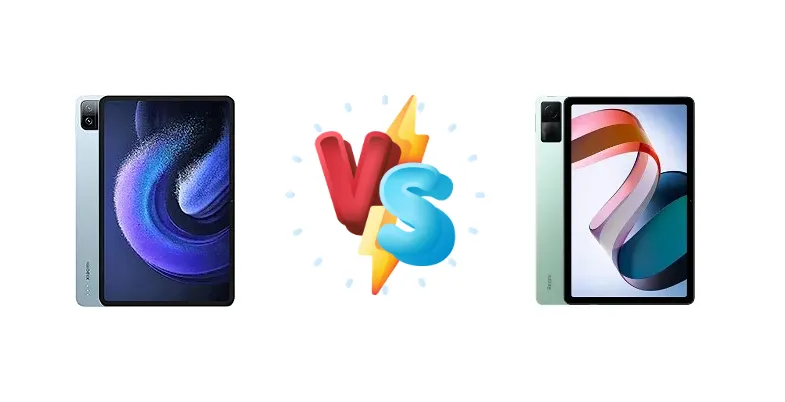
The Xiaomi Pad 6 and Redmi Pad are both compelling Android tablets, but cater to different users. The Pad 6 aims for performance and a premium experience, while the Redmi Pad prioritizes affordability and entertainment. Let's dive into a detailed comparison to see which one comes out on top.
🏆 Quick Verdict
The Xiaomi Pad 6 is the clear winner for performance and display quality, thanks to its Snapdragon 870 chipset and brighter screen. However, the Redmi Pad offers exceptional value for budget-conscious buyers seeking a solid entertainment device. Choose the Pad 6 for power, the Redmi Pad for savings.
| Network |
|---|
| 2G bands | N/A | N/A |
| 3G bands | N/A | N/A |
| 4G bands | - | N/A |
| EDGE | N/A | N/A |
| GPRS | N/A | N/A |
| Technology | No cellular connectivity | No cellular connectivity |
| Launch |
|---|
| Announced | 2023, April 18 | 2022, October 04 |
| Status | Available. Released 2023, April 18 | Available. Released 2022, October 05 |
| Body |
|---|
| Build | Glass front (Gorilla Glass 3), aluminum frame, aluminum back | Glass front, aluminum frame |
| Dimensions | 254 x 165.2 x 6.5 mm (10.0 x 6.50 x 0.26 in) | 250.5 x 158.1 x 7.1 mm (9.86 x 6.22 x 0.28 in) |
| SIM | No | No |
| Weight | 490 g (1.08 lb) | 465 g (1.03 lb) |
| | Stylus support (magnetic) | - |
| Display |
|---|
| Protection | Corning Gorilla Glass 3 | - |
| Resolution | 1800 x 2880 pixels, 16:10 ratio (~309 ppi density) | 1200 x 2000 pixels, 5:3 ratio (~220 ppi density) |
| Size | 11.0 inches, 350.9 cm2 (~83.6% screen-to-body ratio) | 10.61 inches, 320.4 cm2 (~80.9% screen-to-body ratio) |
| Type | IPS LCD, 1B colors, 144Hz, HDR10, Dolby Vision, 550 nits | IPS LCD, 1B colors, 90Hz, 400 nits (typ) |
| Platform |
|---|
| CPU | Octa-core (1x3.2 GHz Kryo 585 & 3x2.42 GHz Kryo 585 & 4x1.80 GHz Kryo 585) | Octa-core (2x2.2 GHz Cortex-A76 & 6x2.0 GHz Cortex-A55) |
| Chipset | Qualcomm SM8250-AC Snapdragon 870 5G (7 nm) | Mediatek Helio G99 (6 nm) |
| GPU | Adreno 650 | Mali-G57 MC2 |
| OS | Android 13, MIUI Pad 14 | Android 12, upgradable to Android 13, MIUI 14 |
| Memory |
|---|
| Card slot | No | microSDXC |
| Internal | 128GB 6GB RAM, 128GB 8GB RAM, 256GB 8GB RAM | 64GB 3GB RAM, 128GB 4GB RAM, 128GB 6GB RAM |
| | UFS 3.1 | UFS 2.2 |
| Main Camera |
|---|
| Features | Dual-LED flash, HDR, panorama | - |
| Single | 13 MP, f/2.2, PDAF | 8 MP, f/2.0, (wide), AF |
| Video | 4K@30fps, 1080p@30/60fps | 1080p@30fps |
| Selfie camera |
|---|
| Single | 8 MP, f/2.2, 1/4.0", 1.12µm | 8 MP, f/2.3, 105° (ultrawide) |
| Video | 1080p@30fps | 1080p@30fps |
| Sound |
|---|
| 3.5mm jack | No | No |
| 35mm jack | No | No |
| Loudspeaker | Yes, with stereo speakers (4 speakers) | Yes, with stereo speakers (4 speakers) |
| | 24-bit/192kHz audio | 24-bit/192kHz audio |
| Comms |
|---|
| Bluetooth | 5.2, A2DP, LE | 5.2, A2DP, LE |
| NFC | No | No |
| Positioning | Unspecified | No |
| Radio | No | No |
| USB | USB Type-C 3.2, accessory connector | USB Type-C, OTG |
| WLAN | Wi-Fi 802.11 a/b/g/n/a/6, dual-band, Wi-Fi Direct | Wi-Fi 802.11 a/b/g/n/ac, dual-band, Wi-Fi Direct |
| Features |
|---|
| Sensors | Accelerometer, gyro, proximity (accessories only) | Accelerometer |
| Battery |
|---|
| Charging | 33W wired, PD3.0, QC4 | 18W wired |
| Type | Li-Po 8840 mAh | Li-Po 8000 mAh |
| Misc |
|---|
| Colors | Black, Blue, Gold | Graphite Gray, Moonlight Silver, Mint Green |
| Models | 23043RP34C, 23043RP34G, 23043RP34I | 22081283G |
| Price | About 400 EUR | About 250 EUR |
| SAR EU | - | 0.36 W/kg (body) |
| Tests |
|---|
| Display | - |
Contrast ratio: 1529:1 (nominal) |
| Loudspeaker | - |
-23.9 LUFS (Very good)
|
| Performance | - |
AnTuTu: 319077 (v9)
GeekBench: 1852 (v5.1)
GFXBench: 13fps (ES 3.1 onscreen) |
Xiaomi Pad 6
- Superior Performance (Snapdragon 870)
- Brighter and Higher Quality Display
- Faster Charging (33W)
- Excellent Battery Life (9:39h active use)
- Higher Price
- Potentially Overkill for Casual Users
Xiaomi Redmi Pad
- Exceptional Value for Money
- Good Display Contrast Ratio
- Suitable for Entertainment
- Lightweight and Portable
- Lower Performance (Helio G99)
- Less Bright Display
- Slower Charging (18W)
- Less Powerful Chipset
Display Comparison
The Xiaomi Pad 6 boasts a significantly brighter display (500 nits vs 402 nits) and a higher contrast ratio (1060:1 vs 1529:1, though the Redmi Pad's is nominal). This translates to a more vibrant and immersive viewing experience, especially in well-lit environments. While the Redmi Pad's contrast ratio is impressive, the lower brightness limits its outdoor usability.
Camera Comparison
Camera quality is generally not a primary concern for tablets, but the Pad 6 likely has a slightly better camera setup. However, both devices offer adequate cameras for video calls and casual snapshots. Specific camera specs are not provided, so a direct comparison is difficult.
Performance
Here, the Xiaomi Pad 6 leaves the Redmi Pad in the dust. The Snapdragon 870 is a flagship-level chipset, offering substantially faster processing speeds and smoother multitasking compared to the Redmi Pad's Helio G99. Expect noticeably better gaming performance and quicker app loading times on the Pad 6.
Battery Life
The Xiaomi Pad 6 demonstrates excellent battery life with an active use score of 9:39h. The Redmi Pad's battery life is likely good, but not as impressive as the Pad 6, given its less efficient chipset. Charging speeds also favor the Pad 6 with 33W wired charging versus the Redmi Pad's 18W.
Buying Guide
The Xiaomi Pad 6 is ideal for students, professionals, or anyone needing a tablet for demanding tasks like gaming, video editing, or multitasking. The Xiaomi Redmi Pad is perfect for casual users, families, and those primarily using their tablet for streaming videos, browsing the web, and light gaming.
Frequently Asked Questions
❓ Is the Xiaomi Pad 6 worth the extra money?
If you prioritize performance, a vibrant display, and faster charging, then yes. The Pad 6 is a significant upgrade over the Redmi Pad. However, if you're on a budget and primarily need a tablet for entertainment, the Redmi Pad offers excellent value.
❓ Can the Redmi Pad handle gaming?
The Redmi Pad can handle casual games and less demanding titles. However, more graphically intensive games will likely experience lag and reduced performance compared to the Xiaomi Pad 6.