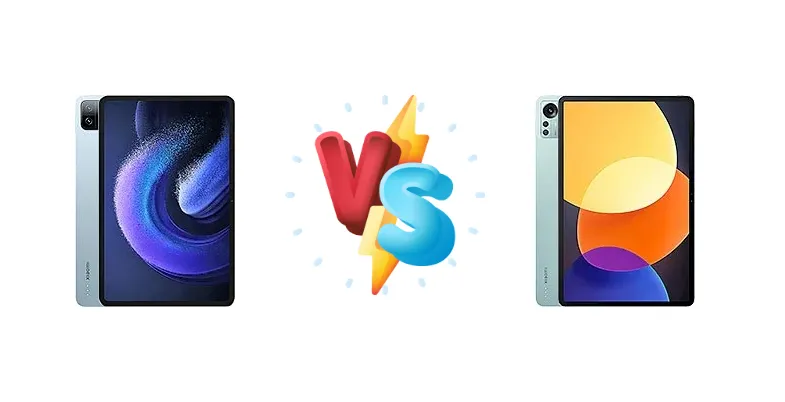
Xiaomi's tablet lineup offers compelling options for both casual users and power users. The Pad 6 brings refinements, while the Pad 5 Pro 12.4 boasts a larger display and faster charging. But which one is right for you? Let's dive into a comprehensive comparison.
🏆 Quick Verdict
The Xiaomi Pad 6 offers a more refined experience with a slightly improved display and efficient performance. However, the Pad 5 Pro 12.4’s larger screen, significantly faster charging, and potentially better speakers (based on general knowledge) make it a strong contender, especially for media consumption and productivity. It depends on your priorities.
| Network |
|---|
| 2G bands | N/A | N/A |
| 3G bands | N/A | N/A |
| 4G bands | - | N/A |
| EDGE | N/A | No |
| GPRS | N/A | No |
| Technology | No cellular connectivity | No cellular connectivity |
| Launch |
|---|
| Announced | 2023, April 18 | 2022, August 11 |
| Status | Available. Released 2023, April 18 | Available. Released 2022, August 24 |
| Body |
|---|
| Build | Glass front (Gorilla Glass 3), aluminum frame, aluminum back | Glass front (Gorilla Glass 3), aluminum frame, aluminum back |
| Dimensions | 254 x 165.2 x 6.5 mm (10.0 x 6.50 x 0.26 in) | 285 x 185.2 x 6.7 mm (11.22 x 7.29 x 0.26 in) |
| SIM | No | No |
| Weight | 490 g (1.08 lb) | 620 g (1.37 lb) |
| | Stylus support (magnetic) | Stylus support (magnetic) |
| Display |
|---|
| Protection | Corning Gorilla Glass 3 | Corning Gorilla Glass 3 |
| Resolution | 1800 x 2880 pixels, 16:10 ratio (~309 ppi density) | 1600 x 2560 pixels, 16:10 ratio (~243 ppi density) |
| Size | 11.0 inches, 350.9 cm2 (~83.6% screen-to-body ratio) | 12.4 inches, 445.8 cm2 (~84.5% screen-to-body ratio) |
| Type | IPS LCD, 1B colors, 144Hz, HDR10, Dolby Vision, 550 nits | IPS LCD, 120Hz, HDR10, Dolby Vision, 500 nits |
| Platform |
|---|
| CPU | Octa-core (1x3.2 GHz Kryo 585 & 3x2.42 GHz Kryo 585 & 4x1.80 GHz Kryo 585) | Octa-core (1x3.2 GHz Kryo 585 & 3x2.42 GHz Kryo 585 & 4x1.80 GHz Kryo 585) |
| Chipset | Qualcomm SM8250-AC Snapdragon 870 5G (7 nm) | Qualcomm SM8250-AC Snapdragon 870 5G (7 nm) |
| GPU | Adreno 650 | Adreno 650 |
| OS | Android 13, MIUI Pad 14 | Android 12, MIUI Pad 13 |
| Memory |
|---|
| Card slot | No | No |
| Internal | 128GB 6GB RAM, 128GB 8GB RAM, 256GB 8GB RAM | 128GB 6GB RAM, 256GB 8GB RAM, 512GB 12GB RAM |
| | UFS 3.1 | UFS 3.1 |
| Main Camera |
|---|
| Dual | - | 50 MP, f/1.8, 1/2.76", 0.64µm, PDAF
Auxiliary lens |
| Features | Dual-LED flash, HDR, panorama | Color spectrum sensor, LED flash, panorama, HDR |
| Single | 13 MP, f/2.2, PDAF | - |
| Video | 4K@30fps, 1080p@30/60fps | 4K@30fps, 1080p@30/60fps |
| Selfie camera |
|---|
| Single | 8 MP, f/2.2, 1/4.0", 1.12µm | 20 MP, f/2.2, 1/3.4", 0.8µm |
| Video | 1080p@30fps | 1080p@30/60fps |
| Sound |
|---|
| 3.5mm jack | No | No |
| 35mm jack | No | No |
| Loudspeaker | Yes, with stereo speakers (4 speakers) | Yes, with stereo speakers (4 speakers) |
| | 24-bit/192kHz audio | - |
| Comms |
|---|
| Bluetooth | 5.2, A2DP, LE | 5.2, A2DP, LE |
| NFC | No | No |
| Positioning | Unspecified | No |
| Radio | No | No |
| USB | USB Type-C 3.2, accessory connector | USB Type-C 3.2 video output |
| WLAN | Wi-Fi 802.11 a/b/g/n/a/6, dual-band, Wi-Fi Direct | Wi-Fi 802.11 a/b/g/n/ac/6, dual-band, Wi-Fi Direct |
| Features |
|---|
| Sensors | Accelerometer, gyro, proximity (accessories only) | Accelerometer, gyro, proximity, compass |
| Battery |
|---|
| Charging | 33W wired, PD3.0, QC4 | 67W wired, PD3.0, QC4, 60% in 36 min, 100% in 68 min |
| Type | Li-Po 8840 mAh | Li-Po 10000 mAh |
| Misc |
|---|
| Colors | Black, Blue, Gold | Black, Silver, Green |
| Models | 23043RP34C, 23043RP34G, 23043RP34I | - |
| Price | About 400 EUR | About 400 EUR |
Xiaomi Pad 6
- Refined design
- Vibrant display
- Efficient performance
- Good battery life
- Slower charging
- Smaller screen compared to Pad 5 Pro
Xiaomi Pad 5 Pro 12.4
- Large, immersive display
- Significantly faster charging
- Potentially better speakers (general knowledge)
- Good performance
- Potentially less color accurate display
- Larger size may be less portable
Display Comparison
The Xiaomi Pad 6 features a vibrant display with a 1060:1 contrast ratio and 500 nits brightness. While the Pad 5 Pro 12.4 doesn't have explicitly stated brightness figures, its 12.4-inch display offers a significantly larger canvas for viewing content and multitasking. The Pad 6's display is likely more color accurate, while the Pad 5 Pro 12.4 wins on sheer size.
Camera Comparison
Camera quality is generally not a primary concern for tablets. Both devices likely feature decent but not exceptional cameras. The Pad 5 Pro 12.4 might have a slight edge due to potentially better image processing algorithms, but this is speculative without specific camera specs.
Performance
Both tablets are powered by the Snapdragon 870 5G chipset, ensuring smooth performance for most tasks. Real-world performance differences will likely be minimal, with both handling demanding apps and games with ease. The Pad 6 might have slightly better thermal management due to its newer design.
Battery Life
The Xiaomi Pad 6 achieves a respectable 9:39 hours of active use. The Pad 5 Pro 12.4, while not having an active use score, boasts significantly faster charging (67W vs 33W), allowing it to reach 60% in 36 minutes and 100% in 68 minutes. This is a major advantage for users who need quick top-ups.
Buying Guide
The Xiaomi Pad 6 is ideal for students, casual users, and those seeking a balanced tablet experience with good performance and a vibrant display. The Xiaomi Pad 5 Pro 12.4 is best suited for users who prioritize a large screen for media consumption, productivity tasks, and appreciate rapid charging capabilities.
Frequently Asked Questions
❓ Is the Xiaomi Pad 6 worth upgrading from the Pad 5?
It depends. If you prioritize a slightly improved display and refined design, then yes. If you value a larger screen and faster charging above all else, the Pad 5 Pro 12.4 remains a strong choice.
❓ Which tablet is better for watching movies?
The Xiaomi Pad 5 Pro 12.4's larger display provides a more immersive viewing experience, making it the better choice for movies and videos.