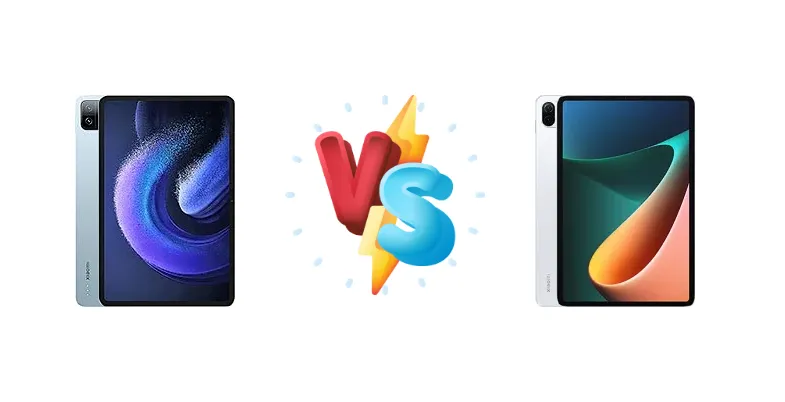
The Xiaomi Pad series has consistently delivered impressive value in the Android tablet market. Now, with the Pad 6 and the still-relevant Pad 5 Pro, choosing the right device can be tricky. This comprehensive comparison will dissect every aspect, helping you make an informed decision.
🏆 Quick Verdict
The Xiaomi Pad 6 offers incremental improvements, particularly in battery life and potentially software updates. However, the Pad 5 Pro retains its appeal with significantly faster charging. For most users, the Pad 6 is the better choice, but the 5 Pro remains a strong contender, especially if charging speed is a priority.
| Network |
|---|
| 2G bands | N/A | GSM 850 / 900 / 1800 / 1900 |
| 3G bands | N/A | HSDPA 800 / 850 / 900 / 1700(AWS) / 1900 / 2100 |
| 4G bands | - | 1, 2, 3, 4, 5, 7, 8, 9, 19, 34, 38, 39, 40, 41, 42 |
| 5G bands | - | 1, 3, 28, 41, 77, 78 Sub6 |
| EDGE | N/A | - |
| GPRS | N/A | - |
| Speed | - | HSPA, LTE, 5G - cellular model only |
| Technology | No cellular connectivity | GSM / CDMA / HSPA / EVDO / LTE / 5G |
| | - | CDMA2000 1xEV-DO |
| Launch |
|---|
| Announced | 2023, April 18 | 2021, August 10 |
| Status | Available. Released 2023, April 18 | Available. Released 2021, August 10 |
| Body |
|---|
| Build | Glass front (Gorilla Glass 3), aluminum frame, aluminum back | Glass front, aluminum frame, plastic back |
| Dimensions | 254 x 165.2 x 6.5 mm (10.0 x 6.50 x 0.26 in) | 254.7 x 166.3 x 6.9 mm (10.03 x 6.55 x 0.27 in) |
| SIM | No | Nano-SIM (cellular model only) |
| Weight | 490 g (1.08 lb) | 515 g (1.14 lb) |
| | Stylus support (magnetic) | Stylus support (magnetic) |
| Display |
|---|
| Protection | Corning Gorilla Glass 3 | - |
| Resolution | 1800 x 2880 pixels, 16:10 ratio (~309 ppi density) | 1600 x 2560 pixels, 16:10 ratio (~274 ppi density) |
| Size | 11.0 inches, 350.9 cm2 (~83.6% screen-to-body ratio) | 11.0 inches, 350.9 cm2 (~82.8% screen-to-body ratio) |
| Type | IPS LCD, 1B colors, 144Hz, HDR10, Dolby Vision, 550 nits | IPS LCD, 1B colors, 120Hz, HDR10, Dolby Vision |
| Platform |
|---|
| CPU | Octa-core (1x3.2 GHz Kryo 585 & 3x2.42 GHz Kryo 585 & 4x1.80 GHz Kryo 585) | Octa-core (1x3.2 GHz Kryo 585 & 3x2.42 GHz Kryo 585 & 4x1.80 GHz Kryo 585) |
| Chipset | Qualcomm SM8250-AC Snapdragon 870 5G (7 nm) | Qualcomm SM8250-AC Snapdragon 870 5G (7 nm) |
| GPU | Adreno 650 | Adreno 650 |
| OS | Android 13, MIUI Pad 14 | Android 11, upgradable to Android 13, MIUI 14 |
| Memory |
|---|
| Card slot | No | No |
| Internal | 128GB 6GB RAM, 128GB 8GB RAM, 256GB 8GB RAM | 128GB 6GB RAM, 256GB 6GB RAM, 256GB 8GB RAM |
| | UFS 3.1 | UFS 3.1 |
| Main Camera |
|---|
| Dual | - | 5G model:
50 MP, 1/2.5", 0.7µm, PDAF
Auxiliary lens
Wi-Fi model
13 MP, f/2.0, AF
Auxiliary lens |
| Features | Dual-LED flash, HDR, panorama | Dual-LED flash, panorama, HDR |
| Single | 13 MP, f/2.2, PDAF | - |
| Video | 4K@30fps, 1080p@30/60fps | 4K@30fps, 1080p@30fps |
| Selfie camera |
|---|
| Single | 8 MP, f/2.2, 1/4.0", 1.12µm | 8 MP, f/2.0 |
| Video | 1080p@30fps | 1080p@30fps |
| Sound |
|---|
| 3.5mm jack | No | No |
| 35mm jack | No | No |
| Loudspeaker | Yes, with stereo speakers (4 speakers) | Yes, with stereo speakers (8 speakers) |
| | 24-bit/192kHz audio | - |
| Comms |
|---|
| Bluetooth | 5.2, A2DP, LE | 5.2, A2DP, LE |
| NFC | No | No |
| Positioning | Unspecified | GPS, GLONASS, GALILEO, QZSS - cellular model only |
| Radio | No | No |
| USB | USB Type-C 3.2, accessory connector | USB Type-C |
| WLAN | Wi-Fi 802.11 a/b/g/n/a/6, dual-band, Wi-Fi Direct | Wi-Fi 802.11 a/b/g/n/ac/6, dual-band, Wi-Fi Direct |
| Features |
|---|
| Sensors | Accelerometer, gyro, proximity (accessories only) | Accelerometer, gyro, proximity, compass |
| Battery |
|---|
| Charging | 33W wired, PD3.0, QC4 | 67W wired, PD3.0, QC4 |
| Type | Li-Po 8840 mAh | Li-Po 8600 mAh |
| Misc |
|---|
| Colors | Black, Blue, Gold | Black, White |
| Models | 23043RP34C, 23043RP34G, 23043RP34I | M2105K81AC, M2105K81C |
| Price | About 400 EUR | About 330 EUR |
Xiaomi Pad 6
- Improved Battery Life
- Slightly Refined Design
- Potentially Longer Software Support
- Good Display
- Slower Charging than Pad 5 Pro
- Incremental Upgrade over Pad 5 Pro
Xiaomi Pad 5 Pro
- Faster 67W Charging
- Excellent Value (especially at discounted prices)
- Powerful Snapdragon 870
- Good Display
- Shorter Battery Life
- Potentially Less Software Support
Display Comparison
Both tablets feature a vibrant 11-inch LCD display with a 120Hz refresh rate. The Pad 6 boasts a slightly improved contrast ratio (1060:1 vs. likely around 1000:1 for the 5 Pro, based on reviews) and a measured peak brightness of 500 nits, offering marginally better outdoor visibility. However, the difference is subtle and unlikely to be a dealbreaker.
Camera Comparison
The Xiaomi Pad 5 Pro has a 13MP rear camera, while the Pad 6 also features a 13MP rear camera. Image quality is generally good for a tablet, suitable for occasional snapshots. Neither tablet excels in camera performance, but they are comparable. Front-facing cameras are also similar, adequate for video calls.
Performance
Both tablets are powered by the Snapdragon 870 5G chipset, ensuring smooth performance for everyday tasks, gaming, and multitasking. While there might be minor software optimizations in the Pad 6, the core processing power remains virtually identical. Expect excellent performance on both devices.
Battery Life
This is where the Pad 6 shines. The active use score of 9:39h demonstrates a significant improvement over the Pad 5 Pro, which typically achieves around 7-8 hours of active use. The Pad 6's larger battery capacity contributes to this extended battery life.
Buying Guide
Who should buy the Xiaomi Pad 6? Users prioritizing longer battery life, a slightly refined design, and potentially longer software support. Who should buy the Xiaomi Pad 5 Pro? Those seeking the fastest charging speeds available and a great value proposition, especially if found at a discounted price.
Frequently Asked Questions
❓ Is the Xiaomi Pad 6 a significant upgrade over the Pad 5 Pro?
It's an incremental upgrade. The biggest improvements are in battery life and potentially software support. If you already own the Pad 5 Pro, the upgrade might not be worth it unless battery life is a major concern.
❓ Which tablet is better for gaming?
Both tablets offer excellent gaming performance thanks to the Snapdragon 870. The Pad 6's slightly better display might provide a marginally improved visual experience, but the difference is minimal.