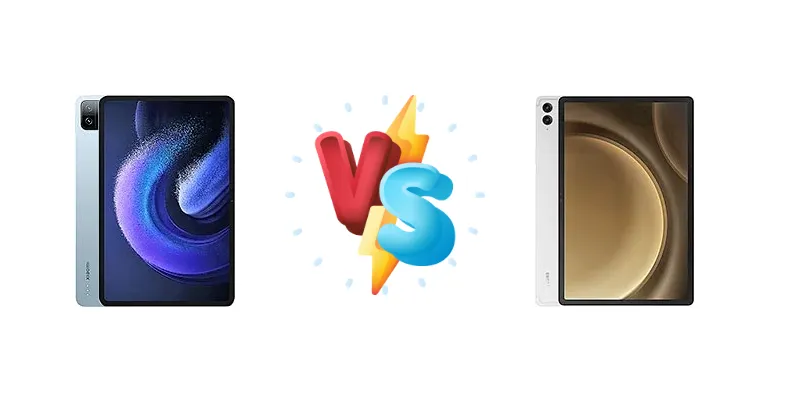
The mid-range tablet market is heating up, with the Xiaomi Pad 6 and Samsung Galaxy Tab S9 FE+ vying for dominance. The Xiaomi Pad 6 brings a flagship-level Snapdragon 870 to a more affordable price point, while the Samsung Tab S9 FE+ counters with a newer Exynos 1380 chipset and a focus on ecosystem integration. This comparison dissects their strengths and weaknesses to determine which tablet delivers the best value.
🏆 Quick Verdict
For users prioritizing raw performance and gaming, the Xiaomi Pad 6 is the clear winner thanks to its Snapdragon 870. However, the Samsung Galaxy Tab S9 FE+ offers a more balanced experience with potentially better thermal management and Samsung’s robust software features, making it ideal for everyday productivity and media consumption.
| Network |
|---|
| 2G bands | N/A | GSM 850 / 900 / 1800 / 1900 |
| 3G bands | N/A | HSDPA 850 / 900 / 1700(AWS) / 1900 / 2100 |
| 4G bands | - | 1, 2, 3, 4, 5, 7, 8, 12, 13, 17, 20, 26, 28, 32, 38, 40, 41, 66 |
| 5G bands | - | 1, 3, 5, 7, 8, 20, 28, 38, 40, 41, 66, 77, 78 SA/NSA/Sub6 |
| EDGE | N/A | - |
| GPRS | N/A | - |
| Speed | - | HSPA, LTE, 5G - cellular model only |
| Technology | No cellular connectivity | GSM / HSPA / LTE / 5G |
| Launch |
|---|
| Announced | 2023, April 18 | 2023, October 04 |
| Status | Available. Released 2023, April 18 | Available. Released 2023, October 16 |
| Body |
|---|
| Build | Glass front (Gorilla Glass 3), aluminum frame, aluminum back | Glass front, aluminum back, aluminum frame |
| Dimensions | 254 x 165.2 x 6.5 mm (10.0 x 6.50 x 0.26 in) | 285.4 x 185.4 x 6.5 mm (11.24 x 7.30 x 0.26 in) |
| SIM | No | Nano-SIM + eSIM (cellular model only) |
| Weight | 490 g (1.08 lb) | 627 g or 628 g (1.38 lb) |
| | Stylus support (magnetic) | - |
| Display |
|---|
| Protection | Corning Gorilla Glass 3 | - |
| Resolution | 1800 x 2880 pixels, 16:10 ratio (~309 ppi density) | 1600 x 2560 pixels, 16:10 ratio (~243 ppi density) |
| Size | 11.0 inches, 350.9 cm2 (~83.6% screen-to-body ratio) | 12.4 inches, 445.8 cm2 (~84.3% screen-to-body ratio) |
| Type | IPS LCD, 1B colors, 144Hz, HDR10, Dolby Vision, 550 nits | IPS LCD, 90Hz |
| Platform |
|---|
| CPU | Octa-core (1x3.2 GHz Kryo 585 & 3x2.42 GHz Kryo 585 & 4x1.80 GHz Kryo 585) | Octa-core (4x2.4 GHz Cortex-A78 & 4x2.0 GHz Cortex-A55) |
| Chipset | Qualcomm SM8250-AC Snapdragon 870 5G (7 nm) | Exynos 1380 (5 nm) |
| GPU | Adreno 650 | Mali-G68 MP5 |
| OS | Android 13, MIUI Pad 14 | Android 13, up to 4 major Android upgrades, One UI 6 |
| Memory |
|---|
| Card slot | No | microSDXC (dedicated slot) |
| Internal | 128GB 6GB RAM, 128GB 8GB RAM, 256GB 8GB RAM | 128GB 6GB RAM, 128GB 8GB RAM, 256GB 8GB RAM, 256GB 12GB RAM |
| | UFS 3.1 | - |
| Main Camera |
|---|
| Dual | - | 8 MP, (wide)
8 MP, (ultrawide) |
| Features | Dual-LED flash, HDR, panorama | - |
| Single | 13 MP, f/2.2, PDAF | - |
| Video | 4K@30fps, 1080p@30/60fps | 4K@30fps, 1080p@30fps |
| Selfie camera |
|---|
| Single | 8 MP, f/2.2, 1/4.0", 1.12µm | 12 MP, (ultrawide) |
| Video | 1080p@30fps | Yes |
| Sound |
|---|
| 3.5mm jack | No | - |
| 35mm jack | No | No |
| Loudspeaker | Yes, with stereo speakers (4 speakers) | Yes, with stereo speakers |
| | 24-bit/192kHz audio | - |
| Comms |
|---|
| Bluetooth | 5.2, A2DP, LE | 5.3, A2DP, LE |
| NFC | No | No |
| Positioning | Unspecified | GPS, GALILEO, GLONASS, BDS, QZSS - cellular model only |
| Radio | No | No |
| USB | USB Type-C 3.2, accessory connector | USB Type-C 2.0, magnetic connector |
| WLAN | Wi-Fi 802.11 a/b/g/n/a/6, dual-band, Wi-Fi Direct | Wi-Fi 802.11 a/b/g/n/ac/6, dual-band, Wi-Fi Direct |
| Features |
|---|
| Sensors | Accelerometer, gyro, proximity (accessories only) | Fingerprint (side-mounted), accelerometer, gyro, compass, proximity (accessories only) |
| Battery |
|---|
| Charging | 33W wired, PD3.0, QC4 | 45W wired, QC2.0 |
| Type | Li-Po 8840 mAh | Li-Po 10090 mAh |
| Misc |
|---|
| Colors | Black, Blue, Gold | Mint, Silver, Gray, Lavender |
| Models | 23043RP34C, 23043RP34G, 23043RP34I | SM-X610, SM-X616B |
| Price | About 400 EUR | About 770 EUR |
| SAR | - | 0.77 W/kg (body) |
| SAR EU | - | 0.50 W/kg (body) |
Xiaomi Pad 6
- Superior CPU and GPU performance with Snapdragon 870
- Excellent battery life (9:39h active use)
- Faster charging standards (PD3.0, QC4)
- Older chipset architecture
- Potential for more thermal throttling under sustained load
Samsung Galaxy Tab S9 FE+
- More power-efficient chipset (Exynos 1380, 5nm)
- Faster charging (45W)
- Samsung ecosystem integration and software support
- Lower peak CPU and GPU performance
- Battery life potentially lower under heavy load
Display Comparison
Both tablets feature large displays suitable for media consumption, but differ in key specs. The Xiaomi Pad 6 boasts a measured peak brightness of 500 nits and a 1060:1 contrast ratio, providing a vibrant viewing experience. While the Tab S9 FE+’s display specs aren’t provided, Samsung typically employs excellent LCD panels. The Xiaomi Pad 6’s contrast ratio suggests deeper blacks, enhancing video content. The lack of LTPO technology in either tablet means refresh rates are likely fixed, impacting battery life during dynamic content. Bezels appear comparable based on available imagery, and color accuracy will likely be strong on both, though independent testing is needed to confirm.
Camera Comparison
Neither tablet is positioned as a photography powerhouse, but camera quality is still relevant for video calls and quick scans. Details on camera sensors are limited. The Samsung Tab S9 FE+ is likely to have a more refined image processing pipeline, leveraging Samsung’s expertise in mobile photography. Given the market segment, expect similar results in good lighting conditions, but the Xiaomi Pad 6 may struggle more in low-light scenarios. Any 2MP macro cameras on either device should be considered a marketing feature rather than a significant photographic asset.
Performance
The core difference lies in the chipsets. The Xiaomi Pad 6’s Snapdragon 870 5G (7nm) is a proven performer, featuring an octa-core configuration with a prime core clocked at 3.2 GHz. This is a generation older than the Exynos 1380 (5nm) in the Tab S9 FE+, but the Snapdragon 870 generally offers superior GPU performance. The Exynos 1380 utilizes a more modern CPU architecture (Cortex-A78 & A55) but its clock speeds are lower (2.4 GHz peak). The 5nm process of the Exynos 1380 *should* offer better power efficiency, potentially leading to less thermal throttling during sustained workloads. However, the Snapdragon 870’s raw power will likely translate to faster app loading and smoother multitasking. RAM configurations are not specified, but LPDDR5 or LPDDR5x is expected on both.
Battery Life
The Xiaomi Pad 6 achieves an impressive 9:39h of active use, demonstrating good battery optimization despite its powerful processor. The Samsung Tab S9 FE+’s battery capacity isn’t specified, but its Exynos 1380’s 5nm process *could* lead to longer battery life under lighter workloads. The Xiaomi Pad 6 supports 33W wired charging with PD3.0 and QC4, while the Tab S9 FE+ offers 45W charging with QC2.0. This means the Tab S9 FE+ should charge faster, potentially offsetting any battery capacity differences. The faster charging is a significant advantage for users who need to quickly top up their device.
Buying Guide
Buy the Xiaomi Pad 6 if you need a tablet that can handle demanding games and applications without breaking the bank. Its Snapdragon 870 provides a significant performance edge. Buy the Samsung Galaxy Tab S9 FE+ if you prefer a tablet deeply integrated with the Samsung ecosystem, value longer-term software support, and prioritize a potentially cooler operating temperature during extended use.
Frequently Asked Questions
❓ Does the Exynos 1380 in the Samsung Tab S9 FE+ overheat during prolonged gaming sessions?
While the Exynos 1380 is a power-efficient chip, sustained gaming can still generate heat. However, the 5nm process and Samsung’s thermal management solutions *should* mitigate throttling better than the Snapdragon 870 in the Xiaomi Pad 6, potentially leading to more consistent performance over longer periods. Independent thermal testing is needed for a definitive answer.
❓ How does the Snapdragon 870 handle demanding games like Genshin Impact or Call of Duty Mobile on the Xiaomi Pad 6?
The Snapdragon 870 is well-equipped to handle demanding games. Expect high frame rates at medium to high settings. However, prolonged gaming may lead to some thermal throttling, potentially reducing sustained performance. The Xiaomi Pad 6’s cooling solution will play a crucial role in managing temperatures.
❓ Is the Samsung Tab S9 FE+ compatible with the S Pen, and does it offer the same features as the Galaxy Tab S8?
Yes, the Samsung Galaxy Tab S9 FE+ is compatible with the S Pen, though it uses a slightly different S Pen than the higher-end Galaxy Tab S8 series. It supports features like Air Actions and handwriting-to-text conversion, making it a valuable tool for note-taking and creative tasks. However, some advanced S Pen features exclusive to the S8 may be absent.