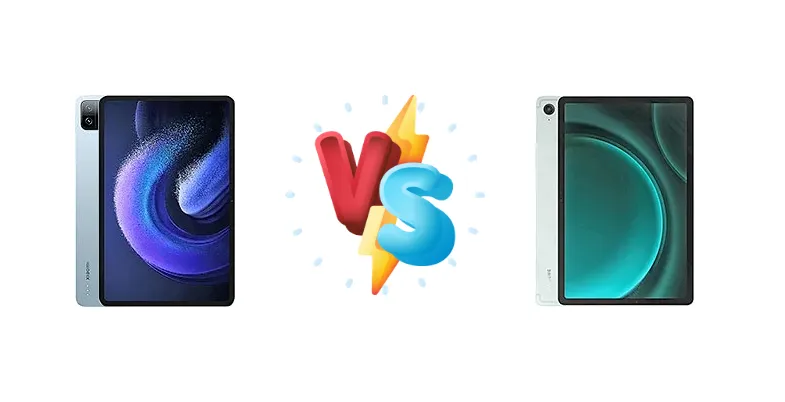
The mid-range Android tablet space is heating up, with the Xiaomi Pad 6 and Samsung Galaxy Tab S9 FE offering compelling features at competitive prices. The Pad 6 leverages the proven Snapdragon 870, while the Tab S9 FE opts for Samsung’s in-house Exynos 1380. This comparison dives deep into the architectural differences and real-world implications to determine which tablet delivers the best experience.
🏆 Quick Verdict
For users prioritizing raw performance and sustained gaming, the Xiaomi Pad 6 emerges as the winner. Its Snapdragon 870 chipset, despite being older, offers a noticeable performance edge. However, the Samsung Galaxy Tab S9 FE provides a more balanced package with potentially better efficiency and Samsung’s ecosystem integration.
| Network |
|---|
| 2G bands | N/A | GSM 850 / 900 / 1800 / 1900 |
| 3G bands | N/A | HSDPA 850 / 900 / 1700(AWS) / 1900 / 2100 |
| 4G bands | - | 1, 2, 3, 4, 5, 7, 8, 12, 13, 17, 20, 26, 28, 32, 38, 40, 41, 66 |
| 5G bands | - | 1, 3, 5, 7, 8, 20, 28, 38, 40, 41, 66, 77, 78 SA/NSA/Sub6 |
| EDGE | N/A | - |
| GPRS | N/A | - |
| Speed | - | HSPA, LTE, 5G - cellular model only |
| Technology | No cellular connectivity | GSM / HSPA / LTE / 5G |
| Launch |
|---|
| Announced | 2023, April 18 | 2023, October 04 |
| Status | Available. Released 2023, April 18 | Available. Released 2023, October 16 |
| Body |
|---|
| Build | Glass front (Gorilla Glass 3), aluminum frame, aluminum back | Glass front, aluminum back, aluminum frame |
| Dimensions | 254 x 165.2 x 6.5 mm (10.0 x 6.50 x 0.26 in) | 254.3 x 165.8 x 6.5 mm (10.01 x 6.53 x 0.26 in) |
| SIM | No | Nano-SIM + eSIM (cellular model only) |
| Weight | 490 g (1.08 lb) | 523 g or 524 g (1.15 lb) |
| | Stylus support (magnetic) | - |
| Display |
|---|
| Protection | Corning Gorilla Glass 3 | - |
| Resolution | 1800 x 2880 pixels, 16:10 ratio (~309 ppi density) | 1440 x 2304 pixels, 16:10 ratio (~249 ppi density) |
| Size | 11.0 inches, 350.9 cm2 (~83.6% screen-to-body ratio) | 10.9 inches, 344.5 cm2 (~81.7% screen-to-body ratio) |
| Type | IPS LCD, 1B colors, 144Hz, HDR10, Dolby Vision, 550 nits | IPS LCD, 90Hz |
| Platform |
|---|
| CPU | Octa-core (1x3.2 GHz Kryo 585 & 3x2.42 GHz Kryo 585 & 4x1.80 GHz Kryo 585) | Octa-core (4x2.4 GHz Cortex-A78 & 4x2.0 GHz Cortex-A55) |
| Chipset | Qualcomm SM8250-AC Snapdragon 870 5G (7 nm) | Exynos 1380 (5 nm) |
| GPU | Adreno 650 | Mali-G68 MP5 |
| OS | Android 13, MIUI Pad 14 | Android 13, up to 4 major Android upgrades, One UI 6 |
| Memory |
|---|
| Card slot | No | microSDXC (dedicated slot) |
| Internal | 128GB 6GB RAM, 128GB 8GB RAM, 256GB 8GB RAM | 128GB 6GB RAM, 128GB 8GB RAM, 256GB 8GB RAM |
| | UFS 3.1 | - |
| Main Camera |
|---|
| Features | Dual-LED flash, HDR, panorama | - |
| Single | 13 MP, f/2.2, PDAF | 8 MP, (wide) |
| Video | 4K@30fps, 1080p@30/60fps | 4K@30fps, 1080p@30fps |
| Selfie camera |
|---|
| Single | 8 MP, f/2.2, 1/4.0", 1.12µm | 12 MP, (ultrawide) |
| Video | 1080p@30fps | Yes |
| Sound |
|---|
| 3.5mm jack | No | - |
| 35mm jack | No | No |
| Loudspeaker | Yes, with stereo speakers (4 speakers) | Yes, with stereo speakers |
| | 24-bit/192kHz audio | - |
| Comms |
|---|
| Bluetooth | 5.2, A2DP, LE | 5.3, A2DP, LE |
| NFC | No | No |
| Positioning | Unspecified | GPS, GALILEO, GLONASS, BDS, QZSS - cellular model only |
| Radio | No | No |
| USB | USB Type-C 3.2, accessory connector | USB Type-C 2.0, magnetic connector |
| WLAN | Wi-Fi 802.11 a/b/g/n/a/6, dual-band, Wi-Fi Direct | Wi-Fi 802.11 a/b/g/n/ac/6, dual-band, Wi-Fi Direct |
| Features |
|---|
| Sensors | Accelerometer, gyro, proximity (accessories only) | Fingerprint (side-mounted), accelerometer, gyro, compass, proximity (accessories only) |
| Battery |
|---|
| Charging | 33W wired, PD3.0, QC4 | 45W wired, QC2.0 |
| Type | Li-Po 8840 mAh | Li-Po 8000 mAh |
| Misc |
|---|
| Colors | Black, Blue, Gold | Mint, Silver, Gray, Lavender |
| Models | 23043RP34C, 23043RP34G, 23043RP34I | SM-X510, SM-X516B |
| Price | About 400 EUR | About 300 EUR |
| SAR | - | 1.55 W/kg (body) |
| SAR EU | - | 0.59 W/kg (body) |
Xiaomi Pad 6
- Superior CPU performance with Snapdragon 870
- Excellent battery life (9:39h active use)
- Faster charging support (PD3.0, QC4)
- Display brightness could be higher
- Camera specs are unknown
Samsung Galaxy Tab S9 FE
- Potentially better power efficiency with Exynos 1380
- Faster charging (45W)
- Samsung ecosystem integration
- Likely lower peak performance compared to Snapdragon 870
- Display specs are unknown
Display Comparison
Both tablets feature 11-inch displays, but key differences lie in their characteristics. The Xiaomi Pad 6 boasts a measured peak brightness of 500 nits and a 1060:1 contrast ratio, providing a vibrant viewing experience. While the Tab S9 FE’s display specs aren’t provided, Samsung typically employs excellent LCD panels. The lack of LTPO technology in either tablet means refresh rates are likely fixed, impacting power consumption during dynamic content. The Xiaomi Pad 6’s contrast ratio suggests deeper blacks, potentially enhancing media consumption.
Camera Comparison
Neither tablet is positioned as a photography powerhouse, but camera quality matters for quick scans and video calls. Without detailed camera specs for the Tab S9 FE, it’s difficult to make a direct comparison. However, given Samsung’s history, the Tab S9 FE likely benefits from more sophisticated image processing. The Xiaomi Pad 6’s camera specs are not provided, so we can only assume a standard configuration for this price point. Focusing on the primary sensor quality will be more impactful than any secondary macro lens.
Performance
The core of the difference lies in the chipsets. The Xiaomi Pad 6’s Snapdragon 870 5G (7nm) is an octa-core processor with a Kryo 585 architecture, offering a strong balance of performance and efficiency. The Samsung Galaxy Tab S9 FE utilizes the Exynos 1380 (5nm), also an octa-core chip, but with a different core configuration (4x2.4 GHz Cortex-A78 & 4x2.0 GHz Cortex-A55). The 5nm process of the Exynos 1380 *should* translate to better power efficiency, but the Snapdragon 870’s more aggressive clock speeds and mature architecture often result in superior sustained performance. The Snapdragon 870’s Adreno 660 GPU is also likely to outperform the Mali-G68 MP5 in the Exynos 1380, benefiting gaming.
Battery Life
The Xiaomi Pad 6 achieves an impressive 9:39h of active use, demonstrating good battery optimization despite the powerful Snapdragon 870. The Samsung Galaxy Tab S9 FE’s battery capacity isn’t specified, but its Exynos 1380’s 5nm process *should* contribute to longer runtimes. The Tab S9 FE supports 45W wired charging with QC2.0, while the Pad 6 offers 33W charging with PD3.0 and QC4. This means the Tab S9 FE will likely charge faster, offsetting any potential battery capacity disadvantage.
Buying Guide
Buy the Xiaomi Pad 6 if you need a tablet for demanding tasks like gaming, video editing, or running multiple apps simultaneously. Its Snapdragon 870 provides the horsepower for these workloads. Buy the Samsung Galaxy Tab S9 FE if you prioritize battery life, seamless integration with other Samsung devices, and a more refined software experience, even if it means sacrificing some peak performance.
Frequently Asked Questions
❓ Does the Exynos 1380 in the Tab S9 FE tend to overheat during prolonged gaming sessions?
While the Exynos 1380 is efficient, sustained high loads can lead to thermal throttling. However, the Tab S9 FE’s larger chassis may provide better heat dissipation compared to some smartphones with the same chipset. It’s unlikely to reach critical temperatures, but performance may dip slightly after extended gaming.
❓ Is the Snapdragon 870 in the Xiaomi Pad 6 still a relevant chipset in 2024?
Absolutely. The Snapdragon 870 remains a very capable chipset, offering performance comparable to newer mid-range chips. Its mature architecture and efficient design ensure smooth performance in most applications and even demanding games. It’s a testament to Qualcomm’s engineering that it still holds up so well.
❓ What kind of storage and RAM options are available for each tablet?
While not specified in the provided data, both tablets are likely to offer multiple configurations. The Xiaomi Pad 6 typically comes in 6GB/8GB RAM and 128GB/256GB storage options. The Samsung Galaxy Tab S9 FE is expected to offer similar configurations, potentially with a 128GB/256GB storage and 6GB/8GB RAM options.