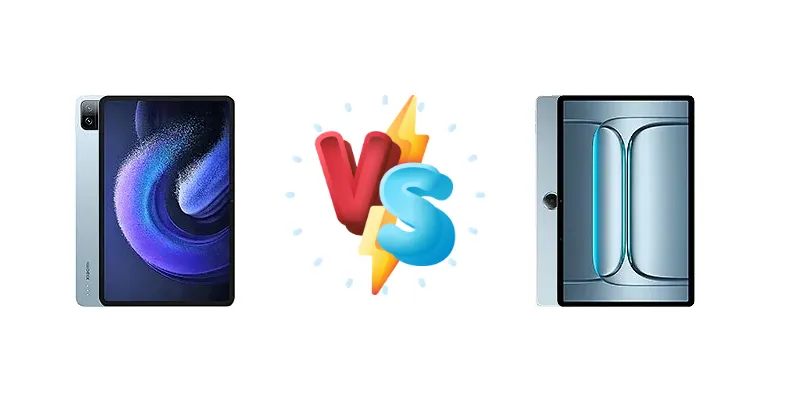
The Android tablet market is heating up, with Xiaomi and OnePlus both offering compelling options at competitive price points. The Xiaomi Pad 6, leveraging the proven Snapdragon 870, faces off against the newer OnePlus Pad Lite, powered by the Mediatek Helio G100. This comparison dives deep into the specifications and real-world implications to determine which tablet best suits your needs.
🏆 Quick Verdict
For users prioritizing performance and a brighter display, the Xiaomi Pad 6 is the clear winner. Its Snapdragon 870 chipset delivers significantly more processing power, making it ideal for demanding tasks and gaming. However, the OnePlus Pad Lite offers a viable alternative for casual users seeking a more affordable option.
| Network |
|---|
| 2G bands | N/A | GSM 850 / 900 / 1800 / 1900 - cellular model only |
| 3G bands | N/A | HSDPA 850 / 900 / 2100 - cellular model only |
| 4G bands | - | LTE - cellular model only |
| EDGE | N/A | - |
| GPRS | N/A | - |
| Speed | - | HSPA, LTE - cellular model only |
| Technology | No cellular connectivity | GSM / HSPA / LTE |
| Launch |
|---|
| Announced | 2023, April 18 | 2025, July 08 |
| Status | Available. Released 2023, April 18 | Available. Released 2025, August 14 |
| Body |
|---|
| Build | Glass front (Gorilla Glass 3), aluminum frame, aluminum back | - |
| Dimensions | 254 x 165.2 x 6.5 mm (10.0 x 6.50 x 0.26 in) | 254.9 x 166.5 x 7.4 mm (10.04 x 6.56 x 0.29 in) |
| SIM | No | Yes - cellular model only |
| Weight | 490 g (1.08 lb) | 530 g (1.17 lb) |
| | Stylus support (magnetic) | - |
| Display |
|---|
| Protection | Corning Gorilla Glass 3 | - |
| Resolution | 1800 x 2880 pixels, 16:10 ratio (~309 ppi density) | 1200 x 1920 pixels, 16:10 ratio (~207 ppi density) |
| Size | 11.0 inches, 350.9 cm2 (~83.6% screen-to-body ratio) | 11.0 inches, 347.5 cm2 (~81.9% screen-to-body ratio) |
| Type | IPS LCD, 1B colors, 144Hz, HDR10, Dolby Vision, 550 nits | IPS LCD, 1B colors, 90Hz, 500 nits |
| Platform |
|---|
| CPU | Octa-core (1x3.2 GHz Kryo 585 & 3x2.42 GHz Kryo 585 & 4x1.80 GHz Kryo 585) | Octa-core (2x2.2 GHz Cortex-A76 & 6x2.0 GHz Cortex-A55) |
| Chipset | Qualcomm SM8250-AC Snapdragon 870 5G (7 nm) | Mediatek Helio G100 (6 nm) |
| GPU | Adreno 650 | Mali-G57 MC2 |
| OS | Android 13, MIUI Pad 14 | Android 15, OxygenOS 15 |
| Memory |
|---|
| Card slot | No | Unspecified |
| Internal | 128GB 6GB RAM, 128GB 8GB RAM, 256GB 8GB RAM | 128GB 6GB RAM, 128GB 8GB RAM |
| | UFS 3.1 | - |
| Main Camera |
|---|
| Features | Dual-LED flash, HDR, panorama | - |
| Single | 13 MP, f/2.2, PDAF | 5 MP |
| Video | 4K@30fps, 1080p@30/60fps | 1080p@30fps |
| Selfie camera |
|---|
| Single | 8 MP, f/2.2, 1/4.0", 1.12µm | 5 MP |
| Video | 1080p@30fps | 1080p@30fps |
| Sound |
|---|
| 3.5mm jack | No | - |
| 35mm jack | No | No |
| Loudspeaker | Yes, with stereo speakers (4 speakers) | Yes, with stereo speakers (4 speakers, Hi-Res audio) |
| | 24-bit/192kHz audio | - |
| Comms |
|---|
| Bluetooth | 5.2, A2DP, LE | 5.2, A2DP, LE, aptX HD |
| NFC | No | No |
| Positioning | Unspecified | GPS, (cellular model only) - unconfirmed |
| Radio | No | No |
| USB | USB Type-C 3.2, accessory connector | USB Type-C 2.0 |
| WLAN | Wi-Fi 802.11 a/b/g/n/a/6, dual-band, Wi-Fi Direct | Wi-Fi 802.11 a/b/g/n/ac, dual-band |
| Features |
|---|
| Sensors | Accelerometer, gyro, proximity (accessories only) | Unspecified |
| Battery |
|---|
| Charging | 33W wired, PD3.0, QC4 | 33W wired |
| Type | Li-Po 8840 mAh | Li-Po 9340 mAh |
| Misc |
|---|
| Colors | Black, Blue, Gold | Aero Blue |
| Models | 23043RP34C, 23043RP34G, 23043RP34I | OPD2480 |
| Price | About 400 EUR | About 200 EUR |
Xiaomi Pad 6
- Superior performance with Snapdragon 870
- Brighter and higher contrast display
- Longer battery life in active use
- Potentially higher price point
- May run slightly warmer under heavy load
OnePlus Pad Lite
- More affordable price
- Decent performance for everyday tasks
- Fast 33W charging
- Significantly less powerful processor
- Likely dimmer display
- Potentially limited multitasking capabilities
Display Comparison
The Xiaomi Pad 6 boasts a display capable of reaching 500 nits of peak brightness, ensuring comfortable viewing even in well-lit environments. While the OnePlus Pad Lite’s brightness isn’t specified, it’s likely lower, potentially impacting outdoor visibility. The Xiaomi Pad 6’s 1060:1 contrast ratio suggests deeper blacks and more vibrant colors, enhancing the overall viewing experience. Both tablets likely utilize IPS LCD panels, but the Xiaomi Pad 6’s superior brightness and contrast give it a distinct advantage for multimedia consumption and creative work.
Camera Comparison
Neither tablet is positioned as a photography powerhouse, and detailed camera specs are limited. Given the market segment, image quality will likely be similar for basic snapshots. Focusing on the chipset's ISP capabilities, the Snapdragon 870 in the Xiaomi Pad 6 offers more advanced image processing potential, potentially resulting in slightly better dynamic range and noise reduction. However, for typical tablet use cases – video calls and occasional photos – the difference will be minimal.
Performance
The core difference lies in the chipsets. The Xiaomi Pad 6’s Qualcomm Snapdragon 870 5G (7nm) is a significantly more powerful processor than the OnePlus Pad Lite’s Mediatek Helio G100 (6nm). The Snapdragon 870’s octa-core configuration (1x3.2 GHz Kryo 585, 3x2.42 GHz Kryo 585, 4x1.80 GHz Kryo 585) provides a substantial performance uplift over the Helio G100’s (2x2.2 GHz Cortex-A76, 6x2.0 GHz Cortex-A55). This translates to faster app loading times, smoother multitasking, and a more responsive user experience. The Snapdragon 870 also benefits from a more mature and optimized GPU, making the Xiaomi Pad 6 the superior choice for gaming. While the Helio G100 is a capable chip, it’s geared towards more casual use cases.
Battery Life
The Xiaomi Pad 6 achieves an impressive 9:39 hours of active use, demonstrating excellent battery efficiency despite its powerful processor. While the OnePlus Pad Lite’s battery capacity isn’t specified, both tablets share the same 33W wired charging capability with PD3.0 and QC4 support on the Xiaomi Pad 6. This means similar charging speeds, likely reaching a full charge in around 60-75 minutes. The Xiaomi Pad 6’s longer active use time suggests better overall battery optimization, allowing for extended use between charges.
Buying Guide
Buy the Xiaomi Pad 6 if you need a tablet capable of handling demanding applications, multitasking, and gaming without compromise. It’s the choice for power users and those who value a brighter, more vibrant display. Buy the OnePlus Pad Lite if you prioritize affordability and primarily use your tablet for media consumption, light browsing, and basic productivity tasks. It’s a solid option for students or families on a budget.
Frequently Asked Questions
❓ Will the Snapdragon 870 in the Xiaomi Pad 6 handle demanding games like Genshin Impact at high settings?
Yes, the Snapdragon 870 is capable of running Genshin Impact and other graphically intensive games at high settings, though you may need to adjust some settings for optimal frame rates. Its Adreno 660 GPU provides ample graphical horsepower for a smooth gaming experience.
❓ Is the Mediatek Helio G100 in the OnePlus Pad Lite sufficient for streaming video and browsing the web?
Absolutely. The Helio G100 is more than capable of handling everyday tasks like streaming video (Netflix, YouTube) and web browsing without any noticeable lag or stuttering. It’s designed for efficient performance in these common use cases.
❓ Does the Xiaomi Pad 6 support stylus input and keyboard accessories?
Yes, the Xiaomi Pad 6 supports stylus input (sold separately) and is compatible with keyboard accessories, transforming it into a more versatile productivity device. This expands its functionality beyond media consumption.
❓ What type of storage does the OnePlus Pad Lite use, and is it expandable?
The OnePlus Pad Lite utilizes UFS 2.2 storage for fast app loading and file transfer speeds. However, it does *not* offer microSD card expansion, so you'll need to choose a storage capacity that meets your long-term needs.