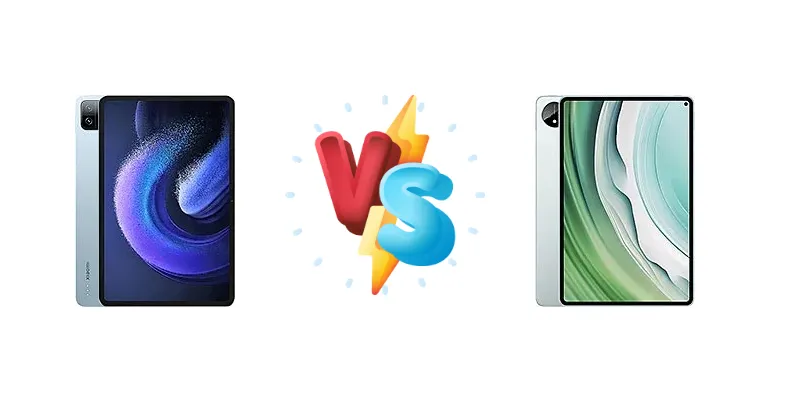
The Android tablet market is heating up, with the Xiaomi Pad 6 offering a compelling blend of performance and value, while the Huawei MatePad Pro 11 (2024) aims for a more premium experience with its in-house Kirin 9000S chipset. This comparison dissects the key differences between these two devices, helping you determine which one best suits your needs.
🏆 Quick Verdict
For most users, the Xiaomi Pad 6 delivers a superior balance of performance and price. Its Snapdragon 870 5G chipset provides ample power for everyday tasks and gaming, coupled with a respectable 9:39h active use battery life. While the Huawei MatePad Pro 11 boasts faster 66W charging, the Kirin 9000S doesn't demonstrably outperform the Snapdragon 870 in typical tablet workloads, making the Xiaomi Pad 6 the more sensible choice.
| Network |
|---|
| 2G bands | N/A | N/A |
| 3G bands | N/A | N/A |
| 4G bands | - | N/A |
| EDGE | N/A | No |
| GPRS | N/A | No |
| Technology | No cellular connectivity | No cellular connectivity |
| Launch |
|---|
| Announced | 2023, April 18 | 2023, November 28 |
| Status | Available. Released 2023, April 18 | Available. Released 2023, December 18 |
| Body |
|---|
| Build | Glass front (Gorilla Glass 3), aluminum frame, aluminum back | - |
| Dimensions | 254 x 165.2 x 6.5 mm (10.0 x 6.50 x 0.26 in) | 249.2 x 160.4 x 5.9 mm (9.81 x 6.31 x 0.23 in) |
| SIM | No | No |
| Weight | 490 g (1.08 lb) | 449 g g cellular model) (15.84 oz) |
| | Stylus support (magnetic) | - |
| Display |
|---|
| Protection | Corning Gorilla Glass 3 | - |
| Resolution | 1800 x 2880 pixels, 16:10 ratio (~309 ppi density) | 2560 x 1600 pixels, 16:10 ratio (~274 ppi density) |
| Size | 11.0 inches, 350.9 cm2 (~83.6% screen-to-body ratio) | 11.0 inches, 350.9 cm2 (~87.8% screen-to-body ratio) |
| Type | IPS LCD, 1B colors, 144Hz, HDR10, Dolby Vision, 550 nits | OLED, 1B colors, 120Hz, 600 nits (typ) |
| Platform |
|---|
| CPU | Octa-core (1x3.2 GHz Kryo 585 & 3x2.42 GHz Kryo 585 & 4x1.80 GHz Kryo 585) | Octa-core (1x2.49 GHz Taishan Big & 3x2.15 GHz Taishan Mid & 4x1.53GHz Cortex-A510) |
| Chipset | Qualcomm SM8250-AC Snapdragon 870 5G (7 nm) | Kirin 9000S (7 nm) |
| GPU | Adreno 650 | Maleoon 910 MP4 |
| OS | Android 13, MIUI Pad 14 | HarmonyOS 4.0 |
| Memory |
|---|
| Card slot | No | No |
| Internal | 128GB 6GB RAM, 128GB 8GB RAM, 256GB 8GB RAM | 128GB 8GB RAM, 256GB 8GB RAM, 256GB 12GB RAM, 512GB 12GB RAM |
| | UFS 3.1 | - |
| Main Camera |
|---|
| Dual | - | 13 MP, f/1.8, (wide), PDAF
8 MP, f/2.2, (ultrawide) |
| Features | Dual-LED flash, HDR, panorama | LED flash, HDR, panorama |
| Single | 13 MP, f/2.2, PDAF | - |
| Video | 4K@30fps, 1080p@30/60fps | 4K@30fps, 1080p@30fps |
| Selfie camera |
|---|
| Single | 8 MP, f/2.2, 1/4.0", 1.12µm | 16 MP, f/2.2 |
| Video | 1080p@30fps | 1080p@30fps |
| Sound |
|---|
| 3.5mm jack | No | - |
| 35mm jack | No | No |
| Loudspeaker | Yes, with stereo speakers (4 speakers) | Yes, with stereo speakers (6 speakers) |
| | 24-bit/192kHz audio | - |
| Comms |
|---|
| Bluetooth | 5.2, A2DP, LE | 5.2, A2DP, LE |
| NFC | No | No |
| Positioning | Unspecified | GPS, GLONASS, BDS, GALILEO, QZSS |
| Radio | No | No |
| USB | USB Type-C 3.2, accessory connector | USB Type-C 3.1, OTG |
| WLAN | Wi-Fi 802.11 a/b/g/n/a/6, dual-band, Wi-Fi Direct | Wi-Fi 802.11 a/b/g/n/ac, dual-band |
| Features |
|---|
| Sensors | Accelerometer, gyro, proximity (accessories only) | Accelerometer, gyro, proximity (accessories only), compass |
| Battery |
|---|
| Charging | 33W wired, PD3.0, QC4 | 66W wired
5W reverse wired |
| Type | Li-Po 8840 mAh | Li-Po 8300 mAh |
| Misc |
|---|
| Colors | Black, Blue, Gold | Gray, Blue, White, Black |
| Models | 23043RP34C, 23043RP34G, 23043RP34I | XYAO-W00 |
| Price | About 400 EUR | About 540 EUR |
Xiaomi Pad 6
- Excellent value for money
- Proven Snapdragon 870 performance
- Long battery life (9:39h active use)
- 33W charging is slower than the competition
- Display specs are limited beyond brightness and contrast
Huawei MatePad Pro 11 (2024)
- Ultra-fast 66W wired charging
- 5W reverse wired charging
- Huawei’s software ecosystem (for existing users)
- Kirin 9000S performance doesn't justify the price premium
- Battery life data is unavailable
Display Comparison
Both tablets feature 11-inch displays, but detailed display specifications beyond the Xiaomi Pad 6’s measured 500 nits and 1060:1 contrast ratio are unavailable for the Huawei MatePad Pro 11. The Xiaomi Pad 6’s 500 nits ensures adequate visibility indoors, while the high contrast ratio delivers vibrant visuals. Without comparable data for the Huawei, it’s difficult to assess potential advantages like color gamut coverage or panel technology (LTPO). The Xiaomi Pad 6’s contrast ratio suggests a good quality IPS panel, suitable for media consumption and general use.
Camera Comparison
Camera performance is unlikely to be a deciding factor for most tablet buyers. Neither device is positioned as a photography powerhouse. Without detailed camera specifications for the Huawei MatePad Pro 11, it’s difficult to make a meaningful comparison. We can assume both tablets will offer adequate cameras for video calls and casual snapshots, but don't expect flagship-level image quality. Focusing on the primary sensor resolution and aperture would be crucial for a more detailed assessment.
Performance
The core of the performance difference lies in the chipsets. The Xiaomi Pad 6 utilizes the Qualcomm Snapdragon 870 5G (7nm), an octa-core processor known for its efficiency and capable performance. The Huawei MatePad Pro 11 (2024) counters with the Kirin 9000S (7nm). While both are fabricated on a 7nm process, the architectural differences are key. The Snapdragon 870’s Kryo 585 cores offer a balanced approach, while the Kirin 9000S employs a tri-cluster configuration with Taishan cores. However, in real-world tablet usage, the Snapdragon 870’s mature optimization and established driver support often translate to smoother performance in demanding applications and games. The lack of LPDDR5x RAM specifications for the Huawei further complicates a direct comparison.
Battery Life
The Xiaomi Pad 6 shines in battery endurance, achieving an impressive 9:39h of active use. The Huawei MatePad Pro 11 (2024) lacks published battery life data, but its 66W wired charging is a significant advantage over the Xiaomi Pad 6’s 33W charging. This means the Huawei can replenish its battery much faster, potentially mitigating any capacity differences. The inclusion of 5W reverse wired charging on the Huawei is a niche feature, useful for topping up accessories but unlikely to be a primary selling point.
Buying Guide
Buy the Xiaomi Pad 6 if you prioritize value, a proven chipset with strong gaming performance, and a long-lasting battery. It’s ideal for students, casual gamers, and anyone seeking a versatile tablet without breaking the bank. Buy the Huawei MatePad Pro 11 (2024) if you specifically need the fastest possible charging speeds and prefer Huawei’s software ecosystem, understanding that the performance gains over the Xiaomi Pad 6 are minimal for the price difference.
Frequently Asked Questions
❓ Does the Kirin 9000S in the Huawei MatePad Pro 11 offer a noticeable gaming advantage over the Snapdragon 870 in the Xiaomi Pad 6?
While the Kirin 9000S is a capable chipset, benchmarks and real-world testing suggest that the Snapdragon 870 in the Xiaomi Pad 6 delivers comparable, and often smoother, gaming performance due to its mature optimization and driver support. The difference isn't substantial enough to justify the price premium for gaming alone.
❓ How long does it take to fully charge the Xiaomi Pad 6 with its 33W charger?
While a precise 0-100% charging time isn't available, based on 33W charging standards and the tablet's battery capacity, a full charge is estimated to take approximately 2-2.5 hours. This is slower than the Huawei MatePad Pro 11's 66W charging, but still reasonable for overnight charging.
❓ Is the lack of Google Mobile Services (GMS) on the Huawei MatePad Pro 11 a significant drawback?
Yes, the absence of GMS is a major consideration. While Huawei offers its AppGallery and allows sideloading of apps, the experience isn't as seamless as having access to the Google Play Store. Many popular apps may not be readily available or require workarounds.