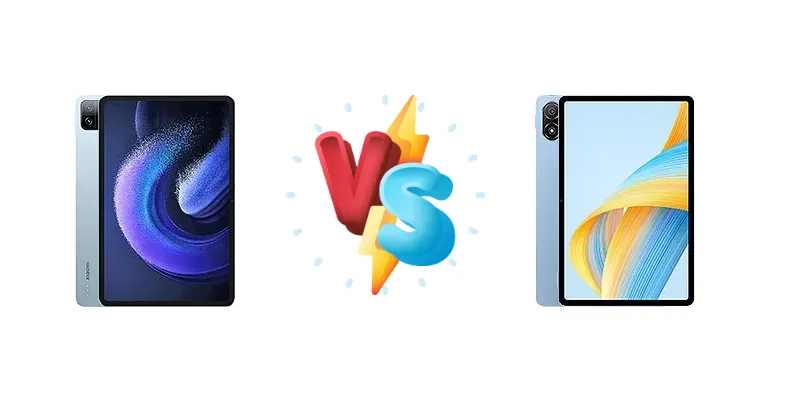
The Android tablet market is heating up, with the Xiaomi Pad 6 and Honor Pad V8 Pro offering compelling features at competitive price points. While both aim to deliver a premium experience, they take different approaches to achieving it. The Xiaomi Pad 6 leverages the proven Snapdragon 870, while the Honor Pad V8 Pro opts for the newer Mediatek Dimensity 8100. This comparison will dissect their strengths and weaknesses to determine which tablet best suits your needs.
🏆 Quick Verdict
For the average user prioritizing sustained performance and a well-rounded experience, the Honor Pad V8 Pro emerges as the winner. Its Dimensity 8100 chipset, built on a 5nm process, offers a performance edge and potentially better thermal management compared to the Xiaomi Pad 6’s Snapdragon 870. However, the Xiaomi Pad 6 remains a strong contender, especially for those seeking a familiar Qualcomm ecosystem.
| Network |
|---|
| 2G bands | N/A | N/A |
| 3G bands | N/A | N/A |
| 4G bands | - | N/A |
| EDGE | N/A | N/A |
| GPRS | N/A | N/A |
| Technology | No cellular connectivity | No cellular connectivity |
| Launch |
|---|
| Announced | 2023, April 18 | 2022, December 26 |
| Status | Available. Released 2023, April 18 | Available. Released 2022, December 30 |
| Body |
|---|
| Build | Glass front (Gorilla Glass 3), aluminum frame, aluminum back | Glass front, aluminum frame, aluminum back or eco leather back |
| Dimensions | 254 x 165.2 x 6.5 mm (10.0 x 6.50 x 0.26 in) | 277 x 179 x 6.6 mm or 7 mm |
| SIM | No | No |
| Weight | 490 g (1.08 lb) | 589 g or 599 g (1.30 lb) |
| | Stylus support (magnetic) | Honor Pencil 3 (15ms latency) |
| Display |
|---|
| Protection | Corning Gorilla Glass 3 | - |
| Resolution | 1800 x 2880 pixels, 16:10 ratio (~309 ppi density) | 2560 x 1600 pixels, 16:10 ratio (~249 ppi density) |
| Size | 11.0 inches, 350.9 cm2 (~83.6% screen-to-body ratio) | 12.1 inches, 424.5 cm2 (~85.6% screen-to-body ratio) |
| Type | IPS LCD, 1B colors, 144Hz, HDR10, Dolby Vision, 550 nits | IPS LCD, 1B colors, 144Hz, 600 nits |
| | - | IMAX enhanced |
| Platform |
|---|
| CPU | Octa-core (1x3.2 GHz Kryo 585 & 3x2.42 GHz Kryo 585 & 4x1.80 GHz Kryo 585) | Octa-core (4x2.85 GHz Cortex-A78 & 4x2.0 GHz Cortex-A55) |
| Chipset | Qualcomm SM8250-AC Snapdragon 870 5G (7 nm) | Mediatek Dimensity 8100 (5 nm) |
| GPU | Adreno 650 | Mali-G610 MC6 |
| OS | Android 13, MIUI Pad 14 | Android 12, MagicOS 7 |
| Memory |
|---|
| Card slot | No | No |
| Internal | 128GB 6GB RAM, 128GB 8GB RAM, 256GB 8GB RAM | 128GB 8GB RAM, 256GB 8GB RAM, 256GB 12GB RAM |
| | UFS 3.1 | - |
| Main Camera |
|---|
| Features | Dual-LED flash, HDR, panorama | LED flash, HDR |
| Single | 13 MP, f/2.2, PDAF | 13 MP, f/2.0, (wide), 1/3.0", AF |
| Video | 4K@30fps, 1080p@30/60fps | 4K@30fps, 1080p@30fps |
| Selfie camera |
|---|
| Single | 8 MP, f/2.2, 1/4.0", 1.12µm | 5 MP, f/2.2 |
| Video | 1080p@30fps | 1080p@30fps |
| Sound |
|---|
| 3.5mm jack | No | No |
| 35mm jack | No | No |
| Loudspeaker | Yes, with stereo speakers (4 speakers) | Yes, with stereo speakers (8 speakers) |
| | 24-bit/192kHz audio | 24-bit/192kHz audio |
| Comms |
|---|
| Bluetooth | 5.2, A2DP, LE | 5.2, A2DP, LE |
| NFC | No | No |
| Positioning | Unspecified | GPS, GLONASS, BDS |
| Radio | No | No |
| USB | USB Type-C 3.2, accessory connector | USB Type-C, magnetic connector |
| WLAN | Wi-Fi 802.11 a/b/g/n/a/6, dual-band, Wi-Fi Direct | Wi-Fi 802.11 a/b/g/n/ac/6, dual-band |
| Features |
|---|
| Sensors | Accelerometer, gyro, proximity (accessories only) | Accelerometer |
| Battery |
|---|
| Charging | 33W wired, PD3.0, QC4 | 35W wired |
| Type | Li-Po 8840 mAh | Li-Po 10050 mAh |
| Misc |
|---|
| Colors | Black, Blue, Gold | Grey, Blue, Orange |
| Models | 23043RP34C, 23043RP34G, 23043RP34I | ROD-W09 |
| Price | About 400 EUR | About 350 EUR |
Xiaomi Pad 6
- Proven Snapdragon 870 performance
- Excellent battery life (9:39h active use)
- Supports fast charging standards (PD3.0, QC4)
- Older 7nm fabrication process
- Display specifications lack detail (refresh rate, color gamut)
Honor Pad V8 Pro
- More modern Dimensity 8100 chipset (5nm)
- Potentially better thermal management
- Slightly faster 35W charging
- Battery life data unavailable
- Display specifications are unknown
Display Comparison
The Xiaomi Pad 6 boasts a display capable of reaching 500 nits of peak brightness, providing adequate visibility in most indoor environments. However, the Honor Pad V8 Pro’s display specifications are currently unavailable, making a direct brightness comparison difficult. The Xiaomi Pad 6’s 1060:1 contrast ratio suggests good image quality, but without knowing the panel technology (e.g., IPS, LCD) or color gamut coverage of the Honor Pad V8 Pro, it’s hard to assess which offers superior visual fidelity. The absence of refresh rate data for both tablets is a notable omission, impacting smoothness during scrolling and gaming.
Camera Comparison
Unfortunately, detailed camera specifications for both tablets are lacking. Without information on sensor size, aperture, or image processing capabilities, a meaningful comparison is impossible. Given the tablet form factor, camera quality is typically not a primary concern for most users, but the absence of this data hinders a complete assessment. We can assume both tablets will feature adequate cameras for video conferencing and casual snapshots, but neither is likely to compete with flagship smartphone cameras.
Performance
The core of the difference lies in the chipsets. The Honor Pad V8 Pro’s Mediatek Dimensity 8100 (5nm) utilizes a more modern architecture than the Xiaomi Pad 6’s Qualcomm Snapdragon 870 (7nm). The Dimensity 8100’s octa-core configuration (4x2.85 GHz Cortex-A78 & 4x2.0 GHz Cortex-A55) is designed for peak performance, while the Snapdragon 870 (1x3.2 GHz Kryo 585 & 3x2.42 GHz Kryo 585 & 4x1.80 GHz Kryo 585) balances performance and efficiency. The 5nm fabrication process of the Dimensity 8100 generally translates to better power efficiency and potentially less thermal throttling under sustained load, crucial for extended gaming sessions. While the Snapdragon 870 remains a capable performer, the Dimensity 8100 offers a clear architectural advantage.
Battery Life
The Xiaomi Pad 6 delivers an impressive 9:39 hours of active use, demonstrating strong battery optimization. The Honor Pad V8 Pro’s battery capacity and real-world usage time are unknown. However, the Dimensity 8100’s 5nm process could contribute to improved power efficiency, potentially offsetting a smaller battery capacity. The Xiaomi Pad 6 supports 33W wired charging with PD3.0 and QC4, while the Honor Pad V8 Pro offers 35W wired charging. The slight charging speed advantage of the Honor Pad V8 Pro is unlikely to be a significant differentiator in everyday use.
Buying Guide
Buy the Xiaomi Pad 6 if you need a reliable tablet with a proven chipset and a focus on all-day battery life, and you value the Qualcomm ecosystem. It’s ideal for students, casual gamers, and media consumers. Buy the Honor Pad V8 Pro if you prioritize raw processing power for demanding tasks like video editing or graphically intensive games, and you want a tablet that can potentially handle future software updates with ease. It’s best suited for power users and creative professionals.
Frequently Asked Questions
❓ Will the Snapdragon 870 in the Xiaomi Pad 6 throttle during extended gaming sessions?
The Snapdragon 870 is a capable chip, but its 7nm process means it's more prone to thermal throttling than the 5nm Dimensity 8100 in the Honor Pad V8 Pro. While the Xiaomi Pad 6 will handle most games well, you might experience performance dips during prolonged, graphically demanding titles.
❓ Does the Mediatek Dimensity 8100 in the Honor Pad V8 Pro support ray tracing?
The Mediatek Dimensity 8100 does *not* natively support hardware-accelerated ray tracing. While it's a powerful chip, this feature is currently limited to Qualcomm's Snapdragon 8 Gen 1 and newer chipsets.
❓ Is the 35W charging on the Honor Pad V8 Pro significantly faster than the 33W charging on the Xiaomi Pad 6?
The difference of 2W in charging wattage is unlikely to result in a noticeable difference in charging times. Both tablets offer relatively fast charging, but the actual 0-100% time will depend on factors like battery temperature and charging protocol.