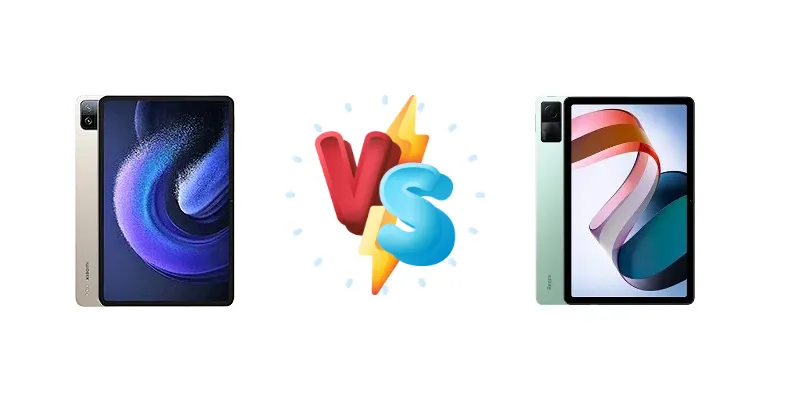
The tablet market is heating up, and Xiaomi is a major player. The Xiaomi Pad 6 Pro and Redmi Pad offer compelling options, but cater to different users. This comprehensive comparison will dissect their strengths and weaknesses to help you choose the perfect device for your needs.
🏆 Quick Verdict
The Xiaomi Pad 6 Pro is the clear winner for performance and features, boasting a flagship Snapdragon processor and faster charging. However, the Redmi Pad offers incredible value for budget-conscious users seeking a capable entertainment device. It depends on your priorities and budget.
| Network |
|---|
| 2G bands | N/A | N/A |
| 3G bands | N/A | N/A |
| 4G bands | - | N/A |
| EDGE | N/A | N/A |
| GPRS | N/A | N/A |
| Technology | No cellular connectivity | No cellular connectivity |
| Launch |
|---|
| Announced | 2023, April 18 | 2022, October 04 |
| Status | Available. Released 2023, April 30 | Available. Released 2022, October 05 |
| Body |
|---|
| Build | Glass front (Gorilla Glass 3), aluminum frame, aluminum back | Glass front, aluminum frame |
| Dimensions | 254 x 165.2 x 6.5 mm (10.0 x 6.50 x 0.26 in) | 250.5 x 158.1 x 7.1 mm (9.86 x 6.22 x 0.28 in) |
| SIM | No | No |
| Weight | 490 g (1.08 lb) | 465 g (1.03 lb) |
| | Stylus support (magnetic) | - |
| Display |
|---|
| Protection | Corning Gorilla Glass 3 | - |
| Resolution | 1800 x 2880 pixels, 16:10 ratio (~309 ppi density) | 1200 x 2000 pixels, 5:3 ratio (~220 ppi density) |
| Size | 11.0 inches, 350.9 cm2 (~83.6% screen-to-body ratio) | 10.61 inches, 320.4 cm2 (~80.9% screen-to-body ratio) |
| Type | IPS LCD, 1B colors, 144Hz, HDR10, Dolby Vision, 550 nits | IPS LCD, 1B colors, 90Hz, 400 nits (typ) |
| Platform |
|---|
| CPU | Octa-core (1x3.19 GHz Cortex-X2 & 3x2.75 GHz Cortex-A710 & 4x1.80 GHz Cortex-A510) | Octa-core (2x2.2 GHz Cortex-A76 & 6x2.0 GHz Cortex-A55) |
| Chipset | Qualcomm SM8475 Snapdragon 8+ Gen 1 (4 nm) | Mediatek Helio G99 (6 nm) |
| GPU | Adreno 730 | Mali-G57 MC2 |
| OS | Android 13, MIUI 14 | Android 12, upgradable to Android 13, MIUI 14 |
| Memory |
|---|
| Card slot | No | microSDXC |
| Internal | 128GB 8GB RAM, 256GB 8GB RAM, 256GB 12GB RAM, 512GB 12GB RAM | 64GB 3GB RAM, 128GB 4GB RAM, 128GB 6GB RAM |
| | UFS 3.1 | UFS 2.2 |
| Main Camera |
|---|
| Dual | 50 MP, f/1.8, (wide), 1/2.76", 0.64µm, PDAF
Auxiliary lens | - |
| Features | Dual-LED flash, HDR, panorama | - |
| Single | - | 8 MP, f/2.0, (wide), AF |
| Video | 4K@30/60fps, 1080p@30/60fps | 1080p@30fps |
| Selfie camera |
|---|
| Single | 20 MP, f/2.2, (wide), 1/3.4", 0.8µm | 8 MP, f/2.3, 105° (ultrawide) |
| Video | 1080p@30/60fps | 1080p@30fps |
| Sound |
|---|
| 3.5mm jack | No | No |
| 35mm jack | No | No |
| Loudspeaker | Yes, with stereo speakers (4 speakers) | Yes, with stereo speakers (4 speakers) |
| | 24-bit/192kHz audio | 24-bit/192kHz audio |
| Comms |
|---|
| Bluetooth | 5.3, A2DP, LE | 5.2, A2DP, LE |
| NFC | No | No |
| Positioning | No | No |
| Radio | No | No |
| USB | USB Type-C 3.2, accessory connector | USB Type-C, OTG |
| WLAN | Wi-Fi 802.11 a/b/g/n/a/6e, dual-band, Wi-Fi Direct | Wi-Fi 802.11 a/b/g/n/ac, dual-band, Wi-Fi Direct |
| Features |
|---|
| Sensors | Accelerometer, gyro, proximity (accessories only) | Accelerometer |
| Battery |
|---|
| Charging | 67W wired, PD3.0, QC4, 100% in 1 hour | 18W wired |
| Type | Li-Po 8600 mAh | Li-Po 8000 mAh |
| Misc |
|---|
| Colors | Black, Blue, Gold | Graphite Gray, Moonlight Silver, Mint Green |
| Models | 23046RP50C | 22081283G |
| Price | About 330 EUR | About 250 EUR |
| SAR EU | - | 0.36 W/kg (body) |
| Tests |
|---|
| Display | - |
Contrast ratio: 1529:1 (nominal) |
| Loudspeaker | - |
-23.9 LUFS (Very good)
|
| Performance | - |
AnTuTu: 319077 (v9)
GeekBench: 1852 (v5.1)
GFXBench: 13fps (ES 3.1 onscreen) |
Xiaomi Pad 6 Pro
- Flagship Snapdragon 8+ Gen 1 processor
- Fast 67W charging
- Likely superior display quality
- Better camera performance
- Higher price point
- Potentially less focus on budget-friendly features
Xiaomi Redmi Pad
- Excellent value for money
- Good display for the price
- Sufficient performance for casual use
- Compact and portable
- Less powerful chipset
- Slower 18W charging
- Lower camera quality
- May struggle with demanding tasks
Display Comparison
The Redmi Pad features a 1529:1 contrast ratio display with 402 nits brightness, offering decent visuals for the price. The Pad 6 Pro likely has a slightly better display with improved color accuracy and potentially higher brightness (though specific specs are not provided). Both offer a good viewing experience for media consumption.
Camera Comparison
While neither tablet is a photography powerhouse, the Pad 6 Pro likely has a slightly better camera system due to its higher-end chipset and potentially better sensors. Expect improved image processing and low-light performance. The Redmi Pad's camera is adequate for basic video calls and casual snapshots.
Performance
Here's where the Pad 6 Pro truly shines. The Snapdragon 8+ Gen 1 is a flagship-level chipset, delivering significantly faster performance than the Redmi Pad's Helio G99. Expect smoother multitasking, faster app loading times, and a much better gaming experience on the Pad 6 Pro.
Battery Life
Both tablets offer respectable battery life. However, the Pad 6 Pro's 67W fast charging is a significant advantage, allowing for much quicker top-ups compared to the Redmi Pad's 18W charging. Expect roughly 8-10 hours of typical usage on both devices.
Buying Guide
The Xiaomi Pad 6 Pro is ideal for power users, students, and creatives who need a fast, responsive tablet for demanding tasks like gaming, video editing, and multitasking. The Xiaomi Redmi Pad is perfect for casual users, families, and those seeking an affordable tablet for media consumption, browsing, and light productivity.
Frequently Asked Questions
❓ Is the Xiaomi Pad 6 Pro worth the extra money?
If you prioritize performance, fast charging, and a potentially better display, then yes. The Snapdragon 8+ Gen 1 makes a significant difference.
❓ What is the Redmi Pad best used for?
The Redmi Pad is ideal for streaming videos, browsing the web, playing casual games, and general entertainment. It's a great option for families and students on a budget.
❓ Does the Xiaomi Pad 6 Pro support a stylus?
Yes, the Xiaomi Pad 6 Pro supports the Xiaomi Smart Pen (sold separately), enhancing its productivity capabilities.