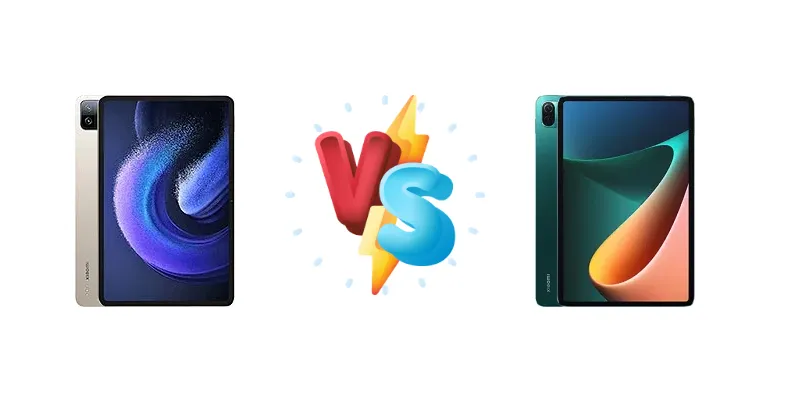
The Xiaomi Pad series has consistently delivered impressive value in the Android tablet market. But with the newer Pad 6 Pro now available, is it worth the upgrade over the still-capable Pad 5? This comprehensive comparison will help you decide which tablet best suits your needs and budget.
🏆 Quick Verdict
The Xiaomi Pad 6 Pro is the clear winner, boasting a significantly faster Snapdragon 8+ Gen 1 chipset, faster charging, and likely improved display technology. However, the Pad 5 remains a compelling option for budget-conscious users who don't need the absolute latest performance.
| Network |
|---|
| 2G bands | N/A | N/A |
| 3G bands | N/A | N/A |
| EDGE | N/A | N/A |
| GPRS | N/A | N/A |
| Technology | No cellular connectivity | No cellular connectivity |
| Launch |
|---|
| Announced | 2023, April 18 | 2021, August 10 |
| Status | Available. Released 2023, April 30 | Available. Released 2021, August 10 |
| Body |
|---|
| Build | Glass front (Gorilla Glass 3), aluminum frame, aluminum back | Glass front, aluminum frame, plastic back |
| Dimensions | 254 x 165.2 x 6.5 mm (10.0 x 6.50 x 0.26 in) | 254.7 x 166.3 x 6.9 mm (10.03 x 6.55 x 0.27 in) |
| SIM | No | No |
| Weight | 490 g (1.08 lb) | 511 g (1.13 lb) |
| | Stylus support (magnetic) | Stylus support (magnetic) |
| Display |
|---|
| Protection | Corning Gorilla Glass 3 | - |
| Resolution | 1800 x 2880 pixels, 16:10 ratio (~309 ppi density) | 1600 x 2560 pixels, 16:10 ratio (~274 ppi density) |
| Size | 11.0 inches, 350.9 cm2 (~83.6% screen-to-body ratio) | 11.0 inches, 350.9 cm2 (~82.8% screen-to-body ratio) |
| Type | IPS LCD, 1B colors, 144Hz, HDR10, Dolby Vision, 550 nits | IPS LCD, 1B colors, 120Hz, HDR10, Dolby Vision |
| Platform |
|---|
| CPU | Octa-core (1x3.19 GHz Cortex-X2 & 3x2.75 GHz Cortex-A710 & 4x1.80 GHz Cortex-A510) | Octa-core (1x2.96 GHz Kryo 485 Gold & 3x2.42 GHz Kryo 485 Gold & 4x1.78 GHz Kryo 485 Silver) |
| Chipset | Qualcomm SM8475 Snapdragon 8+ Gen 1 (4 nm) | Qualcomm Snapdragon 860 (7 nm) |
| GPU | Adreno 730 | Adreno 640 |
| OS | Android 13, MIUI 14 | Android 11, upgradable to Android 13, MIUI 14 |
| Memory |
|---|
| Card slot | No | No |
| Internal | 128GB 8GB RAM, 256GB 8GB RAM, 256GB 12GB RAM, 512GB 12GB RAM | 128GB 6GB RAM, 256GB 6GB RAM |
| | UFS 3.1 | UFS 3.1 |
| Main Camera |
|---|
| Dual | 50 MP, f/1.8, (wide), 1/2.76", 0.64µm, PDAF
Auxiliary lens | - |
| Features | Dual-LED flash, HDR, panorama | Dual-LED flash, HDR, panorama |
| Single | - | 13 MP, f/2.0 |
| Video | 4K@30/60fps, 1080p@30/60fps | 4K@30fps, 1080p@30fps |
| Selfie camera |
|---|
| Single | 20 MP, f/2.2, (wide), 1/3.4", 0.8µm | 8 MP, f/2.0 |
| Video | 1080p@30/60fps | 1080p@30fps |
| Sound |
|---|
| 3.5mm jack | No | No |
| 35mm jack | No | No |
| Loudspeaker | Yes, with stereo speakers (4 speakers) | Yes, with stereo speakers (4 speakers) |
| | 24-bit/192kHz audio | 24-bit/192kHz audio |
| Comms |
|---|
| Bluetooth | 5.3, A2DP, LE | 5.0, A2DP, LE |
| NFC | No | No |
| Positioning | No | No |
| Radio | No | No |
| USB | USB Type-C 3.2, accessory connector | USB Type-C |
| WLAN | Wi-Fi 802.11 a/b/g/n/a/6e, dual-band, Wi-Fi Direct | Wi-Fi 802.11 a/b/g/n/ac, dual-band, Wi-Fi Direct |
| Features |
|---|
| Sensors | Accelerometer, gyro, proximity (accessories only) | Accelerometer, gyro, proximity, compass |
| Battery |
|---|
| Charging | 67W wired, PD3.0, QC4, 100% in 1 hour | 33W wired, PD3.0 |
| Type | Li-Po 8600 mAh | Li-Po 8720 mAh |
| Misc |
|---|
| Colors | Black, Blue, Gold | Cosmic Gray, Pearl White, Green |
| Models | 23046RP50C | 21051182G, 21051182C |
| Price | About 330 EUR | About 350 EUR |
| Tests |
|---|
| Display | - |
Contrast ratio: 1271:1 (nominal) |
| Loudspeaker | - |
-24.4 LUFS (Very good)
|
| Performance | - |
AnTuTu: 473819 (v8), 555079 (v9)
GeekBench: 2583 (v5.1)
GFXBench: 24fps (ES 3.1 onscreen) |
Xiaomi Pad 6 Pro
- Significantly faster performance
- Faster 67W charging
- Likely improved display (brighter, higher refresh rate)
- Premium build quality (expected)
- Higher price
- Potentially less storage options at lower price points
Xiaomi Pad 5
- More affordable
- Still a capable performer for everyday tasks
- Good display quality
- Reliable brand
- Slower performance compared to the Pro
- Slower 33W charging
- Older chipset
Display Comparison
The Xiaomi Pad 6 Pro is expected to have a brighter display with potentially better color accuracy and a higher refresh rate (likely 120Hz) compared to the Pad 5's 60Hz. Both tablets offer a 1271:1 contrast ratio, but the Pro's increased brightness will likely result in a more vibrant and enjoyable viewing experience, especially outdoors. The Pad 5's 478 nits is a decent brightness, but the Pro should surpass it.
Camera Comparison
While neither tablet is a photography powerhouse, the Pad 6 Pro is likely to have a slightly improved camera system. Expect better image processing and potentially slightly better low-light performance. However, tablet cameras are rarely a primary concern for most users.
Performance
This is where the Pad 6 Pro truly shines. The Snapdragon 8+ Gen 1 is a substantial upgrade over the Snapdragon 860. Expect significantly faster app loading times, smoother multitasking, and a much better gaming experience on the Pro. The 860 in the Pad 5 is still capable, but it will show its age when handling more demanding applications.
Battery Life
The Pad 6 Pro's battery capacity is likely similar to the Pad 5 (around 8720mAh), but the faster charging (67W vs 33W) means it will charge significantly quicker. Expect roughly similar battery life under typical usage, but the Pro offers the convenience of rapid charging.
Buying Guide
Who should buy the Xiaomi Pad 6 Pro? Power users, gamers, and anyone needing a responsive tablet for demanding tasks like video editing or graphic design. Who should buy the Xiaomi Pad 5? Students, casual users, and those seeking a reliable tablet for media consumption and light productivity on a tighter budget.
Frequently Asked Questions
❓ Is the Xiaomi Pad 6 Pro worth the upgrade from the Pad 5?
If you prioritize performance, faster charging, and a potentially better display, then yes. However, if you're on a budget and primarily use your tablet for basic tasks, the Pad 5 remains a solid choice.
❓ What is the difference in performance between the Snapdragon 8+ Gen 1 and the Snapdragon 860?
The Snapdragon 8+ Gen 1 offers a significant performance boost, roughly 30-40% faster in CPU and GPU benchmarks, resulting in smoother multitasking and better gaming performance.