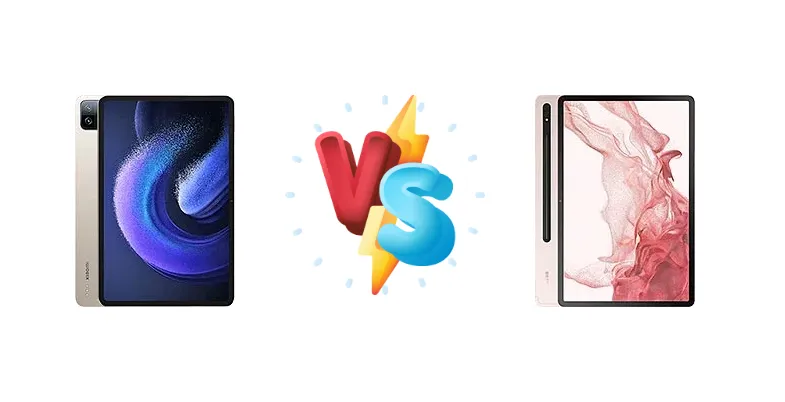
The Android tablet market is heating up, and two contenders are vying for the top spot: the Xiaomi Pad 6 Pro and the Samsung Galaxy Tab S8+. Both offer premium features and impressive performance, but which one truly delivers the best experience? Let's dive into a comprehensive comparison to help you decide.
🏆 Quick Verdict
The Xiaomi Pad 6 Pro offers exceptional value with its Snapdragon 8+ Gen 1 chipset and blazing-fast 67W charging. The Samsung Galaxy Tab S8+ boasts a superior display and S Pen support, but comes at a higher price. For raw power and charging speed, the Xiaomi wins; for a more complete premium experience, the Samsung takes the lead.
| Network |
|---|
| 2G bands | N/A | GSM 850 / 900 / 1800 / 1900 |
| 3G bands | N/A | HSDPA 850 / 900 / 1700(AWS) / 1900 / 2100 |
| 4G bands | - | LTE |
| 5G bands | - | SA/NSA |
| EDGE | N/A | - |
| GPRS | N/A | - |
| Speed | - | HSPA, LTE, 5G - cellular model only |
| Technology | No cellular connectivity | GSM / HSPA / LTE / 5G |
| Launch |
|---|
| Announced | 2023, April 18 | 2022, February 09 |
| Status | Available. Released 2023, April 30 | Available. Released 2022, April 14 |
| Body |
|---|
| Build | Glass front (Gorilla Glass 3), aluminum frame, aluminum back | - |
| Dimensions | 254 x 165.2 x 6.5 mm (10.0 x 6.50 x 0.26 in) | 285 x 185 x 5.7 mm (11.22 x 7.28 x 0.22 in) |
| SIM | No | Nano-SIM (cellular model only) |
| Weight | 490 g (1.08 lb) | 567 g (Wi-Fi), 572 g (5G) (1.25 lb) |
| | Stylus support (magnetic) | Stylus, 6.2ms latency (Bluetooth integration, accelerometer, gyro) |
| Display |
|---|
| Protection | Corning Gorilla Glass 3 | Corning Gorilla Glass 5 |
| Resolution | 1800 x 2880 pixels, 16:10 ratio (~309 ppi density) | 1752 x 2800 pixels, 16:10 ratio (~266 ppi density) |
| Size | 11.0 inches, 350.9 cm2 (~83.6% screen-to-body ratio) | 12.4 inches, 446.1 cm2 (~84.6% screen-to-body ratio) |
| Type | IPS LCD, 1B colors, 144Hz, HDR10, Dolby Vision, 550 nits | Super AMOLED, 120Hz, HDR10+ |
| Platform |
|---|
| CPU | Octa-core (1x3.19 GHz Cortex-X2 & 3x2.75 GHz Cortex-A710 & 4x1.80 GHz Cortex-A510) | Octa-core (1x3.00 GHz Cortex-X2 & 3x2.50 GHz Cortex-A710 & 4x1.80 GHz Cortex-A510) |
| Chipset | Qualcomm SM8475 Snapdragon 8+ Gen 1 (4 nm) | Qualcomm SM8450 Snapdragon 8 Gen 1 (4 nm) |
| GPU | Adreno 730 | Adreno 730 |
| OS | Android 13, MIUI 14 | Android 12, up to 4 major Android upgrades, One UI 6.1.1 |
| Memory |
|---|
| Card slot | No | microSDXC (dedicated slot) |
| Internal | 128GB 8GB RAM, 256GB 8GB RAM, 256GB 12GB RAM, 512GB 12GB RAM | 128GB 8GB RAM, 256GB 8GB RAM, 256GB 12GB RAM, 512GB 8GB RAM, 512GB 16GB RAM |
| | UFS 3.1 | UFS |
| Main Camera |
|---|
| Dual | 50 MP, f/1.8, (wide), 1/2.76", 0.64µm, PDAF
Auxiliary lens | 13 MP, f/2.0, 26mm (wide), 1/3.4", 1.0µm, AF
6 MP, f/2.2, (ultrawide) |
| Features | Dual-LED flash, HDR, panorama | LED flash, HDR, panorama |
| Video | 4K@30/60fps, 1080p@30/60fps | 4K@30/60fps, 1080p@30fps |
| Selfie camera |
|---|
| Dual | - | 12 MP, f/2.4, 120˚ (ultrawide) |
| Features | - | HDR |
| Single | 20 MP, f/2.2, (wide), 1/3.4", 0.8µm | - |
| Video | 1080p@30/60fps | 4K@30/60fps, 1080p@30fps |
| Sound |
|---|
| 3.5mm jack | No | No |
| 35mm jack | No | No |
| Loudspeaker | Yes, with stereo speakers (4 speakers) | Yes, with stereo speakers (4 speakers) |
| | 24-bit/192kHz audio | Tuned by AKG |
| Comms |
|---|
| Bluetooth | 5.3, A2DP, LE | 5.2, A2DP, LE |
| NFC | No | No |
| Positioning | No | GPS, GLONASS, BDS, GALILEO - cellular model only |
| Radio | No | No |
| USB | USB Type-C 3.2, accessory connector | USB Type-C 3.2, magnetic connector |
| WLAN | Wi-Fi 802.11 a/b/g/n/a/6e, dual-band, Wi-Fi Direct | Wi-Fi 802.11 a/b/g/n/ac/6e, dual-band, Wi-Fi Direct |
| Features |
|---|
| Sensors | Accelerometer, gyro, proximity (accessories only) | Fingerprint (under display, optical), accelerometer, gyro, proximity, compass |
| | - | Wireless Samsung DeX |
| Battery |
|---|
| Charging | 67W wired, PD3.0, QC4, 100% in 1 hour | 45W wired, 100% in 82 min |
| Type | Li-Po 8600 mAh | Li-Po 10090 mAh |
| Misc |
|---|
| Colors | Black, Blue, Gold | Graphite, Silver, Pink Gold |
| Models | 23046RP50C | SM-X800, SM-X806, SM-X806B, SM-X806U, SM-X806N |
| Price | About 330 EUR | About 950 EUR |
| SAR EU | - | 0.68 W/kg (body) |
Xiaomi Pad 6 Pro
- Exceptional performance (Snapdragon 8+ Gen 1)
- Blazing-fast 67W charging
- High refresh rate display (144Hz)
- Excellent value for money
- Good audio quality
- LCD display (not as vibrant as AMOLED)
- Camera performance is average
- Software experience can be slightly less polished than Samsung's
Samsung Galaxy Tab S8+
- Stunning Super AMOLED display (120Hz)
- S Pen support for creativity and productivity
- Excellent camera quality
- Premium design and build quality
- Samsung's One UI software experience
- Slower charging speed (45W)
- Higher price point
- Performance slightly behind the Xiaomi Pad 6 Pro
Display Comparison
The Samsung Galaxy Tab S8+ features a vibrant 12.4-inch Super AMOLED display with a 120Hz refresh rate, offering exceptional color accuracy and deep blacks. The Xiaomi Pad 6 Pro has an 11-inch LCD display with a 144Hz refresh rate, providing smooth visuals but lacking the AMOLED's contrast. Samsung wins here.
Camera Comparison
The Samsung Galaxy Tab S8+ generally has better camera quality, with improved image processing and more versatile shooting options. While neither tablet excels in photography, the Samsung's cameras are more consistent and produce more pleasing results. Samsung wins.
Performance
The Xiaomi Pad 6 Pro's Snapdragon 8+ Gen 1 provides a noticeable performance edge over the Tab S8+'s Snapdragon 8 Gen 1, particularly in demanding tasks like gaming and video editing. Both tablets handle everyday use with ease, but the Xiaomi offers slightly better sustained performance. Xiaomi takes the lead.
Battery Life
The Xiaomi Pad 6 Pro's 67W charging is significantly faster than the Tab S8+'s 45W charging, allowing for quicker top-ups. Battery capacity is similar, but the Xiaomi's charging speed gives it a clear advantage. Xiaomi wins.
Buying Guide
The Xiaomi Pad 6 Pro is ideal for users seeking a powerful tablet for gaming, productivity, and media consumption on a budget. The Samsung Galaxy Tab S8+ is perfect for creative professionals, students, and anyone who values a stunning display, S Pen functionality, and a more polished overall experience.
Frequently Asked Questions
❓ Which tablet is better for gaming?
The Xiaomi Pad 6 Pro generally offers slightly better gaming performance due to its more powerful Snapdragon 8+ Gen 1 chipset.
❓ Does the Samsung Galaxy Tab S8+ include the S Pen?
Yes, the Samsung Galaxy Tab S8+ comes with the S Pen included, offering a great tool for note-taking, drawing, and navigation.