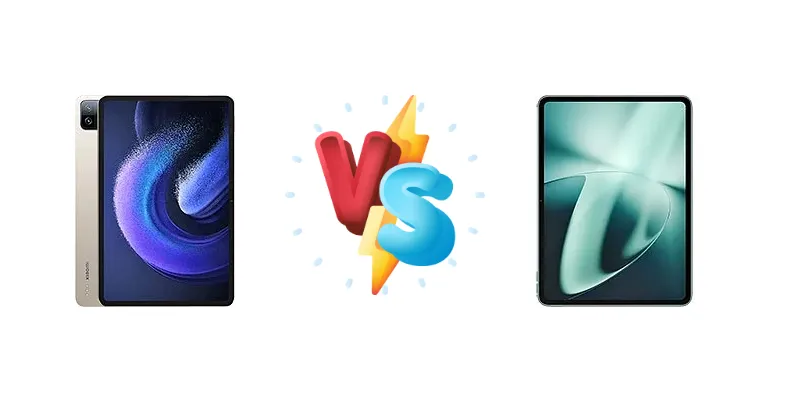
The Android tablet market is heating up, and two contenders are vying for your attention: the Xiaomi Pad 6 Pro and the OnePlus Pad. Both offer premium features and impressive specs, but which one truly delivers the best experience? Let's dive into a detailed comparison to help you decide.
🏆 Quick Verdict
The Xiaomi Pad 6 Pro edges out the OnePlus Pad thanks to its Snapdragon 8+ Gen 1 chipset offering superior performance and faster charging. However, the OnePlus Pad boasts a slightly better display contrast and a more refined software experience, making it a strong contender for media consumption.
| Network |
|---|
| 2G bands | N/A | N/A |
| 3G bands | N/A | N/A |
| 4G bands | - | N/A |
| EDGE | N/A | No |
| GPRS | N/A | No |
| Technology | No cellular connectivity | No cellular connectivity |
| Launch |
|---|
| Announced | 2023, April 18 | 2023, February 07 |
| Status | Available. Released 2023, April 30 | Available. Released 2023, April 28 |
| Body |
|---|
| Build | Glass front (Gorilla Glass 3), aluminum frame, aluminum back | Glass front, aluminum back, aluminum frame |
| Dimensions | 254 x 165.2 x 6.5 mm (10.0 x 6.50 x 0.26 in) | 258 x 189.4 x 6.5 mm (10.16 x 7.46 x 0.26 in) |
| SIM | No | No |
| Weight | 490 g (1.08 lb) | 552 g (1.22 lb) |
| | Stylus support (magnetic) | Stylus support |
| Display |
|---|
| Protection | Corning Gorilla Glass 3 | - |
| Resolution | 1800 x 2880 pixels, 16:10 ratio (~309 ppi density) | 2000 x 2800 pixels (~296 ppi density) |
| Size | 11.0 inches, 350.9 cm2 (~83.6% screen-to-body ratio) | 11.61 inches, 411.3 cm2 (~84.2% screen-to-body ratio) |
| Type | IPS LCD, 1B colors, 144Hz, HDR10, Dolby Vision, 550 nits | IPS LCD, 1B colors, Dolby Vision, HDR10+, 144Hz, 500 nits (typ) |
| Platform |
|---|
| CPU | Octa-core (1x3.19 GHz Cortex-X2 & 3x2.75 GHz Cortex-A710 & 4x1.80 GHz Cortex-A510) | Octa-core (1x3.05 GHz Cortex-X2 & 3x2.85 GHz Cortex-A710 & 4x1.80 GHz Cortex-A510) |
| Chipset | Qualcomm SM8475 Snapdragon 8+ Gen 1 (4 nm) | Mediatek Dimensity 9000 (4 nm) |
| GPU | Adreno 730 | Mali-G710 MC10 |
| OS | Android 13, MIUI 14 | Android 13, upgradable to Android 15, OxygenOS 15 |
| Memory |
|---|
| Card slot | No | No |
| Internal | 128GB 8GB RAM, 256GB 8GB RAM, 256GB 12GB RAM, 512GB 12GB RAM | 128GB 8GB RAM, 256GB 12GB RAM |
| | UFS 3.1 | UFS 3.1 |
| Main Camera |
|---|
| Dual | 50 MP, f/1.8, (wide), 1/2.76", 0.64µm, PDAF
Auxiliary lens | - |
| Features | Dual-LED flash, HDR, panorama | LED flash |
| Single | - | 13 MP, f/2.2, 23mm (wide) |
| Video | 4K@30/60fps, 1080p@30/60fps | 4K@30fps, 1080p@30ps, gyro-EIS |
| Selfie camera |
|---|
| Single | 20 MP, f/2.2, (wide), 1/3.4", 0.8µm | 8 MP, f/2.3, (wide), 1/4.0", 1.12µm |
| Video | 1080p@30/60fps | 1080p@30fps |
| Sound |
|---|
| 3.5mm jack | No | No |
| 35mm jack | No | No |
| Loudspeaker | Yes, with stereo speakers (4 speakers) | Yes, with stereo speakers (4 speakers) |
| | 24-bit/192kHz audio | - |
| Comms |
|---|
| Bluetooth | 5.3, A2DP, LE | 5.3, A2DP, LE, aptX HD |
| NFC | No | No |
| Positioning | No | GPS, GLONASS, GALILEO, BDS (B1+B1c) |
| Radio | No | No |
| USB | USB Type-C 3.2, accessory connector | USB Type-C 2.0, OTG, accessory connector |
| WLAN | Wi-Fi 802.11 a/b/g/n/a/6e, dual-band, Wi-Fi Direct | Wi-Fi 802.11 a/b/g/n/ac/6, dual-band |
| Features |
|---|
| Sensors | Accelerometer, gyro, proximity (accessories only) | Accelerometer, gyro, compass |
| Battery |
|---|
| Charging | 67W wired, PD3.0, QC4, 100% in 1 hour | 67W wired |
| Type | Li-Po 8600 mAh | Li-Po 9510 mAh |
| Misc |
|---|
| Colors | Black, Blue, Gold | Halo Green |
| Models | 23046RP50C | - |
| Price | About 330 EUR | About 500 EUR |
| Tests |
|---|
| Display | - |
Contrast ratio: 1664:1 |
| Loudspeaker | - |
-22.5 LUFS (Excellent)
|
| Performance | - |
AnTuTu: 859019 (v9)
GeekBench: 3158 (v5.1)
GFXBench: 28fps (ES 3.1 onscreen) |
Xiaomi Pad 6 Pro
- Superior Performance (Snapdragon 8+ Gen 1)
- Faster Charging (67W)
- Excellent Value
- Good Display
- Software can be a bit cluttered
- Camera slightly behind OnePlus Pad
OnePlus Pad
- Excellent Display Contrast
- Clean Software Experience (OxygenOS)
- Slightly Better Camera
- Premium Design
- Slightly Lower Performance
- Charging speed may vary
Display Comparison
The OnePlus Pad takes a slight lead here. While the Xiaomi Pad 6 Pro has a good display, the OnePlus Pad's 1664:1 contrast ratio is noticeably better than the Xiaomi's 1195:1. Both offer excellent resolution and color accuracy, but the OnePlus Pad's higher brightness (442 nits measured) contributes to a more immersive viewing experience. The OnePlus Pad also has a slightly larger screen size (11.6 inches vs 11 inches).
Camera Comparison
Camera performance is often secondary on tablets, but the OnePlus Pad generally has a slightly better camera system. While specific megapixel counts are similar, OnePlus's image processing tends to be more refined. Both offer decent front-facing cameras for video calls.
Performance
The Xiaomi Pad 6 Pro wins this round decisively. Its Snapdragon 8+ Gen 1 chipset is significantly more powerful than the OnePlus Pad's Dimensity 9000. Expect smoother multitasking, faster app loading times, and better gaming performance on the Xiaomi Pad 6 Pro. Both have ample RAM, but the chipset difference is key.
Battery Life
The Xiaomi Pad 6 Pro has a clear advantage with its 67W wired charging, allowing for a full charge in just one hour. The OnePlus Pad also offers 67W charging, but real-world charging times may vary. Battery capacity is similar between the two, suggesting comparable battery life under typical usage.
Buying Guide
Who should buy the Xiaomi Pad 6 Pro? Power users, gamers, and those prioritizing raw performance and fast charging will appreciate the Xiaomi Pad 6 Pro. Who should buy the OnePlus Pad? Users focused on media consumption, a clean software experience, and a vibrant display will find the OnePlus Pad a compelling choice.
Frequently Asked Questions
❓ Which tablet is better for gaming?
The Xiaomi Pad 6 Pro is the better choice for gaming due to its more powerful Snapdragon 8+ Gen 1 chipset.
❓ Does the OnePlus Pad have a stylus?
The OnePlus Pad does not come with a stylus, but it supports third-party styluses.
❓ What is the resolution of both tablets?
Both tablets feature a 2.8k resolution display, offering sharp and detailed visuals.