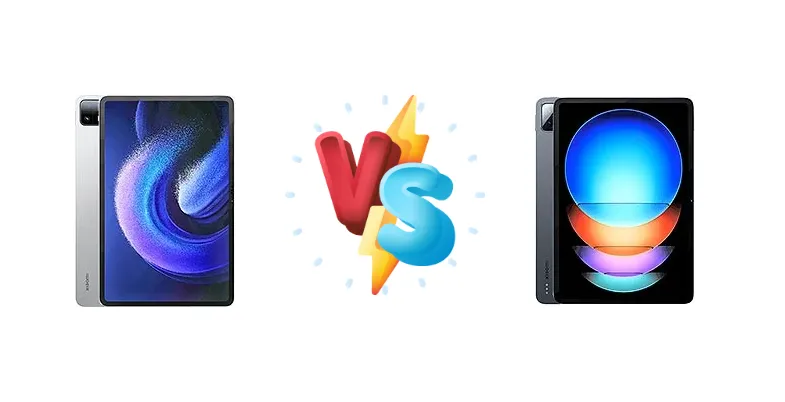
Xiaomi has doubled down on the tablet space with the Pad 6 Max 14 and the Pad 6S Pro 12.4, offering compelling options for users seeking a large-screen Android experience. The Max 14 prioritizes screen real estate and leverages the Snapdragon 8+ Gen 1, while the 6S Pro 12.4 boasts the newer Snapdragon 8 Gen 2 and a faster charging solution. This comparison dissects the key differences to determine which tablet best suits your needs.
🏆 Quick Verdict
For most users, the Xiaomi Pad 6S Pro 12.4 emerges as the superior choice. The Snapdragon 8 Gen 2 provides a noticeable performance uplift, coupled with faster 120W charging and a bright, high-contrast display. While the Pad 6 Max 14 offers a larger screen, the 6S Pro’s overall refinement and efficiency make it the more compelling package.
| Network |
|---|
| 2G bands | N/A | N/A |
| 3G bands | N/A | N/A |
| EDGE | N/A | N/A |
| GPRS | N/A | N/A |
| Technology | No cellular connectivity | No cellular connectivity |
| Launch |
|---|
| Announced | 2023, August 14 | 2024, February 22 |
| Status | Available. Released 2023, August 14 | Available. Released 2024, February 22 |
| Body |
|---|
| Build | Glass front, aluminum back, aluminum frame | Glass front (Gorilla Glass 5), aluminum frame, aluminum back |
| Dimensions | 318.6 x 206.1 x 6.5 mm (12.54 x 8.11 x 0.26 in) | 278.7 x 191.6 x 6.3 mm (10.97 x 7.54 x 0.25 in) |
| SIM | No | No |
| Weight | 750 g (1.65 lb) | 590 g (1.30 lb) |
| Display |
|---|
| Protection | - | Corning Gorilla Glass 5 |
| Resolution | 1800 x 2880 pixels, 16:10 ratio (~242 ppi density) | 2032 x 3048 pixels, 3:2 ratio (~295 ppi density) |
| Size | 14.0 inches, 573.0 cm2 (~87.3% screen-to-body ratio) | 12.4 inches, 457.8 cm2 (~85.7% screen-to-body ratio) |
| Type | IPS LCD, 1B colors, 120Hz, HDR10, Dolby Vision, 600 nits (peak) | IPS LCD, 68B colors, 144Hz, HDR10, Dolby Vision, 900 nits (peak) |
| Platform |
|---|
| CPU | Octa-core (1x3.19 GHz Cortex-X2 & 3x2.75 GHz Cortex-A710 & 4x1.80 GHz Cortex-A510) | Octa-core (1x3.2 GHz Cortex-X3 & 2x2.8 GHz Cortex-A715 & 2x2.8 GHz Cortex-A710 & 3x2.0 GHz Cortex-A510) |
| Chipset | Qualcomm SM8475 Snapdragon 8+ Gen 1 (4 nm) | Qualcomm SM8550-AB Snapdragon 8 Gen 2 (4 nm) |
| GPU | Adreno 730 | Adreno 740 |
| OS | Android 13, MIUI Pad 14 | Android 14, up to 3 major Android upgrades, HyperOS |
| Memory |
|---|
| Card slot | No | No |
| Internal | 256GB 8GB RAM, 256GB 12GB RAM, 512GB 12GB RAM, 1TB 16GB RAM | 256GB 8GB RAM, 256GB 12GB RAM, 512GB 12GB RAM, 1TB 16GB RAM |
| Main Camera |
|---|
| Dual | 50 MP, f/1.8, (wide), 1/2.76", 0.64µm, PDAF
Auxiliary lens | 50 MP, f/1.8, (wide), 1/2.76", 0.64µm, PDAF
Auxiliary lens |
| Features | LED flash, HDR, panorama | LED flash, HDR, panorama |
| Video | 4K@30/60fps, 1080p@30/60fps | 4K@30/60fps, 1080p@30/60fps |
| Selfie camera |
|---|
| Single | 20 MP, f/2.2, (wide), 1/3.4", 0.8µm
ToF sensor | 32 MP, f/2.2, (wide), 1/3.6", 0.61µm |
| Video | 1080p@30/60fps | 1080p@30fps |
| Sound |
|---|
| 35mm jack | No | No |
| Loudspeaker | Yes, with stereo speakers (8 speakers) | Yes, with stereo speakers (6 speakers) |
| Comms |
|---|
| Bluetooth | 5.3, A2DP, LE | 5.3, A2DP, LE, LHDC |
| NFC | Yes | Yes (file transfer only) |
| Positioning | No | No |
| Radio | No | No |
| USB | USB Type-C 3.2, OTG, accessory connector | USB Type-C 3.2, accessory connector |
| WLAN | Wi-Fi 802.11 a/b/g/n/a/6e, dual-band, Wi-Fi Direct | Wi-Fi 802.11 a/b/g/n/a/6/7, dual-band, Wi-Fi Direct |
| Features |
|---|
| Sensors | Accelerometer, gyro, proximity (accessories only), compass | Fingerprint (side-mounted), accelerometer, gyro, proximity (accessories only), compass |
| Battery |
|---|
| Charging | 67W wired, PD3.0, QC4
33W reverse wired, PD3.0 | 120W wired, PD3.0, QC4, 45% in 10 min, 100% in 35 min |
| Type | Li-Po 10000 mAh | 10000 mAh |
| Misc |
|---|
| Colors | Black, Silver | Black, Blue, Green |
| Models | - | 24018RPACG |
| Price | About 450 EUR | About 700 EUR |
| SAR EU | - | 0.99 W/kg (body) |
Xiaomi Pad 6 Max 14
- Larger 14-inch display for immersive viewing
- Snapdragon 8+ Gen 1 offers strong performance
- 67W wired charging with reverse wired charging
- Slower charging compared to the 6S Pro
- Potentially lower peak brightness and contrast
Xiaomi Pad 6S Pro 12.4
- Faster Snapdragon 8 Gen 2 processor
- 120W fast charging (35 minutes to full)
- Brighter and higher contrast display (848 nits, 1378:1)
- Smaller 12.4-inch display
- Potentially higher price point
Display Comparison
The Xiaomi Pad 6S Pro 12.4 features a display capable of reaching 848 nits of peak brightness, a significant advantage for outdoor visibility compared to the unmeasured brightness of the Pad 6 Max 14. The 1378:1 contrast ratio on the 6S Pro further enhances image quality. While the Pad 6 Max 14’s 14-inch panel offers more screen real estate, the 6S Pro’s potentially superior color accuracy and brightness make it a more enjoyable viewing experience. The absence of LTPO technology in either device suggests both will rely on adaptive refresh rates rather than variable refresh rates for power saving.
Camera Comparison
Neither tablet is positioned as a photography powerhouse, but the camera systems are worth noting. Given the lack of detailed camera specs for either device, it's difficult to make a definitive comparison. However, Xiaomi’s typical approach suggests the 6S Pro, being the newer model, likely benefits from improved image processing algorithms. The focus should be on video conferencing and casual snapshots rather than high-quality photography.
Performance
The core difference lies in the chipsets. The Pad 6S Pro 12.4’s Snapdragon 8 Gen 2 (4nm) represents a substantial upgrade over the Pad 6 Max 14’s Snapdragon 8+ Gen 1 (4nm). The Gen 2 features a Cortex-X3 prime core clocked at 3.2 GHz, compared to the X2 in the 8+ Gen 1 at 3.19 GHz, alongside newer Cortex-A715 and A710 cores. This translates to faster processing speeds and improved efficiency. The 6S Pro’s architecture is also more modern, potentially leading to better sustained performance under heavy loads. Both utilize LPDDR5x RAM, but the Gen 2’s superior Neural Processing Unit (NPU) will benefit AI-driven tasks.
Battery Life
The Xiaomi Pad 6S Pro 12.4 demonstrates a clear advantage in charging speed with its 120W wired charging, achieving 45% charge in just 10 minutes and a full charge in 35 minutes. The Pad 6 Max 14’s 67W charging is considerably slower. While the Pad 6S Pro’s battery life is measured at 11:14h of active use, the Pad 6 Max 14’s battery capacity is unlisted. The more efficient Snapdragon 8 Gen 2 in the 6S Pro likely mitigates the impact of a potentially smaller battery capacity, offering comparable or even superior real-world endurance.
Buying Guide
Buy the Xiaomi Pad 6 Max 14 if you absolutely require the largest possible screen for multitasking, digital art, or media consumption and are willing to trade some processing power and charging speed for it. Buy the Xiaomi Pad 6S Pro 12.4 if you prioritize performance, faster charging, and a more efficient overall experience, making it ideal for gaming, demanding applications, and on-the-go productivity.
Frequently Asked Questions
❓ Does the Snapdragon 8 Gen 2 in the Pad 6S Pro 12.4 get noticeably warmer during extended gaming sessions compared to the 8+ Gen 1 in the Pad 6 Max 14?
The Snapdragon 8 Gen 2 is built on a more efficient 4nm process, meaning it generally produces less heat than the 8+ Gen 1 under similar workloads. While both tablets will experience some warming during prolonged gaming, the 6S Pro 12.4 is likely to maintain higher sustained performance due to better thermal management.
❓ Is the 120W charging on the Pad 6S Pro 12.4 compatible with all USB-PD chargers, or do I need a specific Xiaomi charger to achieve the fastest speeds?
The Pad 6S Pro 12.4 supports USB-PD and QC4, but to achieve the full 120W charging speed, it's recommended to use the included Xiaomi charger or a compatible charger specifically rated for that wattage. Using a lower-wattage charger will still charge the device, but at a slower rate.
❓ Given the larger screen size of the Pad 6 Max 14, is it significantly heavier and less comfortable to hold for extended periods?
While official weight figures aren't provided, the 14-inch display of the Pad 6 Max 14 will undoubtedly result in a larger and heavier device compared to the 12.4-inch Pad 6S Pro. This could lead to fatigue during prolonged use without a stand or case.