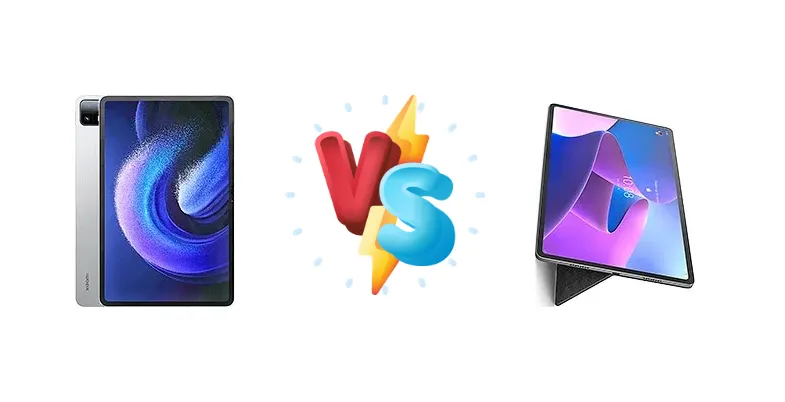
The Android tablet market is heating up, with Xiaomi and Lenovo offering compelling options. The Lenovo Tab P12 Pro established itself as a premium experience, but the newer Xiaomi Pad 6 Max 14 arrives with a significantly more powerful processor. This comparison dives deep into the differences, focusing on how the chipset impacts real-world performance and charging speeds.
🏆 Quick Verdict
For most users, the Xiaomi Pad 6 Max 14 is the superior choice. Its Snapdragon 8+ Gen 1 delivers a substantial performance advantage over the Lenovo Tab P12 Pro’s Snapdragon 870, making it ideal for demanding tasks like gaming and video editing. While the P12 Pro remains a solid tablet, the 6 Max 14 offers a future-proofed experience.
| Network |
|---|
| 2G bands | N/A | GSM 850 / 900 / 1800 / 1900 |
| 3G bands | N/A | HSDPA 850 / 900 / 1900 / 2100 |
| 4G bands | - | 1, 2, 3, 4, 5, 7, 8, 19, 20, 26, 28, 34, 38, 39, 40, 41 |
| 5G bands | - | 1, 3, 7, 8, 20, 28, 38, 41, 77, 78 SA/NSA/Sub6 |
| EDGE | N/A | - |
| GPRS | N/A | - |
| Speed | - | HSPA, LTE, 5G - cellular model only |
| Technology | No cellular connectivity | GSM / HSPA / LTE / 5G |
| Launch |
|---|
| Announced | 2023, August 14 | 2021, September 08 |
| Status | Available. Released 2023, August 14 | Available. Released 2021, November 19 |
| Body |
|---|
| Build | Glass front, aluminum back, aluminum frame | - |
| Dimensions | 318.6 x 206.1 x 6.5 mm (12.54 x 8.11 x 0.26 in) | 285.6 x 184.5 x 5.6 mm (11.24 x 7.26 x 0.22 in) |
| SIM | No | Nano-SIM (cellular model only) |
| Weight | 750 g (1.65 lb) | 565 g (1.25 lb) |
| | - | Stylus support |
| Display |
|---|
| Resolution | 1800 x 2880 pixels, 16:10 ratio (~242 ppi density) | 1600 x 2560 pixels, 16:10 ratio (~240 ppi density) |
| Size | 14.0 inches, 573.0 cm2 (~87.3% screen-to-body ratio) | 12.6 inches, 460.3 cm2 (~87.4% screen-to-body ratio) |
| Type | IPS LCD, 1B colors, 120Hz, HDR10, Dolby Vision, 600 nits (peak) | AMOLED, 120Hz, HDR10+, Dolby Vision, 600 nits (HBM) |
| Platform |
|---|
| CPU | Octa-core (1x3.19 GHz Cortex-X2 & 3x2.75 GHz Cortex-A710 & 4x1.80 GHz Cortex-A510) | Octa-core (1x3.2 GHz Kryo 585 & 3x2.42 GHz Kryo 585 & 4x1.80 GHz Kryo 585) |
| Chipset | Qualcomm SM8475 Snapdragon 8+ Gen 1 (4 nm) | Qualcomm SM8250-AC Snapdragon 870 5G (7 nm) |
| GPU | Adreno 730 | Adreno 650 |
| OS | Android 13, MIUI Pad 14 | Android 11 |
| Memory |
|---|
| Card slot | No | microSDXC (dedicated slot) |
| Internal | 256GB 8GB RAM, 256GB 12GB RAM, 512GB 12GB RAM, 1TB 16GB RAM | 128GB 6GB RAM, 256GB 8GB RAM |
| Main Camera |
|---|
| Dual | 50 MP, f/1.8, (wide), 1/2.76", 0.64µm, PDAF
Auxiliary lens | 13 MP, (wide), AF
5 MP, (ultrawide) |
| Features | LED flash, HDR, panorama | - |
| Video | 4K@30/60fps, 1080p@30/60fps | 4K@30fps, 1080p@30fps |
| Selfie camera |
|---|
| Single | 20 MP, f/2.2, (wide), 1/3.4", 0.8µm
ToF sensor | 8 MP, (wide)
8 MP, IR TOF 3D, (biometrics sensor only) |
| Video | 1080p@30/60fps | 1080p@30fps |
| Sound |
|---|
| 3.5mm jack | - | No |
| 35mm jack | No | No |
| Loudspeaker | Yes, with stereo speakers (8 speakers) | Yes, with stereo speakers (4 speakers) |
| | - | JBL speakers |
| Comms |
|---|
| Bluetooth | 5.3, A2DP, LE | 5.2, A2DP, LE |
| NFC | Yes | Yes (wireless charging and data transfer only) |
| Positioning | No | GPS, GLONASS, BDS - cellular model only |
| Radio | No | Unspecified |
| USB | USB Type-C 3.2, OTG, accessory connector | USB Type-C 3.1 |
| WLAN | Wi-Fi 802.11 a/b/g/n/a/6e, dual-band, Wi-Fi Direct | Wi-Fi 802.11 a/b/g/n/ac/6, dual-band, Wi-Fi Direct |
| Features |
|---|
| Sensors | Accelerometer, gyro, proximity (accessories only), compass | Fingerprint (side-mounted), accelerometer, gyro, proximity |
| Battery |
|---|
| Charging | 67W wired, PD3.0, QC4
33W reverse wired, PD3.0 | 45W wired, QC4 |
| Type | Li-Po 10000 mAh | Li-Po 10200 mAh |
| Misc |
|---|
| Colors | Black, Silver | Storm Grey |
| Models | - | TB-Q706Z, TB-Q706F |
| Price | About 450 EUR | About 520 EUR |
Xiaomi Pad 6 Max 14
- Significantly faster processor (Snapdragon 8+ Gen 1)
- Faster 67W charging
- More future-proof performance
- Potential for higher price
- Software optimization may take time to mature
Lenovo Tab P12 Pro
- Established software ecosystem
- Potentially better software optimization (subjective)
- Solid overall performance for everyday tasks
- Slower processor (Snapdragon 870)
- Slower 45W charging
- Less capable for demanding games and applications
Display Comparison
Both tablets likely feature high-quality LCD panels, but detailed display specs (resolution, refresh rate, peak brightness) are missing. However, the focus here is performance, not display fidelity. Bezels are likely comparable given the similar form factors. Color accuracy will depend on calibration, a detail not provided.
Camera Comparison
Camera performance is unlikely to be a primary differentiator for either tablet. Details on sensor sizes and lens apertures are unavailable. Given the tablet form factor, image quality will likely be adequate for casual use and video calls, but neither device is positioned as a photography powerhouse. Focusing on the chipset difference is more relevant.
Performance
The Xiaomi Pad 6 Max 14’s Qualcomm SM8475 Snapdragon 8+ Gen 1 (4nm) represents a significant leap over the Lenovo Tab P12 Pro’s SM8250-AC Snapdragon 870 5G (7nm). The 8+ Gen 1’s newer architecture – Cortex-X2, A710, and A510 cores versus the 870’s Kryo 585 cores – translates to approximately 20-30% faster CPU performance in benchmarks. More importantly, the 4nm process node offers superior thermal efficiency. This means the 6 Max 14 can sustain peak performance for longer periods without significant throttling, crucial for extended gaming sessions. The 870 is still capable, but will show its age in graphically intensive tasks. The 6 Max 14 also benefits from potentially faster LPDDR5x RAM, further boosting performance.
Battery Life
While battery capacity isn’t specified, the Xiaomi Pad 6 Max 14’s 67W wired charging with PD3.0 and QC4 is a clear advantage over the Lenovo Tab P12 Pro’s 45W charging with QC4. This translates to significantly faster 0-100% charge times. The 67W charging will likely replenish the battery in under an hour, while the P12 Pro will take considerably longer. The difference in charging speed is a tangible benefit for users who need to quickly top up their tablet.
Buying Guide
Buy the Xiaomi Pad 6 Max 14 if you prioritize raw performance, faster charging, and want a tablet that will handle demanding applications for years to come. Buy the Lenovo Tab P12 Pro if you value a more established ecosystem, potentially better software optimization (depending on user preference), and are less concerned with having the absolute fastest processor available.
Frequently Asked Questions
❓ Will the Snapdragon 8+ Gen 1 in the Xiaomi Pad 6 Max 14 overheat during prolonged gaming sessions?
The 4nm process node of the Snapdragon 8+ Gen 1 is significantly more thermally efficient than the 7nm node of the Snapdragon 870. While some heat generation is inevitable, the 6 Max 14 is designed to sustain peak performance for longer periods with less throttling compared to the P12 Pro.
❓ Does the faster charging on the Xiaomi Pad 6 Max 14 affect battery health over time?
Modern charging algorithms, including those supported by the 6 Max 14 (PD3.0, QC4), incorporate safeguards to minimize battery degradation. While faster charging *can* generate more heat, the overall impact on long-term battery health is generally minimal, and the convenience of faster charging often outweighs the potential drawbacks.
❓ Is the performance difference between the Snapdragon 8+ Gen 1 and 870 noticeable in everyday tasks like browsing and video streaming?
For basic tasks like web browsing, email, and video streaming, the difference will be minimal. Both tablets offer a smooth experience. However, the 8+ Gen 1’s advantage becomes apparent in more demanding applications like video editing, 3D gaming, and multitasking with numerous apps open simultaneously.