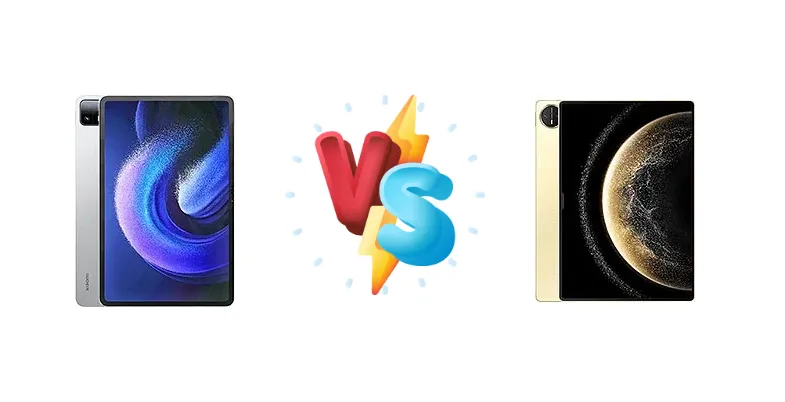
The large-screen Android tablet market is heating up. The Xiaomi Pad 6 Max 14, leveraging Qualcomm’s Snapdragon 8+ Gen 1, aims to deliver flagship performance at a competitive price. Meanwhile, Huawei’s MatePad Pro 13.2 (2025) introduces the Kirin T92 chipset, focusing on a balanced approach to power and efficiency. This comparison dissects these two contenders to determine which tablet best suits your needs.
🏆 Quick Verdict
For users prioritizing raw performance and established gaming compatibility, the Xiaomi Pad 6 Max 14 is the clear winner. Its Snapdragon 8+ Gen 1 offers a demonstrable edge in demanding tasks. However, the Huawei MatePad Pro 13.2 (2025) counters with significantly faster 100W charging, making it ideal for those who value minimal downtime.
| Network |
|---|
| 2G bands | N/A | GSM 850 / 900 / 1800 / 1900 |
| 3G bands | N/A | HSDPA 850 / 900 / 1900 / 2100 |
| 4G bands | - | LTE |
| EDGE | N/A | - |
| GPRS | N/A | - |
| Speed | - | HSPA, LTE - cellular model only |
| Technology | No cellular connectivity | GSM / HSPA / LTE |
| Launch |
|---|
| Announced | 2023, August 14 | 2024, November 26 |
| Status | Available. Released 2023, August 14 | Available. Released 2024, December 12 |
| Body |
|---|
| Build | Glass front, aluminum back, aluminum frame | Glass front, nylon fiber back, magnesium alloy frame |
| Dimensions | 318.6 x 206.1 x 6.5 mm (12.54 x 8.11 x 0.26 in) | 289.1 x 196.1 x 5.5 mm (11.38 x 7.72 x 0.22 in) |
| SIM | No | Nano-SIM (cellular model only) |
| Weight | 750 g (1.65 lb) | 580 g (Wi-FI) or 590 g (LTE) (1.28 lb) |
| Display |
|---|
| Resolution | 1800 x 2880 pixels, 16:10 ratio (~242 ppi density) | 2880 x 1920 pixels, 3:2 ratio (~262 ppi density) |
| Size | 14.0 inches, 573.0 cm2 (~87.3% screen-to-body ratio) | 13.2 inches, 518.8 cm2 (~91.5% screen-to-body ratio) |
| Type | IPS LCD, 1B colors, 120Hz, HDR10, Dolby Vision, 600 nits (peak) | OLED, 1B colors, 144Hz, HDR Vivid, 1000 nits (peak) |
| Platform |
|---|
| CPU | Octa-core (1x3.19 GHz Cortex-X2 & 3x2.75 GHz Cortex-A710 & 4x1.80 GHz Cortex-A510) | Octa-core |
| Chipset | Qualcomm SM8475 Snapdragon 8+ Gen 1 (4 nm) | Kirin T92 |
| GPU | Adreno 730 | - |
| OS | Android 13, MIUI Pad 14 | Harmony OS 4.3 |
| Memory |
|---|
| Card slot | No | No |
| Internal | 256GB 8GB RAM, 256GB 12GB RAM, 512GB 12GB RAM, 1TB 16GB RAM | 256GB 12GB RAM, 512GB 12GB RAM, 1TB 16GB RAM |
| Main Camera |
|---|
| Dual | 50 MP, f/1.8, (wide), 1/2.76", 0.64µm, PDAF
Auxiliary lens | 50 MP, f/1.8, (wide), PDAF
8 MP, f/2.2, (ultrawide) |
| Features | LED flash, HDR, panorama | LED flash |
| Video | 4K@30/60fps, 1080p@30/60fps | 4K@30fps, 1080p@30fps |
| Selfie camera |
|---|
| Single | 20 MP, f/2.2, (wide), 1/3.4", 0.8µm
ToF sensor | 16 MP, f/2.2 |
| Video | 1080p@30/60fps | 1080p@30fps |
| Sound |
|---|
| 35mm jack | No | No |
| Loudspeaker | Yes, with stereo speakers (8 speakers) | Yes, with stereo speakers (6 speakers) |
| Comms |
|---|
| Bluetooth | 5.3, A2DP, LE | 5.2, A2DP, LE, L2HC |
| NFC | Yes | No |
| Positioning | No | GPS, GALILEO, GLONASS, BDS |
| Radio | No | No |
| USB | USB Type-C 3.2, OTG, accessory connector | USB Type-C 3.1, OTG, DisplayPort 1.2, accessory connector pins |
| WLAN | Wi-Fi 802.11 a/b/g/n/a/6e, dual-band, Wi-Fi Direct | Wi-Fi 802.11 a/b/g/n/ac/6, dual-band |
| Features |
|---|
| Sensors | Accelerometer, gyro, proximity (accessories only), compass | Fingerprint (side-mounted), accelerometer, gyro, compass, proximity (accessories only) |
| Battery |
|---|
| Charging | 67W wired, PD3.0, QC4
33W reverse wired, PD3.0 | 100W wired
7.5W reverse wired |
| Type | Li-Po 10000 mAh | Li-Po 10100 mAh |
| Misc |
|---|
| Colors | Black, Silver | Black, White, Gold |
| Models | - | WEB-W00, PCE-W29 |
| Price | About 450 EUR | About 680 EUR |
Xiaomi Pad 6 Max 14
- Superior processing power with Snapdragon 8+ Gen 1
- Faster RAM (LPDDR5x) for improved multitasking
- Potentially more versatile camera system
- Slower charging speed (67W)
- Reverse charging is faster, but still not class-leading
Huawei MatePad Pro 13.2 (2025)
- Ultra-fast 100W wired charging
- Potentially optimized software experience (HarmonyOS)
- Larger screen size for immersive viewing
- Kirin T92 chipset performance is unproven
- Slower reverse charging speed (7.5W)
Display Comparison
Both tablets are expected to feature large, high-resolution displays, but detailed display specs are currently unavailable. However, given Xiaomi’s recent focus on high refresh rates, the Pad 6 Max 14 likely incorporates a 120Hz or 144Hz panel. The Huawei MatePad Pro 13.2 (2025) will likely prioritize color accuracy and potentially feature LTPO technology for adaptive refresh rates, conserving battery life. Bezels will be a key differentiator, and the larger screen size of the MatePad Pro could offer a more immersive viewing experience.
Camera Comparison
Camera performance is unlikely to be a primary focus for either tablet, but the Xiaomi Pad 6 Max 14 is expected to have a more versatile camera system. Details are scarce, but Xiaomi typically prioritizes camera hardware. The Huawei MatePad Pro 13.2 (2025) will likely focus on software optimization for video conferencing and document scanning. Without specific sensor details, it’s difficult to assess image quality, but the Xiaomi’s likely larger sensor size will give it an advantage in low-light conditions.
Performance
The core difference lies in the chipsets. The Xiaomi Pad 6 Max 14’s Snapdragon 8+ Gen 1 (4nm) is a proven performer, boasting an octa-core configuration with a prime Cortex-X2 core clocked at 3.19 GHz. This translates to excellent single-core and multi-core performance. The Huawei MatePad Pro 13.2 (2025) utilizes the Kirin T92. While core counts are similar, the Kirin T92’s architecture and manufacturing process are unknown, making direct performance comparisons difficult. The Snapdragon’s Adreno GPU is a known quantity, offering robust graphics capabilities. The Kirin T92’s GPU performance remains to be seen. The Xiaomi Pad 6 Max 14 also benefits from LPDDR5x RAM, which will contribute to faster data transfer speeds and improved multitasking.
Battery Life
The Huawei MatePad Pro 13.2 (2025) takes a significant lead in charging speed with its 100W wired charging capability, promising a much faster 0-100% charge time compared to the Xiaomi Pad 6 Max 14’s 67W charging. While the Xiaomi Pad 6 Max 14 offers 33W reverse wired charging, the Huawei’s 7.5W reverse charging is considerably slower. Battery capacity is unknown for both devices, but the faster charging of the Huawei could offset a potentially smaller battery size, providing a similar overall user experience in terms of uptime.
Buying Guide
Buy the Xiaomi Pad 6 Max 14 if you need a tablet for demanding games, video editing, or multitasking, and value the widespread compatibility of the Snapdragon ecosystem. Buy the Huawei MatePad Pro 13.2 (2025) if you prioritize rapid charging, a potentially more refined software experience (depending on HarmonyOS preferences), and are less concerned with pushing the absolute limits of processing power.
Frequently Asked Questions
❓ Will the Kirin T92 chipset in the Huawei MatePad Pro 13.2 (2025) be able to handle demanding games like Genshin Impact at high settings?
That remains to be seen. The Kirin T92’s GPU performance is currently unknown. While Huawei has made strides in chipset development, the Snapdragon 8+ Gen 1 in the Xiaomi Pad 6 Max 14 is a proven performer in gaming. Expect the MatePad Pro to be capable, but potentially require some graphical settings adjustments for optimal performance.
❓ How does the 67W charging on the Xiaomi Pad 6 Max 14 compare to charging speeds of other tablets in its class?
67W is a respectable charging speed, placing the Xiaomi Pad 6 Max 14 above many mid-range tablets. However, it falls short of the ultra-fast charging offered by the Huawei MatePad Pro 13.2 (2025) with its 100W support. Expect a full charge to take approximately 1.5-2 hours with the Xiaomi, while the Huawei could potentially achieve a full charge in under an hour.
❓ Does the Xiaomi Pad 6 Max 14 support stylus input and keyboard accessories for enhanced productivity?
While not explicitly stated in the provided specs, Xiaomi typically offers stylus and keyboard accessories for its Pad series. Expect the Pad 6 Max 14 to be compatible with a dedicated stylus and potentially a magnetic keyboard cover, enhancing its functionality for note-taking and document editing.