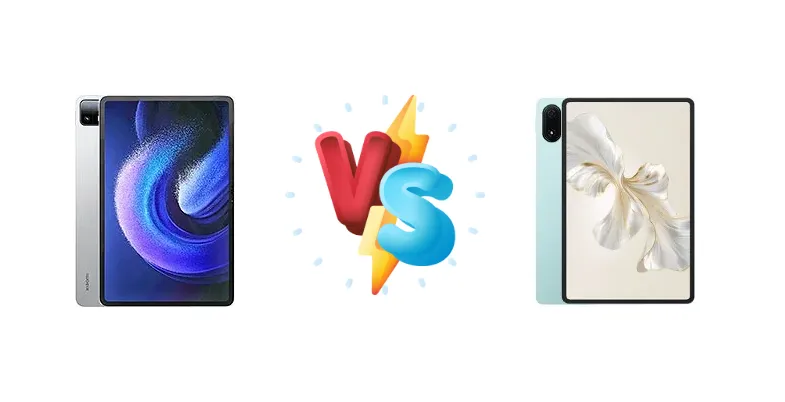
The Android tablet market is heating up, with Xiaomi and Honor both offering compelling options. The Xiaomi Pad 6 Max 14 aims for flagship performance with its Snapdragon 8+ Gen 1, while the Honor Pad 9 Pro prioritizes a balance of power and efficiency with the Dimensity 8100. This comparison dissects their key differences to determine which tablet best suits your needs.
🏆 Quick Verdict
For users prioritizing raw performance and faster charging, the Xiaomi Pad 6 Max 14 is the clear winner. Its Snapdragon 8+ Gen 1 delivers a noticeable edge in demanding tasks. However, the Honor Pad 9 Pro provides a more efficient experience and a competitive feature set, making it a strong contender for everyday use.
| Network |
|---|
| 2G bands | N/A | N/A |
| 3G bands | N/A | N/A |
| EDGE | N/A | No |
| GPRS | N/A | No |
| Technology | No cellular connectivity | No cellular connectivity |
| Launch |
|---|
| Announced | 2023, August 14 | 2024, July 12 |
| Status | Available. Released 2023, August 14 | Available. Released 2024, July 12 |
| Body |
|---|
| Build | Glass front, aluminum back, aluminum frame | Glass front, aluminum frame, aluminum back |
| Dimensions | 318.6 x 206.1 x 6.5 mm (12.54 x 8.11 x 0.26 in) | 277 x 179.9 x 6.6 mm (10.91 x 7.08 x 0.26 in) |
| SIM | No | No |
| Weight | 750 g (1.65 lb) | 589 g (1.30 lb) |
| Display |
|---|
| Resolution | 1800 x 2880 pixels, 16:10 ratio (~242 ppi density) | 1600 x 2560 pixels, 16:10 ratio (~249 ppi density) |
| Size | 14.0 inches, 573.0 cm2 (~87.3% screen-to-body ratio) | 12.1 inches, 424.5 cm2 (~85.2% screen-to-body ratio) |
| Type | IPS LCD, 1B colors, 120Hz, HDR10, Dolby Vision, 600 nits (peak) | IPS LCD, 1B colors, 144Hz |
| Platform |
|---|
| CPU | Octa-core (1x3.19 GHz Cortex-X2 & 3x2.75 GHz Cortex-A710 & 4x1.80 GHz Cortex-A510) | Octa-core (4x2.85 GHz Cortex-A78 & 4x2.0 GHz Cortex-A55) |
| Chipset | Qualcomm SM8475 Snapdragon 8+ Gen 1 (4 nm) | Mediatek Dimensity 8100 (5 nm) |
| GPU | Adreno 730 | Mali-G610 MC6 |
| OS | Android 13, MIUI Pad 14 | Android 14, Magic OS 8.1 |
| Memory |
|---|
| Card slot | No | No |
| Internal | 256GB 8GB RAM, 256GB 12GB RAM, 512GB 12GB RAM, 1TB 16GB RAM | 256GB 12GB RAM, 256GB 8GB RAM |
| Main Camera |
|---|
| Dual | 50 MP, f/1.8, (wide), 1/2.76", 0.64µm, PDAF
Auxiliary lens | - |
| Features | LED flash, HDR, panorama | HDR |
| Single | - | 13 MP, f/2.0, (wide), AF |
| Video | 4K@30/60fps, 1080p@30/60fps | 4K@30fps, 1080p@30fps |
| Selfie camera |
|---|
| Single | 20 MP, f/2.2, (wide), 1/3.4", 0.8µm
ToF sensor | 5 MP, f/2.2, (wide) |
| Video | 1080p@30/60fps | 1080p@30fps |
| Sound |
|---|
| 35mm jack | No | No |
| Loudspeaker | Yes, with stereo speakers (8 speakers) | Yes, with stereo speakers (8 speakers) |
| Comms |
|---|
| Bluetooth | 5.3, A2DP, LE | 5.2, A2DP, LE |
| NFC | Yes | No |
| Positioning | No | No |
| Radio | No | No |
| USB | USB Type-C 3.2, OTG, accessory connector | USB Type-C 2.0, OTG |
| WLAN | Wi-Fi 802.11 a/b/g/n/a/6e, dual-band, Wi-Fi Direct | Wi-Fi 802.11 a/b/g/n/ac/6, dual-band, Wi-Fi Direct |
| Features |
|---|
| Sensors | Accelerometer, gyro, proximity (accessories only), compass | Accelerometer |
| Battery |
|---|
| Charging | 67W wired, PD3.0, QC4
33W reverse wired, PD3.0 | 35W wired |
| Type | Li-Po 10000 mAh | Li-Po 10050 mAh |
| Misc |
|---|
| Colors | Black, Silver | Sky Blue, Star Gray |
| Price | About 450 EUR | About 290 EUR |
Xiaomi Pad 6 Max 14
- Superior processing power with Snapdragon 8+ Gen 1
- Significantly faster 67W charging
- Potentially better camera image processing
- May generate more heat under sustained load
- Potentially higher price point
Honor Pad 9 Pro
- More efficient Dimensity 8100 chipset
- Competitive price point
- Balanced performance for everyday tasks
- Slower 35W charging
- Less powerful processor for demanding applications
Display Comparison
While both tablets likely feature high-resolution displays (data not provided), the core difference lies in their processing power, impacting UI responsiveness. The absence of display specs necessitates a focus on the chipset's ability to drive a smooth visual experience. The Snapdragon 8+ Gen 1 in the Xiaomi Pad 6 Max 14 has the headroom to maintain high refresh rates even under heavy load, while the Dimensity 8100 in the Honor Pad 9 Pro will likely offer a very good, but potentially less consistently fluid, experience.
Camera Comparison
Without specific camera sensor details, a direct comparison is limited. However, given the market positioning, it's reasonable to assume the Xiaomi Pad 6 Max 14 may prioritize camera capabilities slightly more. The Snapdragon 8+ Gen 1’s ISP (Image Signal Processor) is generally more advanced, potentially leading to better image processing and low-light performance. The Honor Pad 9 Pro will likely offer a capable camera system for casual photography, but may not match the Xiaomi’s potential for more detailed and dynamic images.
Performance
The Xiaomi Pad 6 Max 14’s Qualcomm SM8475 Snapdragon 8+ Gen 1 (4nm) is a significant step up in processing power compared to the Honor Pad 9 Pro’s MediaTek Dimensity 8100 (5nm). The Snapdragon 8+ Gen 1’s Cortex-X2 prime core, clocked at 3.19 GHz, provides a substantial performance boost over the Dimensity 8100’s Cortex-A78 cores at 2.85 GHz. The 4nm process node of the Snapdragon also contributes to better thermal efficiency, potentially reducing throttling during sustained workloads. While the Dimensity 8100 is no slouch, the Snapdragon 8+ Gen 1 is geared towards more demanding tasks like high-end gaming and video editing.
Battery Life
The Xiaomi Pad 6 Max 14’s 67W wired charging is a major advantage over the Honor Pad 9 Pro’s 35W charging. This translates to significantly faster charging times, allowing you to quickly top up the battery when needed. While battery capacity isn't specified, the faster charging speed of the Xiaomi Pad 6 Max 14 mitigates any potential disadvantage from a slightly smaller battery. The inclusion of PD3.0 and QC4 standards on the Xiaomi also offers broader compatibility with chargers.
Buying Guide
Buy the Xiaomi Pad 6 Max 14 if you need uncompromising performance for gaming, video editing, or multitasking, and value the convenience of 67W fast charging. Buy the Honor Pad 9 Pro if you prefer a tablet that balances performance with efficiency, offering a smooth experience for media consumption, productivity, and light gaming, without sacrificing essential features.
Frequently Asked Questions
❓ Will the Dimensity 8100 in the Honor Pad 9 Pro struggle with graphically intensive games like Genshin Impact?
The Dimensity 8100 is capable of running Genshin Impact, but you may need to lower graphics settings for a consistently smooth experience. The Xiaomi Pad 6 Max 14’s Snapdragon 8+ Gen 1 will provide a more stable and higher-fidelity gaming experience without requiring significant compromises.
❓ How long will it take to fully charge the Xiaomi Pad 6 Max 14 from 0% with the 67W charger?
With 67W charging, the Xiaomi Pad 6 Max 14 should be able to charge from 0% to 100% in approximately 45-60 minutes, depending on battery capacity (which is not specified). This is considerably faster than the Honor Pad 9 Pro’s 35W charging.
❓ Does the Xiaomi Pad 6 Max 14's Snapdragon 8+ Gen 1 generate excessive heat during prolonged use?
While the Snapdragon 8+ Gen 1 is a powerful chip, the 4nm process helps mitigate heat generation. However, it's likely to get warmer than the Honor Pad 9 Pro during extended gaming or video editing sessions. Xiaomi likely employs thermal management solutions to prevent significant throttling.