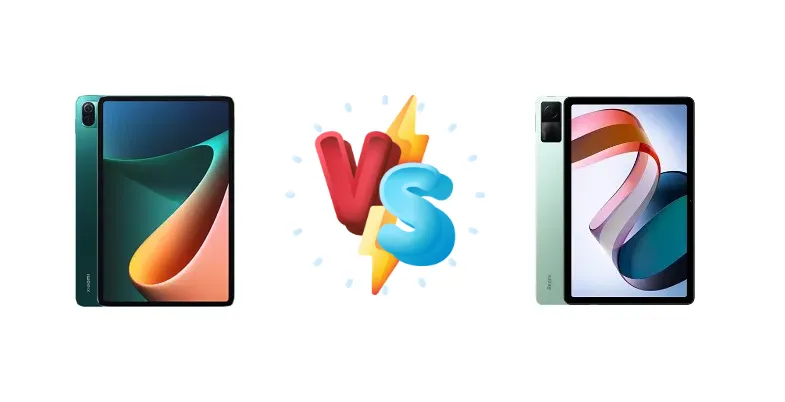
The Xiaomi Pad 5 and Redmi Pad are both compelling tablets offering excellent value. But which one is right for you? This comprehensive comparison dives deep into their specs, features, and performance to help you make an informed decision.
🏆 Quick Verdict
The Xiaomi Pad 5 offers significantly better performance thanks to its Snapdragon 860 chipset and faster charging. However, the Redmi Pad provides a more budget-friendly option with a slightly better contrast ratio and a more portable design. The Pad 5 is the performance king, while the Redmi Pad excels in value.
| Network |
|---|
| 2G bands | N/A | N/A |
| 3G bands | N/A | N/A |
| 4G bands | - | N/A |
| EDGE | N/A | N/A |
| GPRS | N/A | N/A |
| Technology | No cellular connectivity | No cellular connectivity |
| Launch |
|---|
| Announced | 2021, August 10 | 2022, October 04 |
| Status | Available. Released 2021, August 10 | Available. Released 2022, October 05 |
| Body |
|---|
| Build | Glass front, aluminum frame, plastic back | Glass front, aluminum frame |
| Dimensions | 254.7 x 166.3 x 6.9 mm (10.03 x 6.55 x 0.27 in) | 250.5 x 158.1 x 7.1 mm (9.86 x 6.22 x 0.28 in) |
| SIM | No | No |
| Weight | 511 g (1.13 lb) | 465 g (1.03 lb) |
| | Stylus support (magnetic) | - |
| Display |
|---|
| Resolution | 1600 x 2560 pixels, 16:10 ratio (~274 ppi density) | 1200 x 2000 pixels, 5:3 ratio (~220 ppi density) |
| Size | 11.0 inches, 350.9 cm2 (~82.8% screen-to-body ratio) | 10.61 inches, 320.4 cm2 (~80.9% screen-to-body ratio) |
| Type | IPS LCD, 1B colors, 120Hz, HDR10, Dolby Vision | IPS LCD, 1B colors, 90Hz, 400 nits (typ) |
| Platform |
|---|
| CPU | Octa-core (1x2.96 GHz Kryo 485 Gold & 3x2.42 GHz Kryo 485 Gold & 4x1.78 GHz Kryo 485 Silver) | Octa-core (2x2.2 GHz Cortex-A76 & 6x2.0 GHz Cortex-A55) |
| Chipset | Qualcomm Snapdragon 860 (7 nm) | Mediatek Helio G99 (6 nm) |
| GPU | Adreno 640 | Mali-G57 MC2 |
| OS | Android 11, upgradable to Android 13, MIUI 14 | Android 12, upgradable to Android 13, MIUI 14 |
| Memory |
|---|
| Card slot | No | microSDXC |
| Internal | 128GB 6GB RAM, 256GB 6GB RAM | 64GB 3GB RAM, 128GB 4GB RAM, 128GB 6GB RAM |
| | UFS 3.1 | UFS 2.2 |
| Main Camera |
|---|
| Features | Dual-LED flash, HDR, panorama | - |
| Single | 13 MP, f/2.0 | 8 MP, f/2.0, (wide), AF |
| Video | 4K@30fps, 1080p@30fps | 1080p@30fps |
| Selfie camera |
|---|
| Single | 8 MP, f/2.0 | 8 MP, f/2.3, 105° (ultrawide) |
| Video | 1080p@30fps | 1080p@30fps |
| Sound |
|---|
| 3.5mm jack | No | No |
| 35mm jack | No | No |
| Loudspeaker | Yes, with stereo speakers (4 speakers) | Yes, with stereo speakers (4 speakers) |
| | 24-bit/192kHz audio | 24-bit/192kHz audio |
| Comms |
|---|
| Bluetooth | 5.0, A2DP, LE | 5.2, A2DP, LE |
| NFC | No | No |
| Positioning | No | No |
| Radio | No | No |
| USB | USB Type-C | USB Type-C, OTG |
| WLAN | Wi-Fi 802.11 a/b/g/n/ac, dual-band, Wi-Fi Direct | Wi-Fi 802.11 a/b/g/n/ac, dual-band, Wi-Fi Direct |
| Features |
|---|
| Sensors | Accelerometer, gyro, proximity, compass | Accelerometer |
| Battery |
|---|
| Charging | 33W wired, PD3.0 | 18W wired |
| Type | Li-Po 8720 mAh | Li-Po 8000 mAh |
| Misc |
|---|
| Colors | Cosmic Gray, Pearl White, Green | Graphite Gray, Moonlight Silver, Mint Green |
| Models | 21051182G, 21051182C | 22081283G |
| Price | About 350 EUR | About 250 EUR |
| SAR EU | - | 0.36 W/kg (body) |
| Tests |
|---|
| Display |
Contrast ratio: 1271:1 (nominal) |
Contrast ratio: 1529:1 (nominal) |
| Loudspeaker |
-24.4 LUFS (Very good)
|
-23.9 LUFS (Very good)
|
| Performance |
AnTuTu: 473819 (v8), 555079 (v9)
GeekBench: 2583 (v5.1)
GFXBench: 24fps (ES 3.1 onscreen) |
AnTuTu: 319077 (v9)
GeekBench: 1852 (v5.1)
GFXBench: 13fps (ES 3.1 onscreen) |
Xiaomi Pad 5
- Superior Performance (Snapdragon 860)
- Faster Charging (33W)
- Brighter Display (478 nits)
- Better Speakers
- Higher Price
- Slightly heavier than Redmi Pad
Xiaomi Redmi Pad
- More Affordable
- Slightly Better Contrast Ratio
- More Portable
- Good Value for Money
- Lower Performance (Helio G99)
- Slower Charging (18W)
- Less Vibrant Display
Display Comparison
Both tablets feature excellent displays, but the Xiaomi Pad 5 boasts a slightly higher peak brightness (478 nits vs 402 nits) and a more vibrant color profile. The Redmi Pad has a slightly better contrast ratio (1529:1 vs 1271:1), resulting in deeper blacks. The Pad 5's display is generally considered more visually appealing for multimedia.
Camera Comparison
While neither tablet excels in camera quality, the Xiaomi Pad 5 generally offers slightly better image quality due to its more advanced hardware. Both cameras are primarily intended for video calls and occasional snapshots.
Performance
The Xiaomi Pad 5's Snapdragon 860 chipset provides a substantial performance advantage over the Redmi Pad's Helio G99. Expect smoother multitasking, faster app loading times, and better gaming performance on the Pad 5. The Redmi Pad is still capable for everyday tasks, but it will struggle with more demanding applications.
Battery Life
Both tablets offer decent battery life, but the Xiaomi Pad 5's 33W fast charging significantly reduces charging times compared to the Redmi Pad's 18W charging. Expect roughly 8-10 hours of mixed usage on both devices.
Buying Guide
The Xiaomi Pad 5 is ideal for users who prioritize performance, gaming, and faster charging. It's a great choice for students, professionals, and anyone who wants a smooth and responsive tablet experience. The Xiaomi Redmi Pad is perfect for casual users, students on a budget, and those who want a portable tablet for media consumption and light tasks.
Frequently Asked Questions
❓ Is the Xiaomi Pad 5 worth the extra money?
If performance is a priority, then yes. The Snapdragon 860 offers a significant upgrade over the Helio G99. However, if you're on a budget and primarily use your tablet for casual tasks, the Redmi Pad is a great value.
❓ Which tablet is better for gaming?
The Xiaomi Pad 5 is the clear winner for gaming due to its more powerful chipset and better thermal management.