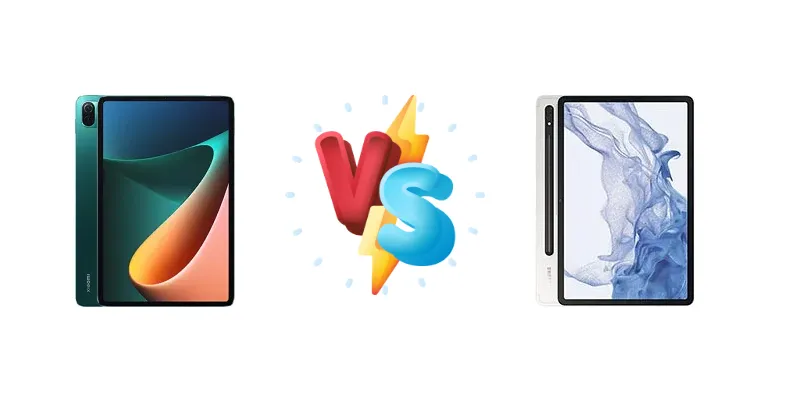
The tablet market is heating up, and two contenders are vying for your attention: the Xiaomi Pad 5 and the Samsung Galaxy Tab S8. Both offer compelling features, but cater to different needs and budgets. Let's dive into a detailed comparison to help you decide which one is right for you.
🏆 Quick Verdict
The Samsung Galaxy Tab S8 takes the crown with its superior performance, vibrant display, and S Pen support. However, the Xiaomi Pad 5 offers excellent value for money, providing a solid experience at a more affordable price point. It's a clear win for Samsung, but Xiaomi remains a strong contender.
| Network |
|---|
| 2G bands | N/A | GSM 850 / 900 / 1800 / 1900 |
| 3G bands | N/A | HSDPA 850 / 900 / 1700(AWS) / 1900 / 2100 |
| 4G bands | - | LTE |
| 5G bands | - | SA/NSA |
| EDGE | N/A | - |
| GPRS | N/A | - |
| Speed | - | HSPA, LTE, 5G - cellular model only |
| Technology | No cellular connectivity | GSM / HSPA / LTE / 5G |
| Launch |
|---|
| Announced | 2021, August 10 | 2022, February 09 |
| Status | Available. Released 2021, August 10 | Available. Released 2022, March 22 |
| Body |
|---|
| Build | Glass front, aluminum frame, plastic back | - |
| Dimensions | 254.7 x 166.3 x 6.9 mm (10.03 x 6.55 x 0.27 in) | 253.8 x 165.3 x 6.3 mm (9.99 x 6.51 x 0.25 in) |
| SIM | No | Nano-SIM (cellular model only) |
| Weight | 511 g (1.13 lb) | 503 g (Wi-Fi), 507 g (5G) (1.11 lb) |
| | Stylus support (magnetic) | Stylus, 6.2ms latency (Bluetooth integration, accelerometer, gyro) |
| Display |
|---|
| Protection | - | Corning Gorilla Glass 5 |
| Resolution | 1600 x 2560 pixels, 16:10 ratio (~274 ppi density) | 1600 x 2560 pixels, 16:10 ratio (~274 ppi density) |
| Size | 11.0 inches, 350.9 cm2 (~82.8% screen-to-body ratio) | 11.0 inches, 350.9 cm2 (~83.6% screen-to-body ratio) |
| Type | IPS LCD, 1B colors, 120Hz, HDR10, Dolby Vision | TFT LCD, 120Hz |
| Platform |
|---|
| CPU | Octa-core (1x2.96 GHz Kryo 485 Gold & 3x2.42 GHz Kryo 485 Gold & 4x1.78 GHz Kryo 485 Silver) | Octa-core (1x3.00 GHz Cortex-X2 & 3x2.50 GHz Cortex-A710 & 4x1.80 GHz Cortex-A510) |
| Chipset | Qualcomm Snapdragon 860 (7 nm) | Qualcomm SM8450 Snapdragon 8 Gen 1 (4 nm) |
| GPU | Adreno 640 | Adreno 730 |
| OS | Android 11, upgradable to Android 13, MIUI 14 | Android 12, up to 4 major Android upgrades, One UI 6.1.1 |
| Memory |
|---|
| Card slot | No | microSDXC (dedicated slot) |
| Internal | 128GB 6GB RAM, 256GB 6GB RAM | 128GB 8GB RAM, 256GB 8GB RAM, 256GB 12GB RAM |
| | UFS 3.1 | UFS |
| Main Camera |
|---|
| Dual | - | 13 MP, f/2.0, 26mm (wide), 1/3.4", 1.0µm, AF
6 MP, f/2.2, (ultrawide) |
| Features | Dual-LED flash, HDR, panorama | LED flash, HDR, panorama |
| Single | 13 MP, f/2.0 | - |
| Video | 4K@30fps, 1080p@30fps | 4K@30/60fps, 1080p@30fps |
| Selfie camera |
|---|
| Dual | - | 12 MP, f/2.4, 120˚ (ultrawide) |
| Features | - | HDR |
| Single | 8 MP, f/2.0 | - |
| Video | 1080p@30fps | 4K@30/60fps, 1080p@30fps |
| Sound |
|---|
| 3.5mm jack | No | No |
| 35mm jack | No | No |
| Loudspeaker | Yes, with stereo speakers (4 speakers) | Yes, with stereo speakers (4 speakers) |
| | 24-bit/192kHz audio | Tuned by AKG |
| Comms |
|---|
| Bluetooth | 5.0, A2DP, LE | 5.2, A2DP, LE |
| NFC | No | No |
| Positioning | No | GPS, GLONASS, BDS, GALILEO - cellular model only |
| Radio | No | No |
| USB | USB Type-C | USB Type-C 3.2, magnetic connector |
| WLAN | Wi-Fi 802.11 a/b/g/n/ac, dual-band, Wi-Fi Direct | Wi-Fi 802.11 a/b/g/n/ac/6e, dual-band, Wi-Fi Direct |
| Features |
|---|
| Sensors | Accelerometer, gyro, proximity, compass | Fingerprint (side-mounted), accelerometer, gyro, proximity, compass |
| | - | Wireless Samsung DeX |
| Battery |
|---|
| Charging | 33W wired, PD3.0 | 45W wired, 100% in 80 min |
| Type | Li-Po 8720 mAh | Li-Po 8000 mAh |
| Misc |
|---|
| Colors | Cosmic Gray, Pearl White, Green | Graphite, Silver, Pink Gold |
| Models | 21051182G, 21051182C | SM-X700, SM-X706, SM-X706B, SM-X706U, SM-X706N |
| Price | About 350 EUR | About 350 EUR |
| SAR EU | - | 0.87 W/kg (body) |
| Tests |
|---|
| Display |
Contrast ratio: 1271:1 (nominal) | - |
| Loudspeaker |
-24.4 LUFS (Very good)
| - |
| Performance |
AnTuTu: 473819 (v8), 555079 (v9)
GeekBench: 2583 (v5.1)
GFXBench: 24fps (ES 3.1 onscreen) | - |
Xiaomi Pad 5
- Excellent value for money
- Large, vibrant display
- Good performance for the price
- 33W fast charging
- Performance lags behind the Tab S8
- Camera quality is average
- LCD display not as vibrant as AMOLED
- No S Pen support
Samsung Galaxy Tab S8
- Top-tier performance
- Stunning AMOLED display with 120Hz
- S Pen included
- Excellent camera quality
- Fast 45W charging
- More expensive
- Can get warm under heavy load
- Software updates can be slow
Display Comparison
The Samsung Galaxy Tab S8 boasts a brighter and more vibrant 120Hz AMOLED display, offering richer colors and smoother scrolling. While the Xiaomi Pad 5's LCD display has a good contrast ratio, it lacks the punch and responsiveness of the Tab S8's AMOLED panel. The Tab S8's display is simply in a different league.
Camera Comparison
The Samsung Galaxy Tab S8 generally offers better camera quality, with improved image processing and more detail. While neither tablet is a photography powerhouse, the Tab S8's cameras are noticeably better, especially in low-light conditions. The Xiaomi Pad 5's cameras are adequate for basic use.
Performance
The Snapdragon 8 Gen 1 in the Galaxy Tab S8 significantly outperforms the Snapdragon 860 in the Xiaomi Pad 5. Expect faster app loading times, smoother multitasking, and better gaming performance on the Tab S8. The Tab S8 handles demanding tasks with ease, while the Pad 5 can show signs of strain under heavy load.
Battery Life
Both tablets offer decent battery life, but the Samsung Galaxy Tab S8's larger battery and efficient processor give it a slight edge. The 45W charging on the Tab S8 also allows for faster charging times compared to the Xiaomi Pad 5's 33W charging.
Buying Guide
The Xiaomi Pad 5 is ideal for students, casual users, and those on a budget who want a large, capable tablet for media consumption and light productivity. The Samsung Galaxy Tab S8 is perfect for creative professionals, power users, and anyone who demands top-tier performance, a stunning display, and the versatility of the S Pen.
Frequently Asked Questions
❓ Is the Xiaomi Pad 5 good for gaming?
The Xiaomi Pad 5 is decent for casual gaming, but it may struggle with demanding titles at high settings. The Samsung Galaxy Tab S8 offers a significantly better gaming experience.
❓ Does the Samsung Galaxy Tab S8 come with a stylus?
Yes, the Samsung Galaxy Tab S8 includes the S Pen, providing excellent note-taking and drawing capabilities.