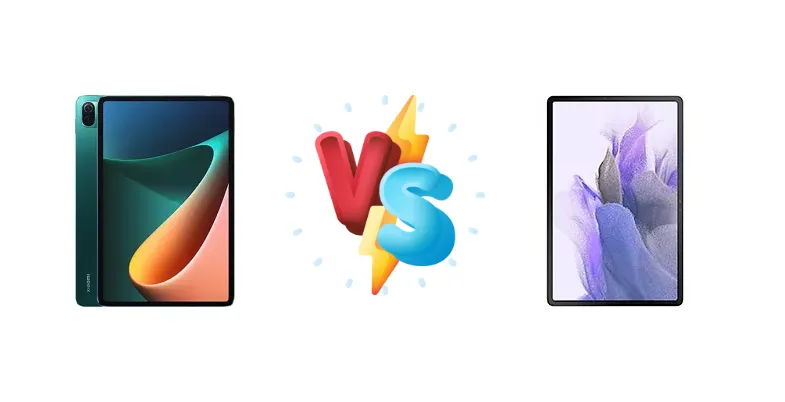
The Android tablet market is heating up, and two contenders are vying for your attention: the Xiaomi Pad 5 and the Samsung Galaxy Tab S7 FE. Both offer compelling features at different price points, but which one truly delivers the best experience? Let's dive into a detailed comparison to help you decide.
🏆 Quick Verdict
The Samsung Galaxy Tab S7 FE offers a more refined experience with its brighter display, faster charging, and generally smoother software. However, the Xiaomi Pad 5 provides excellent value with its powerful Snapdragon 860 chipset, making it a strong choice for budget-conscious users seeking performance.
| Network |
|---|
| 2G bands | N/A | GSM 850 / 900 / 1800 / 1900 |
| 3G bands | N/A | HSDPA 850 / 900 / 1700(AWS) / 1900 / 2100 |
| 4G bands | - | 1, 2, 3, 4, 5, 7, 8, 12, 13, 17, 20, 25, 26, 28, 32, 38, 40, 41, 66 |
| 5G bands | - | 1, 3, 5, 7, 8, 20, 28, 38, 40, 41, 77, 78 SA/NSA/Sub6 |
| EDGE | N/A | - |
| GPRS | N/A | - |
| Speed | - | HSPA, LTE, 5G - cellular model only |
| Technology | No cellular connectivity | GSM / HSPA / LTE / 5G |
| Launch |
|---|
| Announced | 2021, August 10 | 2021, May 25 |
| Status | Available. Released 2021, August 10 | Available. Released 2021, June 18 |
| Body |
|---|
| Build | Glass front, aluminum frame, plastic back | Glass front, aluminum back, aluminum frame |
| Dimensions | 254.7 x 166.3 x 6.9 mm (10.03 x 6.55 x 0.27 in) | 284.8 x 185 x 6.3 mm (11.21 x 7.28 x 0.25 in) |
| SIM | No | Nano-SIM (cellular model only) |
| Weight | 511 g (1.13 lb) | 608 g (1.34 lb) |
| | Stylus support (magnetic) | Stylus support |
| Display |
|---|
| Resolution | 1600 x 2560 pixels, 16:10 ratio (~274 ppi density) | 1600 x 2560 pixels, 16:10 ratio (~243 ppi density) |
| Size | 11.0 inches, 350.9 cm2 (~82.8% screen-to-body ratio) | 12.4 inches, 445.8 cm2 (~84.6% screen-to-body ratio) |
| Type | IPS LCD, 1B colors, 120Hz, HDR10, Dolby Vision | TFT LCD |
| Platform |
|---|
| CPU | Octa-core (1x2.96 GHz Kryo 485 Gold & 3x2.42 GHz Kryo 485 Gold & 4x1.78 GHz Kryo 485 Silver) | Octa-core (2x2.2 GHz Kryo 570 & 6x1.8 GHz Kryo 570) - 5G modelOcta-core (1x2.4 GHz Cortex-A78 & 3x2.2 GHz Cortex-A78 & 4x1.9 GHz Cortex-A55) - Wi-Fi model |
| Chipset | Qualcomm Snapdragon 860 (7 nm) | Qualcomm SM7225 Snapdragon 750G 5G (8 nm) - 5G modelQualcomm SM7325 Snapdragon 778G 5G (6 nm) - Wi-Fi model |
| GPU | Adreno 640 | Adreno 619 - 5G modelAdreno 642L - Wi-Fi model |
| OS | Android 11, upgradable to Android 13, MIUI 14 | Android 11, upgradable to Android 14, One UI 6 |
| Memory |
|---|
| Card slot | No | microSDXC (dedicated slot) |
| Internal | 128GB 6GB RAM, 256GB 6GB RAM | 64GB 4GB RAM, 128GB 6GB RAM, 256GB 8GB RAM |
| | UFS 3.1 | - |
| Main Camera |
|---|
| Features | Dual-LED flash, HDR, panorama | - |
| Single | 13 MP, f/2.0 | 8 MP, AF |
| Video | 4K@30fps, 1080p@30fps | 1080p@30fps |
| Selfie camera |
|---|
| Single | 8 MP, f/2.0 | 5 MP |
| Video | 1080p@30fps | 1080p@30fps |
| Sound |
|---|
| 3.5mm jack | No | No |
| 35mm jack | No | No |
| Loudspeaker | Yes, with stereo speakers (4 speakers) | Yes, with stereo speakers |
| | 24-bit/192kHz audio | Tuned by AKG |
| Comms |
|---|
| Bluetooth | 5.0, A2DP, LE | 5.2, A2DP, LE (Wi-Fi), 5.2, A2DP, LE (5G) |
| NFC | No | No |
| Positioning | No | GPS, GLONASS, BDS, GALILEO - cellular model only |
| Radio | No | No |
| USB | USB Type-C | USB Type-C 3.2, magnetic connector |
| WLAN | Wi-Fi 802.11 a/b/g/n/ac, dual-band, Wi-Fi Direct | Wi-Fi 802.11 a/b/g/n/ac/6 (Wi-Fi), Wi-Fi 802.11 a/b/g/n/ac (5G) |
| Features |
|---|
| Sensors | Accelerometer, gyro, proximity, compass | Accelerometer, proximity, compass, gyro (5G model only) |
| | - | Samsung DeX |
| Battery |
|---|
| Charging | 33W wired, PD3.0 | 45W wired, 100% in 190 min |
| Type | Li-Po 8720 mAh | Li-Po 10090 mAh |
| Misc |
|---|
| Colors | Cosmic Gray, Pearl White, Green | Mystic Black, Mystic Silver, Mystic Green, Mystic Pink |
| Models | 21051182G, 21051182C | SM-T730, SM-T733, SM-T736B, SM-T735 |
| Price | About 350 EUR | About 650 EUR |
| SAR EU | - | 1.15 W/kg (body) |
| Tests |
|---|
| Display |
Contrast ratio: 1271:1 (nominal) | Contrast ratio: 1886:1 (nominal) |
| Loudspeaker |
-24.4 LUFS (Very good)
| -27.2 LUFS (Good) |
| Performance |
AnTuTu: 473819 (v8), 555079 (v9)
GeekBench: 2583 (v5.1)
GFXBench: 24fps (ES 3.1 onscreen) | AnTuTu: 292530 (v8), 355430 (v9)
GeekBench: 1904 (v5.1)
GFXBench: 9.7fps (ES 3.1 onscreen) |
Xiaomi Pad 5
- Excellent performance for the price
- Smooth 120Hz display
- Good value
- Decent speakers
- Lower brightness display compared to Tab S7 FE
- Slower charging
- Less refined software experience
Samsung Galaxy Tab S7 FE
- Brighter and more vibrant display
- S Pen support
- Faster charging
- Premium design and build quality
- Generally smoother software
- Higher price
- Performance not as strong as Xiaomi Pad 5
- Can be slightly slower in demanding tasks
Display Comparison
The Samsung Galaxy Tab S7 FE boasts a slightly brighter display (522 nits vs 478 nits) and a higher contrast ratio (1886:1 vs 1271:1), resulting in more vibrant colors and deeper blacks. Both tablets feature a 120Hz refresh rate for smooth scrolling, but Samsung's panel edges out Xiaomi's in overall visual quality. The Tab S7 FE also includes S Pen support, a significant advantage for note-taking and creative tasks.
Camera Comparison
Camera quality is generally not a primary concern for tablets, but the Tab S7 FE typically offers slightly better image quality in both front and rear cameras. The Xiaomi Pad 5's cameras are adequate for basic use, but lack the refinement of the Samsung.
Performance
The Xiaomi Pad 5 holds a performance edge thanks to its Snapdragon 860 chipset. While the Samsung Tab S7 FE's Snapdragon 750G/778G is capable, the 860 offers noticeably faster processing speeds, particularly beneficial for demanding games and multitasking. The Wi-Fi version of the Tab S7 FE has a slight performance advantage over the 5G version.
Battery Life
The Samsung Galaxy Tab S7 FE has a larger battery capacity and faster charging (45W vs 33W), allowing it to charge significantly quicker. Both tablets offer respectable battery life for everyday use, but the Tab S7 FE's faster charging provides a noticeable convenience.
Buying Guide
The Xiaomi Pad 5 is ideal for users prioritizing performance and gaming on a budget. The Samsung Galaxy Tab S7 FE is better suited for those who value a vibrant display, S Pen support, and a more premium overall experience, even if it comes at a higher price.
Frequently Asked Questions
❓ Which tablet is better for gaming?
The Xiaomi Pad 5 generally offers better gaming performance due to its more powerful Snapdragon 860 chipset.
❓ Does the Samsung Tab S7 FE come with the S Pen?
Yes, the Samsung Galaxy Tab S7 FE includes the S Pen stylus, providing a versatile tool for note-taking, drawing, and navigation.
❓ Which tablet has better software support?
Samsung typically provides longer software update support for its tablets compared to Xiaomi.