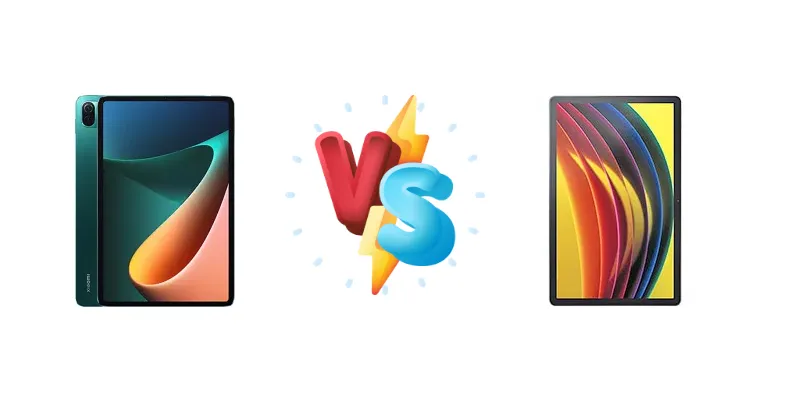
The Android tablet market is heating up, with options ranging from ultra-premium to budget-friendly. The Xiaomi Pad 5 and Lenovo Tab P11 Plus represent compelling choices in the mid-range, but cater to different priorities. The Pad 5 aims for near-flagship performance, while the P11 Plus focuses on delivering a solid experience at a more accessible price point. This comparison dives deep into the specs and real-world implications to determine which tablet best suits your needs.
🏆 Quick Verdict
For users prioritizing performance and a brighter display, the Xiaomi Pad 5 is the clear winner. Its Snapdragon 860 chipset delivers significantly more processing power than the Lenovo Tab P11 Plus’s Helio G90T. However, the P11 Plus offers a respectable experience for everyday tasks and media consumption at a lower cost.
| Network |
|---|
| 2G bands | N/A | GSM 850 / 900 / 1800 / 1900 |
| 3G bands | N/A | HSDPA 850 / 900 / 1900 / 2100 |
| 4G bands | - | 1, 2, 3, 4, 5, 7, 8, 20, 28, 38, 40, 41 |
| EDGE | N/A | - |
| GPRS | N/A | - |
| Speed | - | HSPA, LTE - cellular model only |
| Technology | No cellular connectivity | GSM / HSPA / LTE |
| Launch |
|---|
| Announced | 2021, August 10 | 2021, June 28 |
| Status | Available. Released 2021, August 10 | Available. Released 2021, July 29 |
| Body |
|---|
| Build | Glass front, aluminum frame, plastic back | - |
| Dimensions | 254.7 x 166.3 x 6.9 mm (10.03 x 6.55 x 0.27 in) | 258.4 x 163 x 7.5 mm (10.17 x 6.42 x 0.30 in) |
| SIM | No | Nano-SIM (cellular model only) |
| Weight | 511 g (1.13 lb) | 490 g (1.08 lb) |
| | Stylus support (magnetic) | Stylus support |
| Display |
|---|
| Resolution | 1600 x 2560 pixels, 16:10 ratio (~274 ppi density) | 1200 x 2000 pixels, 5:3 ratio (~212 ppi density) |
| Size | 11.0 inches, 350.9 cm2 (~82.8% screen-to-body ratio) | 11.0 inches, 344.4 cm2 (~81.8% screen-to-body ratio) |
| Type | IPS LCD, 1B colors, 120Hz, HDR10, Dolby Vision | IPS LCD, 400 nits (typ) |
| Platform |
|---|
| CPU | Octa-core (1x2.96 GHz Kryo 485 Gold & 3x2.42 GHz Kryo 485 Gold & 4x1.78 GHz Kryo 485 Silver) | Octa-core (2x2.05 GHz Cortex-A76 & 6x2.0 GHz Cortex-A55) |
| Chipset | Qualcomm Snapdragon 860 (7 nm) | Mediatek MT6785 Helio G90T (12 nm) |
| GPU | Adreno 640 | Mali-G76 MC4 |
| OS | Android 11, upgradable to Android 13, MIUI 14 | Android 11 |
| Memory |
|---|
| Card slot | No | microSDXC (dedicated slot) |
| Internal | 128GB 6GB RAM, 256GB 6GB RAM | 64GB 4GB RAM, 128GB 4GB RAM, 128GB 6GB RAM |
| | UFS 3.1 | - |
| Main Camera |
|---|
| Features | Dual-LED flash, HDR, panorama | LED flash |
| Single | 13 MP, f/2.0 | 13 MP, (wide), AF |
| Video | 4K@30fps, 1080p@30fps | 1080p@30fps |
| Selfie camera |
|---|
| Single | 8 MP, f/2.0 | 8 MP, (wide) |
| Video | 1080p@30fps | 1080p@30fps |
| Sound |
|---|
| 3.5mm jack | No | No |
| 35mm jack | No | No |
| Loudspeaker | Yes, with stereo speakers (4 speakers) | Yes, with stereo speakers (4 speakers) |
| | 24-bit/192kHz audio | - |
| Comms |
|---|
| Bluetooth | 5.0, A2DP, LE | 5.1, A2DP, LE |
| NFC | No | No |
| Positioning | No | GPS, GLONASS, BDS - cellular model only |
| Radio | No | FM radio |
| USB | USB Type-C | USB Type-C 2.0 |
| WLAN | Wi-Fi 802.11 a/b/g/n/ac, dual-band, Wi-Fi Direct | Wi-Fi 802.11 a/b/g/n/ac, dual-band, Wi-Fi Direct |
| Features |
|---|
| Sensors | Accelerometer, gyro, proximity, compass | Accelerometer, gyro, proximity |
| Battery |
|---|
| Charging | 33W wired, PD3.0 | 20W wired |
| Type | Li-Po 8720 mAh | Li-Po 7700 mAh |
| Misc |
|---|
| Colors | Cosmic Gray, Pearl White, Green | Slate Grey, Platinum Grey, Modernist teal |
| Models | 21051182G, 21051182C | ZA940124SE |
| Price | About 350 EUR | About 300 EUR |
| Tests |
|---|
| Display |
Contrast ratio: 1271:1 (nominal) | - |
| Loudspeaker |
-24.4 LUFS (Very good)
| - |
| Performance |
AnTuTu: 473819 (v8), 555079 (v9)
GeekBench: 2583 (v5.1)
GFXBench: 24fps (ES 3.1 onscreen) | - |
Xiaomi Pad 5
- Significantly faster processor for gaming and multitasking
- Brighter and higher contrast display for better viewing
- Faster 33W charging with PD3.0 support
- Likely higher price point
- May require separate purchase of keyboard and stylus accessories
Lenovo Tab P11 Plus
- More affordable price
- Potentially longer battery life during light usage
- Good for basic tasks like browsing and video streaming
- Slower processor struggles with demanding tasks
- Slower 20W charging
- Display is less vibrant and bright
Display Comparison
The Xiaomi Pad 5 boasts a brighter display, reaching a measured 478 nits compared to an assumed lower brightness on the P11 Plus (Lenovo does not publish this data). This makes the Pad 5 more usable outdoors or in brightly lit environments. Both tablets feature similar resolutions, but the Pad 5’s 1271:1 contrast ratio suggests deeper blacks and more vibrant colors. While both likely utilize IPS LCD panels, the superior brightness and contrast of the Pad 5 provide a noticeably better viewing experience. Bezels appear comparable based on available imagery, but the overall visual impact favors the Xiaomi device.
Camera Comparison
Neither tablet is a photography powerhouse, but the Xiaomi Pad 5 likely holds an advantage due to its more powerful ISP (Image Signal Processor) integrated within the Snapdragon 860. While specific camera specs are not provided for either device, the Pad 5’s chipset allows for more sophisticated image processing, potentially resulting in better dynamic range and low-light performance. The P11 Plus’s Helio G90T, while capable, is less equipped to handle complex image processing tasks. We’d advise against relying on either tablet for serious photography.
Performance
The core difference lies in the chipsets. The Xiaomi Pad 5’s Qualcomm Snapdragon 860 (7nm) is a significant step up from the Lenovo Tab P11 Plus’s MediaTek Helio G90T (12nm). The Snapdragon 860’s Kryo 485 cores, with their varied clock speeds (2.96 GHz, 2.42 GHz, and 1.78 GHz), offer a more balanced and powerful CPU configuration than the G90T’s Cortex-A76 (2.05 GHz) and A55 (2.0 GHz) setup. The 7nm fabrication process of the Snapdragon 860 also translates to better thermal efficiency, reducing the likelihood of performance throttling during extended gaming sessions. This means the Pad 5 will maintain higher frame rates and smoother performance for longer periods.
Battery Life
The Lenovo Tab P11 Plus features 20W wired charging, while the Xiaomi Pad 5 supports faster 33W charging with PD3.0. This means the Pad 5 will charge from 0-100% significantly faster than the P11 Plus. While battery capacity isn’t specified for either device, the faster charging of the Pad 5 mitigates any potential disadvantage from a slightly smaller battery. The Snapdragon 860’s improved efficiency also contributes to better battery life during demanding tasks, despite the faster charging.
Buying Guide
Buy the Xiaomi Pad 5 if you need a tablet capable of handling demanding games, video editing, or multitasking without slowdowns. It’s ideal for students, creative professionals, or anyone who wants a responsive and future-proof device. Buy the Lenovo Tab P11 Plus if you prioritize affordability and a larger screen for media consumption, light productivity, and casual gaming. It’s a great choice for families or users who primarily browse the web and stream videos.
Frequently Asked Questions
❓ Will the Xiaomi Pad 5 handle graphically intensive games like Genshin Impact smoothly?
Yes, the Snapdragon 860 in the Xiaomi Pad 5 is capable of running Genshin Impact at medium to high settings with stable frame rates. The 7nm process and optimized GPU ensure sustained performance, minimizing throttling during extended gaming sessions. The Lenovo Tab P11 Plus will struggle with these titles.
❓ Is the Lenovo Tab P11 Plus suitable for taking notes with a stylus?
While the Lenovo Tab P11 Plus supports a stylus (sold separately), the experience won't be as refined as on the Xiaomi Pad 5. The P11 Plus’s display lacks the high refresh rate and low latency of some premium tablets, which can result in noticeable lag when writing or drawing. The Pad 5, with its faster processor and potentially lower latency display, offers a more responsive stylus experience.
❓ Does the Xiaomi Pad 5 support external displays via USB-C?
Yes, the Xiaomi Pad 5, thanks to the capabilities of the Snapdragon 860 and USB-C port, supports connecting to external displays. You can mirror your screen or extend it for a more productive workspace. The P11 Plus likely supports this as well, but the Snapdragon 860 will provide a smoother experience with higher resolutions.