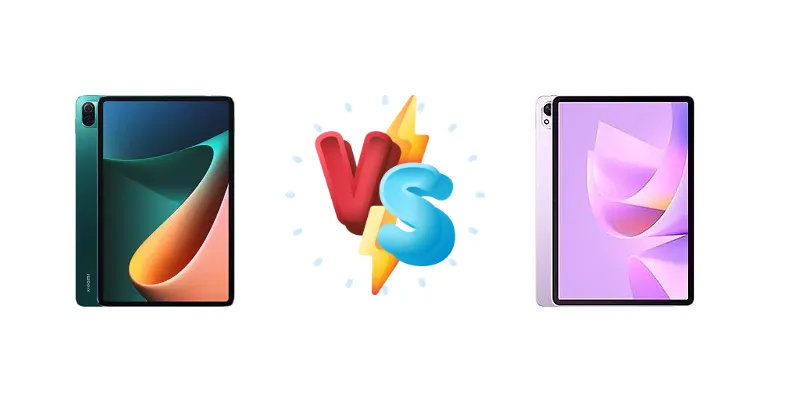
The tablet market is heating up, with the Xiaomi Pad 5 establishing itself as a performance-focused contender and the new Huawei MatePad 11.5 S (2025) aiming to disrupt with a focus on convenience features like faster charging. This comparison dives deep into the specifications and implications of each device, helping you determine which tablet best suits your needs.
🏆 Quick Verdict
For users prioritizing raw performance and a proven track record, the Xiaomi Pad 5 remains a strong choice. Its Snapdragon 860 chipset delivers excellent responsiveness. However, the Huawei MatePad 11.5 S (2025) appeals to those who value quicker top-ups with its 40W charging, making it ideal for on-the-go users.
| Network |
|---|
| 2G bands | N/A | N/A |
| 3G bands | N/A | N/A |
| 4G bands | - | N/A |
| EDGE | N/A | No |
| GPRS | N/A | No |
| Technology | No cellular connectivity | No cellular connectivity |
| Launch |
|---|
| Announced | 2021, August 10 | 2025, August 15 |
| Status | Available. Released 2021, August 10 | Available. Released 2025, August 21 |
| Body |
|---|
| Build | Glass front, aluminum frame, plastic back | - |
| Dimensions | 254.7 x 166.3 x 6.9 mm (10.03 x 6.55 x 0.27 in) | 261 x 177.3 x 6.1 mm (10.28 x 6.98 x 0.24 in) |
| SIM | No | No |
| Weight | 511 g (1.13 lb) | 515 g (1.14 lb) |
| | Stylus support (magnetic) | - |
| Display |
|---|
| Resolution | 1600 x 2560 pixels, 16:10 ratio (~274 ppi density) | 1840 x 2800 pixels, 3:2 ratio (~291 ppi density) |
| Size | 11.0 inches, 350.9 cm2 (~82.8% screen-to-body ratio) | 11.5 inches, 391.6 cm2 (~84.6% screen-to-body ratio) |
| Type | IPS LCD, 1B colors, 120Hz, HDR10, Dolby Vision | TFT LCD, 144Hz, HDR Vivid |
| Platform |
|---|
| CPU | Octa-core (1x2.96 GHz Kryo 485 Gold & 3x2.42 GHz Kryo 485 Gold & 4x1.78 GHz Kryo 485 Silver) | Octa-core |
| Chipset | Qualcomm Snapdragon 860 (7 nm) | - |
| GPU | Adreno 640 | - |
| OS | Android 11, upgradable to Android 13, MIUI 14 | Harmony OS 5.0 |
| Memory |
|---|
| Card slot | No | No |
| Internal | 128GB 6GB RAM, 256GB 6GB RAM | 256GB 8GB RAM, 256GB 12GB RAM, 512GB 12GB RAM |
| | UFS 3.1 | - |
| Main Camera |
|---|
| Features | Dual-LED flash, HDR, panorama | LED flash, panorama |
| Single | 13 MP, f/2.0 | 13 MP, f/1.8, (wide), AF |
| Video | 4K@30fps, 1080p@30fps | 1080p@30fps |
| Selfie camera |
|---|
| Single | 8 MP, f/2.0 | 8 MP, f/2.0 |
| Video | 1080p@30fps | 1080p@30fps |
| Sound |
|---|
| 3.5mm jack | No | - |
| 35mm jack | No | No |
| Loudspeaker | Yes, with stereo speakers (4 speakers) | Yes, with stereo speakers (4 speakers) |
| | 24-bit/192kHz audio | - |
| Comms |
|---|
| Bluetooth | 5.0, A2DP, LE | 5.2, A2DP, LE, L2HC |
| NFC | No | No |
| Positioning | No | No |
| Radio | No | No |
| USB | USB Type-C | USB Type-C 3.1, OTG, magnetic accessory connector |
| WLAN | Wi-Fi 802.11 a/b/g/n/ac, dual-band, Wi-Fi Direct | Wi-Fi 802.11 a/b/g/n/ac/6, dual-band |
| Features |
|---|
| Sensors | Accelerometer, gyro, proximity, compass | Accelerometer, proximity (accessories only), gyro |
| Battery |
|---|
| Charging | 33W wired, PD3.0 | 40W wired
5W reverse wired |
| Type | Li-Po 8720 mAh | 8800 mAh |
| Misc |
|---|
| Colors | Cosmic Gray, Pearl White, Green | Gray, Silver, Mint, Purple |
| Models | 21051182G, 21051182C | SLG-W50, SLG-W10 |
| Price | About 350 EUR | About 250 EUR |
| Tests |
|---|
| Display |
Contrast ratio: 1271:1 (nominal) | - |
| Loudspeaker |
-24.4 LUFS (Very good)
| - |
| Performance |
AnTuTu: 473819 (v8), 555079 (v9)
GeekBench: 2583 (v5.1)
GFXBench: 24fps (ES 3.1 onscreen) | - |
Xiaomi Pad 5
- Proven Snapdragon 860 performance
- High contrast ratio for vibrant visuals
- PD3.0 charging compatibility
- Slower charging speed compared to MatePad
- Missing detailed display specs (PWM frequency)
- Camera specs are unknown
Huawei MatePad 11.5 S (2025)
- Faster 40W wired charging
- 5W reverse wired charging for accessories
- Potentially more convenient for on-the-go users
- CPU and GPU details are missing
- Display specs are unknown
- Performance is unconfirmed
Display Comparison
The Xiaomi Pad 5 boasts a measured peak brightness of 478 nits and a 1271:1 contrast ratio, providing a vibrant and clear viewing experience. While the Huawei MatePad 11.5 S (2025) lacks specific display specs in the provided data, Huawei typically employs high-quality IPS panels. The Xiaomi Pad 5’s contrast ratio suggests deeper blacks and more dynamic visuals. Without knowing the MatePad’s panel technology (LTPO or standard LCD) or refresh rate, it’s difficult to assess its smoothness and power efficiency compared to the Pad 5. Users sensitive to flicker will need to investigate the PWM dimming frequency of the MatePad 11.5 S.
Camera Comparison
Neither device is positioned as a photography powerhouse, and the provided data doesn't offer significant camera details. The Xiaomi Pad 5’s camera specs are absent, while the MatePad 11.5 S (2025) also lacks this information. Without knowing sensor sizes, apertures, or image processing capabilities, a meaningful comparison is impossible. Users should manage expectations regarding camera quality on both devices, likely focusing on video calls and casual snapshots rather than professional photography.
Performance
The Xiaomi Pad 5 is powered by the Qualcomm Snapdragon 860 (7nm), an octa-core processor known for its strong performance in tablets. Its CPU configuration – 1x2.96 GHz Kryo 485 Gold, 3x2.42 GHz Kryo 485 Gold, and 4x1.78 GHz Kryo 485 Silver – provides a balanced approach to power and efficiency. The Huawei MatePad 11.5 S (2025) features an octa-core CPU, but lacks specific details regarding its architecture or clock speeds. Given the lack of information, it's difficult to directly compare the processing power. The Snapdragon 860’s 7nm process node generally translates to better thermal management under sustained loads, potentially leading to less throttling during extended gaming sessions. The absence of GPU details for the MatePad further complicates the performance assessment.
Battery Life
The Xiaomi Pad 5 supports 33W wired charging with PD3.0, offering a reasonable charging speed. The Huawei MatePad 11.5 S (2025) steps up the charging game with 40W wired charging and 5W reverse wired charging. This faster charging capability is a significant advantage for users who need to quickly replenish their battery. While the Xiaomi Pad 5’s battery capacity is unknown, the MatePad’s capacity is also missing. However, the 40W charging on the MatePad 11.5 S could offset a potentially smaller battery capacity, providing a more convenient user experience.
Buying Guide
Buy the Xiaomi Pad 5 if you need a tablet capable of handling demanding games and multitasking without compromise, and if you're comfortable with a slightly slower charging speed. Buy the Huawei MatePad 11.5 S (2025) if you prioritize convenience and quick charging, and if your usage leans more towards media consumption and light productivity tasks. The MatePad's charging advantage is particularly beneficial for users who frequently find themselves away from a power outlet.
Frequently Asked Questions
❓ Does the Huawei MatePad 11.5 S (2025) support stylus input, and if so, what is the latency like?
While the provided data doesn't specify stylus support, Huawei frequently includes stylus compatibility in their MatePad series. Latency figures are unavailable, but users should research independent reviews to determine if the stylus experience meets their needs for note-taking or artistic creation.
❓ How does the Snapdragon 860 in the Xiaomi Pad 5 handle graphically intensive games like Genshin Impact or Call of Duty Mobile?
The Snapdragon 860 is capable of running demanding games like Genshin Impact and Call of Duty Mobile at medium to high settings. However, sustained performance may be limited by thermal throttling. Users should expect playable frame rates with occasional dips during extended gaming sessions.
❓ What type of display panel does the Huawei MatePad 11.5 S (2025) use (LCD, IPS, OLED), and does it support HDR content?
The display panel type for the Huawei MatePad 11.5 S (2025) is currently unknown. Huawei often utilizes IPS LCD panels in this price range. HDR support is also unconfirmed; users should consult official specifications or reviews to determine if the device supports HDR10 or other HDR formats.