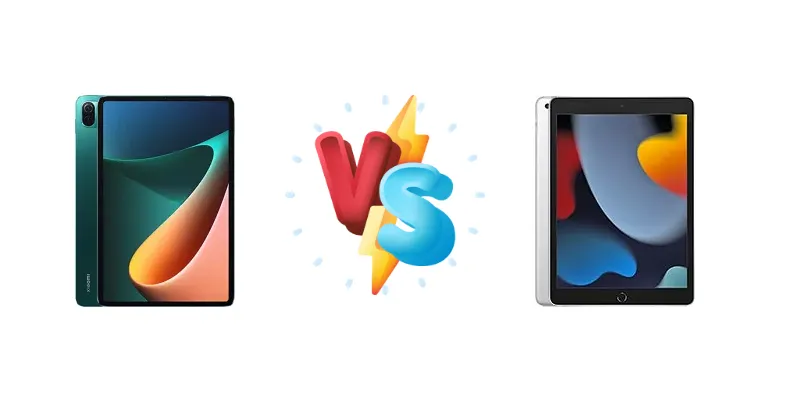
The tablet market is heating up, and two contenders are vying for your attention: the Xiaomi Pad 5 and the Apple iPad 10.2 (2021). Both offer compelling features, but cater to different needs and budgets. Let's dive into a detailed comparison to help you decide which one is right for you.
🏆 Quick Verdict
The iPad 10.2 (2021) offers a smoother, more integrated ecosystem and generally better software support. However, the Xiaomi Pad 5 provides significantly more power for the price and a vibrant display. Ultimately, the choice depends on your budget and preferred operating system.
| Network |
|---|
| 2G bands | N/A | GSM 850 / 900 / 1800 / 1900 |
| 3G bands | N/A | HSDPA 800 / 850 / 900 / 1700(AWS) / 1900 / 2100 |
| 4G bands | - | 1, 2, 3, 4, 5, 7, 8, 11, 12, 13, 14, 17, 18, 19, 20, 21, 25, 26, 29, 30, 34, 38, 39, 40, 41, 66, 71 - A2603 |
| EDGE | N/A | - |
| GPRS | N/A | - |
| Speed | - | HSPA, LTE - cellular model only |
| Technology | No cellular connectivity | GSM / HSPA / LTE |
| | - | 1, 2, 3, 4, 5, 7, 8, 11, 12, 13, 14, 17, 18, 19, 20, 21, 25, 26, 28, 29, 30, 34, 38, 39, 40, 41, 66 - A2604 |
| Launch |
|---|
| Announced | 2021, August 10 | 2021, September 14 |
| Status | Available. Released 2021, August 10 | Available. Released 2021, September 24 |
| Body |
|---|
| Build | Glass front, aluminum frame, plastic back | Glass front, aluminum back, aluminum frame |
| Dimensions | 254.7 x 166.3 x 6.9 mm (10.03 x 6.55 x 0.27 in) | 250.6 x 174.1 x 7.5 mm (9.87 x 6.85 x 0.30 in) |
| SIM | No | Nano-SIM + eSIM (cellular model only) |
| Weight | 511 g (1.13 lb) | 487 g (Wi-Fi) / 498 g (LTE) (1.07 lb) |
| | Stylus support (magnetic) | Stylus support (1st gen only) |
| Display |
|---|
| Protection | - | Scratch-resistant glass, oleophobic coating |
| Resolution | 1600 x 2560 pixels, 16:10 ratio (~274 ppi density) | 1620 x 2160 pixels, 4:3 ratio (~265 ppi density) |
| Size | 11.0 inches, 350.9 cm2 (~82.8% screen-to-body ratio) | 10.2 inches, 322.2 cm2 (~73.8% screen-to-body ratio) |
| Type | IPS LCD, 1B colors, 120Hz, HDR10, Dolby Vision | Retina IPS LCD, 500 nits (typ) |
| Platform |
|---|
| CPU | Octa-core (1x2.96 GHz Kryo 485 Gold & 3x2.42 GHz Kryo 485 Gold & 4x1.78 GHz Kryo 485 Silver) | Hexa-core (2x2.65 GHz Lightning + 4x1.8 GHz Thunder) |
| Chipset | Qualcomm Snapdragon 860 (7 nm) | Apple A13 Bionic (7 nm+) |
| GPU | Adreno 640 | Apple GPU (4-core graphics) |
| OS | Android 11, upgradable to Android 13, MIUI 14 | iPadOS 15, upgradable to iPadOS 26.1 |
| Memory |
|---|
| Card slot | No | No |
| Internal | 128GB 6GB RAM, 256GB 6GB RAM | 64GB 3GB RAM, 256GB 3GB RAM |
| | UFS 3.1 | - |
| Main Camera |
|---|
| Features | Dual-LED flash, HDR, panorama | HDR, panorama |
| Single | 13 MP, f/2.0 | 8 MP, f/2.4, 31mm (standard), 1.12µm, AF |
| Video | 4K@30fps, 1080p@30fps | 1080p@25/30fps, 720p@120fps; gyro-EIS |
| Selfie camera |
|---|
| Features | - | HDR |
| Single | 8 MP, f/2.0 | 12 MP, f/2.4, 122˚ (ultrawide) |
| Video | 1080p@30fps | 1080p@25/30/60fps, gyro-EIS |
| Sound |
|---|
| 3.5mm jack | No | Yes |
| 35mm jack | No | Yes |
| Loudspeaker | Yes, with stereo speakers (4 speakers) | Yes, with stereo speakers |
| | 24-bit/192kHz audio | - |
| Comms |
|---|
| Bluetooth | 5.0, A2DP, LE | 4.2, A2DP, EDR, LE |
| NFC | No | No |
| Positioning | No | GPS, GLONASS - cellular model only |
| Radio | No | No |
| USB | USB Type-C | Lightning, USB 2.0; magnetic connector |
| WLAN | Wi-Fi 802.11 a/b/g/n/ac, dual-band, Wi-Fi Direct | Wi-Fi 802.11 a/b/g/n/ac, dual-band, hotspot |
| Features |
|---|
| Sensors | Accelerometer, gyro, proximity, compass | Fingerprint (front-mounted), accelerometer, gyro, compass, barometer |
| Battery |
|---|
| Charging | 33W wired, PD3.0 | - |
| Type | Li-Po 8720 mAh | Li-Ion 8557 mAh (32.4 Wh) |
| Misc |
|---|
| Colors | Cosmic Gray, Pearl White, Green | Silver, Space Gray |
| Models | 21051182G, 21051182C | A2603, A2604, iPad12,1, iPad12,2 |
| Price | About 350 EUR | About 430 EUR |
| Tests |
|---|
| Camera | - |
Photo / Video |
| Display |
Contrast ratio: 1271:1 (nominal) |
Contrast ratio: 1123:1 (nominal) |
| Loudspeaker |
-24.4 LUFS (Very good)
|
-29.4 LUFS (Average)
|
| Performance |
AnTuTu: 473819 (v8), 555079 (v9)
GeekBench: 2583 (v5.1)
GFXBench: 24fps (ES 3.1 onscreen) |
AnTuTu: 617292(v9)
GeekBench: 3124 (v5.1)
GFXBench: 44fps (ES 3.1 onscreen) |
Xiaomi Pad 5
- Powerful Snapdragon 860 processor
- Vibrant display with potentially 120Hz refresh rate
- Competitive price
- Fast 33W charging
- Android ecosystem may not appeal to all
- Camera details are limited
- Software update support may be shorter than iPad
Apple iPad 10.2 (2021)
- Seamless integration with Apple ecosystem
- Optimized iPadOS software
- Long-term software updates
- Slightly brighter display
- Higher price point
- Less powerful processor than Xiaomi Pad 5
- No 120Hz refresh rate
Display Comparison
The Xiaomi Pad 5 boasts a slightly higher contrast ratio (1271:1 vs 1123:1) and a marginally brighter display (478 nits vs 513 nits). Both offer excellent viewing angles and color accuracy, but the iPad's slightly higher brightness can be advantageous in direct sunlight. The Xiaomi Pad 5 also often includes a 120Hz refresh rate for smoother scrolling and animations, a feature absent in the iPad 10.2.
Camera Comparison
The iPad 10.2 (2021) includes a photo/video camera, while the Xiaomi Pad 5's camera capabilities are less detailed in the provided specs. Generally, iPads have a reputation for better camera quality, especially in video recording, but the Xiaomi Pad 5's camera is likely adequate for casual use. Specific camera specs (resolution, aperture) would be needed for a more precise comparison.
Performance
The Xiaomi Pad 5's Snapdragon 860 generally outperforms the iPad 10.2's A13 Bionic in raw processing power, particularly in graphics-intensive tasks like gaming. While the A13 is still a capable chip, the 860 provides a noticeable edge. However, iPadOS is highly optimized, so real-world performance differences may not always be drastic.
Battery Life
Battery life is generally comparable between the two devices, both offering all-day usage with moderate use. However, the iPad's power efficiency due to iPadOS optimization can sometimes give it a slight edge. Specific battery capacities (mAh) are needed for a more accurate comparison.
Buying Guide
Who should buy the Xiaomi Pad 5? Users seeking a powerful Android tablet for gaming, media consumption, and productivity on a budget. Who should buy the Apple iPad 10.2 (2021)? Those deeply invested in the Apple ecosystem, prioritizing ease of use, and requiring long-term software updates.
Frequently Asked Questions
❓ Which tablet is better for gaming?
The Xiaomi Pad 5 generally offers better gaming performance due to its more powerful Snapdragon 860 processor.
❓ Is the iPad 10.2 worth the extra cost?
If you're heavily invested in the Apple ecosystem and value long-term software support, the iPad 10.2 is a worthwhile investment. Otherwise, the Xiaomi Pad 5 provides excellent value for its price.