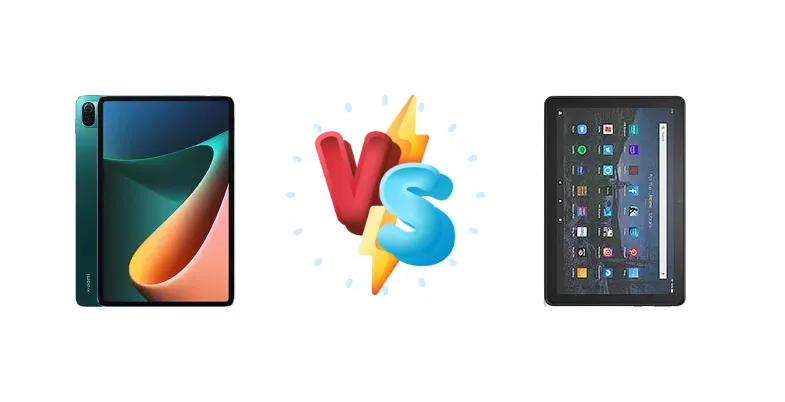
The tablet market offers a wide range of options, but finding the right balance between price and performance can be challenging. We pit the Xiaomi Pad 5, a performance-focused Android tablet, against the Amazon Fire HD 10 Plus (2021), a budget-friendly option heavily integrated with Amazon’s ecosystem, to determine which device delivers the best overall experience.
🏆 Quick Verdict
For users prioritizing performance and a versatile Android experience, the Xiaomi Pad 5 is the clear winner. Its Snapdragon 860 chipset provides significantly faster processing speeds, making it ideal for gaming and demanding applications. However, the Fire HD 10 Plus remains a compelling choice for those deeply invested in the Amazon ecosystem and seeking a basic tablet for media consumption.
| Network |
|---|
| 2G bands | N/A | N/A |
| 3G bands | N/A | - |
| EDGE | N/A | No |
| GPRS | N/A | No |
| Technology | No cellular connectivity | No cellular connectivity |
| Launch |
|---|
| Announced | 2021, August 10 | 2021, April 27. Released 2021, May 26 |
| Status | Available. Released 2021, August 10 | Discontinued |
| Body |
|---|
| Build | Glass front, aluminum frame, plastic back | - |
| Dimensions | 254.7 x 166.3 x 6.9 mm (10.03 x 6.55 x 0.27 in) | 247 x 166 x 9.2 mm (9.72 x 6.54 x 0.36 in) |
| SIM | No | No |
| Weight | 511 g (1.13 lb) | 468 g (1.03 lb) |
| | Stylus support (magnetic) | - |
| Display |
|---|
| Protection | - | Aluminosilicate glass |
| Resolution | 1600 x 2560 pixels, 16:10 ratio (~274 ppi density) | 1920 x 1200 pixels, 16:10 ratio (~224 ppi density) |
| Size | 11.0 inches, 350.9 cm2 (~82.8% screen-to-body ratio) | 10.1 inches, 295.8 cm2 (~72.1% screen-to-body ratio) |
| Type | IPS LCD, 1B colors, 120Hz, HDR10, Dolby Vision | IPS LCD |
| Platform |
|---|
| CPU | Octa-core (1x2.96 GHz Kryo 485 Gold & 3x2.42 GHz Kryo 485 Gold & 4x1.78 GHz Kryo 485 Silver) | Octa-core (4x2.0 GHz Cortex-A73 & 4x2.0 GHz Cortex-A53) |
| Chipset | Qualcomm Snapdragon 860 (7 nm) | Mediatek MT8183 Helio P60T (12 nm) |
| GPU | Adreno 640 | Mali-G72 MP3 |
| OS | Android 11, upgradable to Android 13, MIUI 14 | Android 9.0 (Pie), Fire OS 7 |
| Memory |
|---|
| Card slot | No | microSDXC (dedicated slot) |
| Internal | 128GB 6GB RAM, 256GB 6GB RAM | 32GB 4GB RAM, 64GB 4GB RAM |
| | UFS 3.1 | eMMC 5.1 |
| Main Camera |
|---|
| Features | Dual-LED flash, HDR, panorama | - |
| Single | 13 MP, f/2.0 | 5 MP |
| Video | 4K@30fps, 1080p@30fps | 720p |
| Selfie camera |
|---|
| Single | 8 MP, f/2.0 | 2 MP |
| Video | 1080p@30fps | 720p |
| Sound |
|---|
| 3.5mm jack | No | Yes |
| 35mm jack | No | Yes |
| Loudspeaker | Yes, with stereo speakers (4 speakers) | Yes, with stereo speakers |
| | 24-bit/192kHz audio | - |
| Comms |
|---|
| Bluetooth | 5.0, A2DP, LE | 5.0, A2DP, LE |
| NFC | No | No |
| Positioning | No | No |
| Radio | No | No |
| USB | USB Type-C | USB Type-C 2.0, OTG |
| WLAN | Wi-Fi 802.11 a/b/g/n/ac, dual-band, Wi-Fi Direct | Wi-Fi 802.11 a/b/g/n/ac, dual-band |
| Features |
|---|
| Sensors | Accelerometer, gyro, proximity, compass | Accelerometer |
| | - | Text-to-Speech English-language content reader |
| Battery |
|---|
| Charging | 33W wired, PD3.0 | Wireless |
| Type | Li-Po 8720 mAh | Li-Ion |
| Misc |
|---|
| Colors | Cosmic Gray, Pearl White, Green | Slate |
| Models | 21051182G, 21051182C | T76N2P |
| Price | About 350 EUR | About 150 EUR |
| Tests |
|---|
| Display |
Contrast ratio: 1271:1 (nominal) | - |
| Loudspeaker |
-24.4 LUFS (Very good)
| - |
| Performance |
AnTuTu: 473819 (v8), 555079 (v9)
GeekBench: 2583 (v5.1)
GFXBench: 24fps (ES 3.1 onscreen) | - |
Xiaomi Pad 5
- Significantly faster processor for gaming and multitasking
- Brighter and higher contrast display for better visuals
- Faster 33W wired charging with PD3.0
- More versatile Android operating system
- Higher price point
- No wireless charging
Amazon Fire HD 10 Plus (2021)
- Lower price point
- Wireless charging for added convenience
- Deep integration with Amazon services
- Simple and user-friendly interface
- Significantly slower processor
- Lower display quality
- Limited app ecosystem compared to Android
- Heavily reliant on Amazon's ecosystem
Display Comparison
The Xiaomi Pad 5 boasts a superior display experience. While both tablets feature similar screen sizes, the Xiaomi Pad 5’s measured 478 nits of max brightness significantly outshines the Fire HD 10 Plus (brightness data unavailable, but typically lower for this segment). More importantly, the Xiaomi Pad 5’s 1271:1 contrast ratio delivers richer, more vibrant visuals. The Fire HD 10 Plus, while adequate for basic viewing, lacks the color accuracy and dynamic range of the Xiaomi Pad 5, making it less suitable for content creation or critical viewing. The Xiaomi Pad 5’s display is a clear advantage for media consumption and creative tasks.
Camera Comparison
Neither tablet excels in the camera department, but the Xiaomi Pad 5 likely holds an advantage due to its more modern chipset and image signal processor. The Fire HD 10 Plus’s camera specifications are not readily available, but Amazon Fire tablets generally prioritize functionality over camera quality. The Snapdragon 860 in the Xiaomi Pad 5 allows for better image processing and potentially sharper photos and videos, though neither tablet should be considered a primary camera device.
Performance
The performance gap between these tablets is substantial. The Xiaomi Pad 5’s Qualcomm Snapdragon 860 (7nm) is a significantly more powerful chipset than the Amazon Fire HD 10 Plus’s MediaTek MT8183 Helio P60T (12nm). The Snapdragon 860’s octa-core configuration, with its Kryo 485 Gold and Silver cores clocked up to 2.96 GHz, provides a noticeable boost in CPU performance. The 7nm manufacturing process also contributes to better thermal efficiency, reducing the likelihood of throttling during sustained workloads. The Helio P60T, while capable of handling basic tasks, struggles with demanding games and multitasking. The Xiaomi Pad 5 offers a smoother, more responsive user experience overall.
Battery Life
Battery life is difficult to compare directly without standardized testing. The Xiaomi Pad 5 supports 33W wired charging with PD3.0, enabling faster charging speeds than the Fire HD 10 Plus’s wireless charging. While wireless charging offers convenience, it’s typically slower than wired charging. The Xiaomi Pad 5’s faster charging capability minimizes downtime, making it more practical for users who rely on their tablet throughout the day. The actual battery capacity of both devices is not specified, but the Snapdragon 860’s improved efficiency may offset any capacity differences.
Buying Guide
Buy the Xiaomi Pad 5 if you need a tablet capable of handling demanding tasks like gaming, video editing, or running multiple apps simultaneously. Its superior processor and display quality make it a better long-term investment for power users. Buy the Amazon Fire HD 10 Plus (2021) if you primarily want a tablet for reading, streaming video, and accessing Amazon services. Its lower price point and wireless charging are attractive for casual users who don't require high-end performance.
Frequently Asked Questions
❓ Will the Snapdragon 860 in the Xiaomi Pad 5 handle demanding games like Genshin Impact?
Yes, the Snapdragon 860 is capable of running Genshin Impact and other graphically intensive games at medium to high settings. While it won't match the performance of flagship Snapdragon 8 Gen series chips, it provides a smooth and enjoyable gaming experience on a tablet.
❓ How much does Amazon's ecosystem lock-in affect the Fire HD 10 Plus experience?
The Fire HD 10 Plus is heavily integrated with Amazon's services. While you can sideload apps, the primary experience revolves around Amazon's Appstore, Prime Video, Kindle, and other Amazon offerings. Users who aren't heavily invested in the Amazon ecosystem may find the limited app selection and constant Amazon promotions restrictive.
❓ Can I use Google Play Store on the Xiaomi Pad 5?
Yes, the Xiaomi Pad 5 runs a full version of Android, giving you access to the Google Play Store and a vast library of apps. This is a significant advantage over the Fire HD 10 Plus, which relies on Amazon's Appstore.
❓ Is the wireless charging on the Fire HD 10 Plus convenient enough to offset the slower charging speeds?
Wireless charging is convenient for casual users who don't mind longer charging times. However, if you frequently use your tablet throughout the day, the Xiaomi Pad 5's 33W wired charging will be significantly more practical.