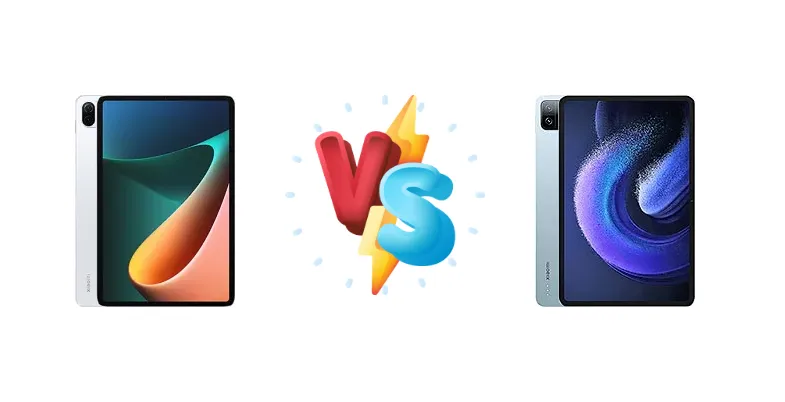
The Xiaomi Pad series has consistently delivered impressive value in the Android tablet market. But with the Pad 5 Pro and Pad 6 both vying for your attention, choosing the right one can be tricky. This comprehensive comparison will dissect every aspect, from display quality to battery life, to help you make an informed decision.
🏆 Quick Verdict
The Xiaomi Pad 6 offers a slightly improved experience with its brighter display and longer battery life, while the Pad 5 Pro retains its edge with faster charging. Ultimately, the Pad 6 is the better all-around choice for most users, especially those prioritizing battery endurance.
| Network |
|---|
| 2G bands | GSM 850 / 900 / 1800 / 1900 | N/A |
| 3G bands | HSDPA 800 / 850 / 900 / 1700(AWS) / 1900 / 2100 | N/A |
| 4G bands | 1, 2, 3, 4, 5, 7, 8, 9, 19, 34, 38, 39, 40, 41, 42 | - |
| 5G bands | 1, 3, 28, 41, 77, 78 Sub6 | - |
| EDGE | - | N/A |
| GPRS | - | N/A |
| Speed | HSPA, LTE, 5G - cellular model only | - |
| Technology | GSM / CDMA / HSPA / EVDO / LTE / 5G | No cellular connectivity |
| | CDMA2000 1xEV-DO | - |
| Launch |
|---|
| Announced | 2021, August 10 | 2023, April 18 |
| Status | Available. Released 2021, August 10 | Available. Released 2023, April 18 |
| Body |
|---|
| Build | Glass front, aluminum frame, plastic back | Glass front (Gorilla Glass 3), aluminum frame, aluminum back |
| Dimensions | 254.7 x 166.3 x 6.9 mm (10.03 x 6.55 x 0.27 in) | 254 x 165.2 x 6.5 mm (10.0 x 6.50 x 0.26 in) |
| SIM | Nano-SIM (cellular model only) | No |
| Weight | 515 g (1.14 lb) | 490 g (1.08 lb) |
| | Stylus support (magnetic) | Stylus support (magnetic) |
| Display |
|---|
| Protection | - | Corning Gorilla Glass 3 |
| Resolution | 1600 x 2560 pixels, 16:10 ratio (~274 ppi density) | 1800 x 2880 pixels, 16:10 ratio (~309 ppi density) |
| Size | 11.0 inches, 350.9 cm2 (~82.8% screen-to-body ratio) | 11.0 inches, 350.9 cm2 (~83.6% screen-to-body ratio) |
| Type | IPS LCD, 1B colors, 120Hz, HDR10, Dolby Vision | IPS LCD, 1B colors, 144Hz, HDR10, Dolby Vision, 550 nits |
| Platform |
|---|
| CPU | Octa-core (1x3.2 GHz Kryo 585 & 3x2.42 GHz Kryo 585 & 4x1.80 GHz Kryo 585) | Octa-core (1x3.2 GHz Kryo 585 & 3x2.42 GHz Kryo 585 & 4x1.80 GHz Kryo 585) |
| Chipset | Qualcomm SM8250-AC Snapdragon 870 5G (7 nm) | Qualcomm SM8250-AC Snapdragon 870 5G (7 nm) |
| GPU | Adreno 650 | Adreno 650 |
| OS | Android 11, upgradable to Android 13, MIUI 14 | Android 13, MIUI Pad 14 |
| Memory |
|---|
| Card slot | No | No |
| Internal | 128GB 6GB RAM, 256GB 6GB RAM, 256GB 8GB RAM | 128GB 6GB RAM, 128GB 8GB RAM, 256GB 8GB RAM |
| | UFS 3.1 | UFS 3.1 |
| Main Camera |
|---|
| Dual | 5G model:
50 MP, 1/2.5", 0.7µm, PDAF
Auxiliary lens
Wi-Fi model
13 MP, f/2.0, AF
Auxiliary lens | - |
| Features | Dual-LED flash, panorama, HDR | Dual-LED flash, HDR, panorama |
| Single | - | 13 MP, f/2.2, PDAF |
| Video | 4K@30fps, 1080p@30fps | 4K@30fps, 1080p@30/60fps |
| Selfie camera |
|---|
| Single | 8 MP, f/2.0 | 8 MP, f/2.2, 1/4.0", 1.12µm |
| Video | 1080p@30fps | 1080p@30fps |
| Sound |
|---|
| 3.5mm jack | No | No |
| 35mm jack | No | No |
| Loudspeaker | Yes, with stereo speakers (8 speakers) | Yes, with stereo speakers (4 speakers) |
| | - | 24-bit/192kHz audio |
| Comms |
|---|
| Bluetooth | 5.2, A2DP, LE | 5.2, A2DP, LE |
| NFC | No | No |
| Positioning | GPS, GLONASS, GALILEO, QZSS - cellular model only | Unspecified |
| Radio | No | No |
| USB | USB Type-C | USB Type-C 3.2, accessory connector |
| WLAN | Wi-Fi 802.11 a/b/g/n/ac/6, dual-band, Wi-Fi Direct | Wi-Fi 802.11 a/b/g/n/a/6, dual-band, Wi-Fi Direct |
| Features |
|---|
| Sensors | Accelerometer, gyro, proximity, compass | Accelerometer, gyro, proximity (accessories only) |
| Battery |
|---|
| Charging | 67W wired, PD3.0, QC4 | 33W wired, PD3.0, QC4 |
| Type | Li-Po 8600 mAh | Li-Po 8840 mAh |
| Misc |
|---|
| Colors | Black, White | Black, Blue, Gold |
| Models | M2105K81AC, M2105K81C | 23043RP34C, 23043RP34G, 23043RP34I |
| Price | About 330 EUR | About 400 EUR |
Xiaomi Pad 5 Pro
- Faster Charging (67W)
- Powerful Snapdragon 870
- Excellent 120Hz Display
- Likely lower display brightness than Pad 6
- Shorter battery life than Pad 6
Xiaomi Pad 6
- Longer Battery Life (9:39h active use)
- Brighter Display (500 nits)
- Refined Design
- Slower Charging (33W)
- Potentially slightly less optimized software
Display Comparison
The Xiaomi Pad 6 boasts a noticeable improvement in display brightness, reaching 500 nits compared to the Pad 5 Pro's likely lower figure (spec not provided, but generally lower). The 1060:1 contrast ratio on the Pad 6 also contributes to richer colors and deeper blacks. Both tablets feature excellent 120Hz refresh rates for smooth scrolling and gaming, but the Pad 6's brightness gives it a slight advantage, especially in well-lit environments.
Camera Comparison
Camera quality is generally not a primary concern for tablets. Both devices likely feature similar camera setups, with decent but not exceptional image quality. Expect adequate performance for video calls and casual snapshots, but don't expect flagship-level photography.
Performance
Both tablets share the same Snapdragon 870 5G chipset, ensuring comparable performance in everyday tasks and demanding games. You can expect smooth multitasking, responsive app loading, and excellent gaming performance on either device. Differences in software optimization might lead to minor variations in real-world performance, but they're unlikely to be significant.
Battery Life
The Xiaomi Pad 6 shines in this category, boasting an impressive active use score of 9 hours and 39 minutes. The Pad 5 Pro's battery life is respectable, but falls short of the Pad 6's endurance. This makes the Pad 6 a better choice for users who need their tablet to last through a full day of heavy use.
Buying Guide
Who should buy the Xiaomi Pad 5 Pro? Users who prioritize fast charging and don't mind a slightly less vibrant display. Who should buy the Xiaomi Pad 6? Those seeking longer battery life, a brighter screen for outdoor use, and a more refined overall experience.
Frequently Asked Questions
❓ Is the Snapdragon 870 chipset still good in 2024?
Yes, the Snapdragon 870 remains a very capable chipset, offering excellent performance for everyday tasks, gaming, and multitasking. It's more than sufficient for most tablet users.
❓ Which tablet has better speakers?
Both tablets feature quad-speaker setups, but the Xiaomi Pad 6 is generally considered to have slightly better audio quality and louder volume due to improved tuning and placement.