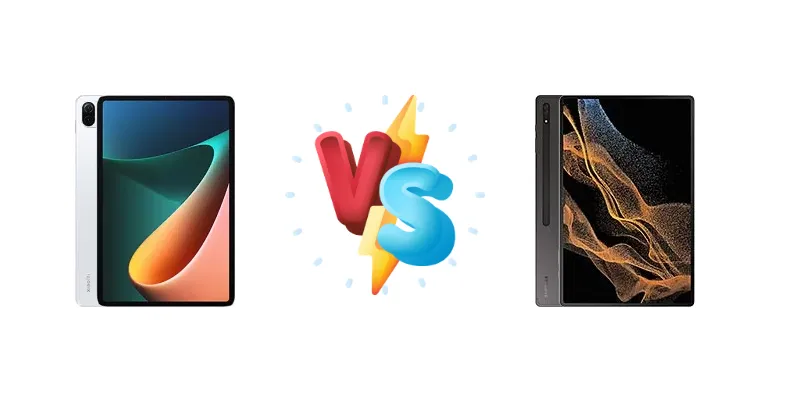
The Android tablet market is heating up, with Xiaomi and Samsung offering compelling high-end options. The Xiaomi Pad 5 Pro, leveraging the proven Snapdragon 870, aims for a balance of performance and value. Meanwhile, Samsung’s Galaxy Tab S8 Ultra throws down the gauntlet with the latest Snapdragon 8 Gen 1, boasting a massive display and premium features. This comparison dissects these tablets to determine which one best suits your needs.
🏆 Quick Verdict
For most users, the Samsung Galaxy Tab S8 Ultra emerges as the superior choice, justifying its higher price with a significantly more powerful processor and a stunning display. However, the Xiaomi Pad 5 Pro remains a strong contender for budget-conscious users prioritizing efficiency and fast charging.
| Network |
|---|
| 2G bands | GSM 850 / 900 / 1800 / 1900 | GSM 850 / 900 / 1800 / 1900 |
| 3G bands | HSDPA 800 / 850 / 900 / 1700(AWS) / 1900 / 2100 | HSDPA 850 / 900 / 1700(AWS) / 1900 / 2100 |
| 4G bands | 1, 2, 3, 4, 5, 7, 8, 9, 19, 34, 38, 39, 40, 41, 42 | LTE |
| 5G bands | 1, 3, 28, 41, 77, 78 Sub6 | SA/NSA |
| Speed | HSPA, LTE, 5G - cellular model only | HSPA, LTE, 5G - cellular model only |
| Technology | GSM / CDMA / HSPA / EVDO / LTE / 5G | GSM / HSPA / LTE / 5G |
| | CDMA2000 1xEV-DO | - |
| Launch |
|---|
| Announced | 2021, August 10 | 2022, February 09 |
| Status | Available. Released 2021, August 10 | Available. Released 2022, April 30 |
| Body |
|---|
| Build | Glass front, aluminum frame, plastic back | - |
| Dimensions | 254.7 x 166.3 x 6.9 mm (10.03 x 6.55 x 0.27 in) | 326.4 x 208.6 x 5.5 mm (12.85 x 8.21 x 0.22 in) |
| SIM | Nano-SIM (cellular model only) | Nano-SIM (cellular model only) |
| Weight | 515 g (1.14 lb) | 726 g (Wi-Fi), 728 g (5G) (1.60 lb) |
| | Stylus support (magnetic) | Stylus, 2.8ms latency (Bluetooth integration, accelerometer, gyro) |
| Display |
|---|
| Protection | - | Corning Gorilla Glass 5 |
| Resolution | 1600 x 2560 pixels, 16:10 ratio (~274 ppi density) | 1848 x 2960 pixels, 16:10 ratio (~240 ppi density) |
| Size | 11.0 inches, 350.9 cm2 (~82.8% screen-to-body ratio) | 14.6 inches, 612.6 cm2 (~90.0% screen-to-body ratio) |
| Type | IPS LCD, 1B colors, 120Hz, HDR10, Dolby Vision | Super AMOLED, 120Hz, HDR10+ |
| Platform |
|---|
| CPU | Octa-core (1x3.2 GHz Kryo 585 & 3x2.42 GHz Kryo 585 & 4x1.80 GHz Kryo 585) | Octa-core (1x3.00 GHz Cortex-X2 & 3x2.50 GHz Cortex-A710 & 4x1.80 GHz Cortex-A510) |
| Chipset | Qualcomm SM8250-AC Snapdragon 870 5G (7 nm) | Qualcomm SM8450 Snapdragon 8 Gen 1 (4 nm) |
| GPU | Adreno 650 | Adreno 730 |
| OS | Android 11, upgradable to Android 13, MIUI 14 | Android 12, up to 4 major Android upgrades, One UI 6.1.1 |
| Memory |
|---|
| Card slot | No | microSDXC (dedicated slot) |
| Internal | 128GB 6GB RAM, 256GB 6GB RAM, 256GB 8GB RAM | 128GB 8GB RAM, 256GB 8GB RAM, 256GB 12GB RAM, 256GB 16GB RAM, 512GB 12GB RAM, 512GB 16GB RAM |
| | UFS 3.1 | UFS |
| Main Camera |
|---|
| Dual | 5G model:
50 MP, 1/2.5", 0.7µm, PDAF
Auxiliary lens
Wi-Fi model
13 MP, f/2.0, AF
Auxiliary lens | 13 MP, f/2.0, 26mm (wide), 1/3.4", 1.0µm, AF
6 MP, f/2.2, (ultrawide) |
| Features | Dual-LED flash, panorama, HDR | LED flash, HDR, panorama |
| Video | 4K@30fps, 1080p@30fps | 4K@30/60fps, 1080p@30fps |
| Selfie camera |
|---|
| Dual | - | 12 MP, f/2.2, 26mm (wide)
12 MP, f/2.4, 120˚ (ultrawide) |
| Features | - | HDR |
| Single | 8 MP, f/2.0 | - |
| Video | 1080p@30fps | 4K@30/60fps, 1080p@30fps |
| Sound |
|---|
| 3.5mm jack | No | No |
| 35mm jack | No | No |
| Loudspeaker | Yes, with stereo speakers (8 speakers) | Yes, with stereo speakers (4 speakers) |
| | - | Tuned by AKG |
| Comms |
|---|
| Bluetooth | 5.2, A2DP, LE | 5.2, A2DP, LE |
| NFC | No | No |
| Positioning | GPS, GLONASS, GALILEO, QZSS - cellular model only | GPS, GLONASS, BDS, GALILEO - cellular model only |
| Radio | No | No |
| USB | USB Type-C | USB Type-C 3.2, magnetic connector |
| WLAN | Wi-Fi 802.11 a/b/g/n/ac/6, dual-band, Wi-Fi Direct | Wi-Fi 802.11 a/b/g/n/ac/6e, dual-band, Wi-Fi Direct |
| Features |
|---|
| Sensors | Accelerometer, gyro, proximity, compass | Fingerprint (under display, optical), accelerometer, gyro, proximity, compass |
| | - | Wireless Samsung DeX |
| Battery |
|---|
| Charging | 67W wired, PD3.0, QC4 | 45W wired, 100% in 82 min |
| Type | Li-Po 8600 mAh | Li-Po 11200 mAh |
| Misc |
|---|
| Colors | Black, White | Graphite |
| Models | M2105K81AC, M2105K81C | SM-X900, SM-X906, SM-X906B, SM-X906U, SM-X906N |
| Price | About 330 EUR | About 1150 EUR |
| SAR EU | - | 0.69 W/kg (body) |
Xiaomi Pad 5 Pro
- Faster 67W charging for quick top-ups
- More power-efficient Snapdragon 870
- Generally more affordable price point
- Less powerful processor compared to the Snapdragon 8 Gen 1
- Likely inferior display technology (IPS vs AMOLED)
Samsung Galaxy Tab S8 Ultra
- Significantly more powerful Snapdragon 8 Gen 1
- Stunning 14.6-inch Super AMOLED display
- Faster RAM (LPDDR5x)
- Slower 45W charging
- Higher price tag
- Potentially more susceptible to thermal throttling under heavy load
Display Comparison
While both tablets feature large displays, the Samsung Galaxy Tab S8 Ultra’s 14.6-inch Super AMOLED panel is a clear standout. The Xiaomi Pad 5 Pro’s display specs are not provided, but based on its market positioning, it likely utilizes an IPS LCD. The Snapdragon 8 Gen 1 in the Tab S8 Ultra allows for potentially higher refresh rates and more advanced display features. The Tab S8 Ultra’s AMOLED technology delivers superior contrast and color accuracy, crucial for content creators and media enthusiasts. The larger screen real estate of the Tab S8 Ultra is a boon for multitasking and productivity.
Camera Comparison
Camera performance isn’t a primary focus for tablets, but the Tab S8 Ultra likely holds an advantage due to its more advanced chipset and potentially larger sensors. Details on the camera specs for both devices are limited, but Samsung typically prioritizes camera quality even in its tablets. The Snapdragon 8 Gen 1’s image signal processor (ISP) offers superior image processing capabilities, resulting in better dynamic range and low-light performance. The Xiaomi Pad 5 Pro will likely suffice for casual snapshots, but the Tab S8 Ultra is the better choice for users who occasionally rely on their tablet for photography or video conferencing.
Performance
The core difference lies in the chipsets. The Samsung Galaxy Tab S8 Ultra’s Snapdragon 8 Gen 1 (4nm) represents a significant leap in performance over the Xiaomi Pad 5 Pro’s Snapdragon 870 (7nm). The 8 Gen 1 features a newer CPU architecture – Cortex-X2, A710, and A510 – compared to the 870’s Kryo 585 cores. This translates to faster processing speeds and improved efficiency. While the 870 is still a capable chip, the 8 Gen 1’s 4nm process offers better thermal efficiency, potentially mitigating throttling during sustained workloads. The Tab S8 Ultra’s LPDDR5x RAM further enhances performance, providing faster data access compared to the Pad 5 Pro’s likely LPDDR5 configuration.
Battery Life
The Xiaomi Pad 5 Pro’s 67W wired charging is a significant advantage, promising faster top-ups compared to the Tab S8 Ultra’s 45W charging (82 minutes to 100%). While the Tab S8 Ultra likely has a larger battery capacity to compensate for the more power-hungry Snapdragon 8 Gen 1, the Pad 5 Pro’s faster charging speeds offer greater convenience. The 7nm process of the Snapdragon 870 in the Pad 5 Pro also contributes to better battery efficiency, potentially resulting in longer runtimes for similar usage scenarios.
Buying Guide
Buy the Xiaomi Pad 5 Pro if you need a powerful tablet for everyday tasks, media consumption, and light gaming, and value fast 67W charging and a more affordable price point. Buy the Samsung Galaxy Tab S8 Ultra if you demand uncompromising performance for demanding applications, professional workflows, and immersive entertainment, and are willing to pay a premium for the largest and brightest display available.
Frequently Asked Questions
❓ Will the Snapdragon 8 Gen 1 in the Tab S8 Ultra overheat during extended gaming sessions?
The Snapdragon 8 Gen 1 is known to generate more heat than previous generations. However, Samsung has implemented advanced thermal management solutions in the Tab S8 Ultra, including vapor chamber cooling. While some throttling may occur during prolonged, demanding gaming, it’s unlikely to be severe enough to significantly impact the experience.
❓ Is the 67W charging on the Xiaomi Pad 5 Pro significantly faster in real-world use?
Yes, 67W charging is noticeably faster than 45W. While the Tab S8 Ultra takes approximately 82 minutes to reach 100%, the Pad 5 Pro can likely achieve a full charge in under an hour, providing a significant convenience boost for users who frequently need to top up their battery.
❓ Does the Samsung Galaxy Tab S8 Ultra support DeX mode for a desktop-like experience?
Yes, the Galaxy Tab S8 Ultra fully supports Samsung DeX, allowing you to connect it to an external monitor, keyboard, and mouse for a desktop-like experience. This makes it a versatile device for productivity tasks and professional workflows.