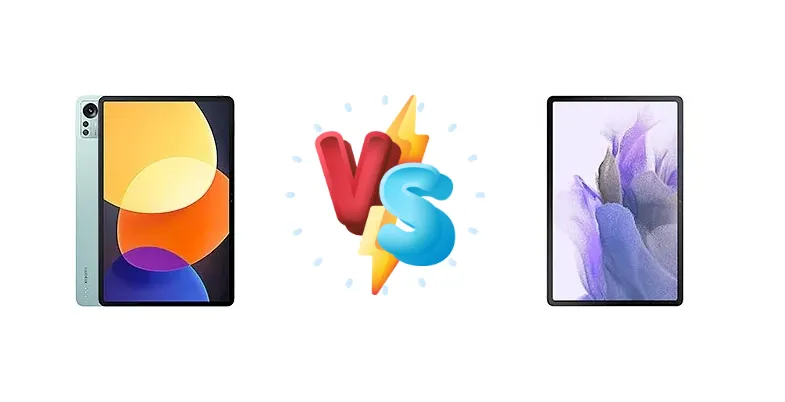
Choosing the right tablet can be tough, especially with so many options available. Today, we're pitting two strong contenders against each other: the Xiaomi Pad 5 Pro 12.4 and the Samsung Galaxy Tab S7 FE. Both offer large displays and Android functionality, but which one delivers the best overall experience?
🏆 Quick Verdict
The Xiaomi Pad 5 Pro 12.4 takes the crown for raw performance thanks to its Snapdragon 870 chipset and faster charging. However, the Tab S7 FE boasts a slightly better display and Samsung's refined software, making it a strong contender for media consumption and creative tasks.
| Network |
|---|
| 2G bands | N/A | GSM 850 / 900 / 1800 / 1900 |
| 3G bands | N/A | HSDPA 850 / 900 / 1700(AWS) / 1900 / 2100 |
| 4G bands | N/A | 1, 2, 3, 4, 5, 7, 8, 12, 13, 17, 20, 25, 26, 28, 32, 38, 40, 41, 66 |
| 5G bands | - | 1, 3, 5, 7, 8, 20, 28, 38, 40, 41, 77, 78 SA/NSA/Sub6 |
| EDGE | No | - |
| GPRS | No | - |
| Speed | - | HSPA, LTE, 5G - cellular model only |
| Technology | No cellular connectivity | GSM / HSPA / LTE / 5G |
| Launch |
|---|
| Announced | 2022, August 11 | 2021, May 25 |
| Status | Available. Released 2022, August 24 | Available. Released 2021, June 18 |
| Body |
|---|
| Build | Glass front (Gorilla Glass 3), aluminum frame, aluminum back | Glass front, aluminum back, aluminum frame |
| Dimensions | 285 x 185.2 x 6.7 mm (11.22 x 7.29 x 0.26 in) | 284.8 x 185 x 6.3 mm (11.21 x 7.28 x 0.25 in) |
| SIM | No | Nano-SIM (cellular model only) |
| Weight | 620 g (1.37 lb) | 608 g (1.34 lb) |
| | Stylus support (magnetic) | Stylus support |
| Display |
|---|
| Protection | Corning Gorilla Glass 3 | - |
| Resolution | 1600 x 2560 pixels, 16:10 ratio (~243 ppi density) | 1600 x 2560 pixels, 16:10 ratio (~243 ppi density) |
| Size | 12.4 inches, 445.8 cm2 (~84.5% screen-to-body ratio) | 12.4 inches, 445.8 cm2 (~84.6% screen-to-body ratio) |
| Type | IPS LCD, 120Hz, HDR10, Dolby Vision, 500 nits | TFT LCD |
| Platform |
|---|
| CPU | Octa-core (1x3.2 GHz Kryo 585 & 3x2.42 GHz Kryo 585 & 4x1.80 GHz Kryo 585) | Octa-core (2x2.2 GHz Kryo 570 & 6x1.8 GHz Kryo 570) - 5G modelOcta-core (1x2.4 GHz Cortex-A78 & 3x2.2 GHz Cortex-A78 & 4x1.9 GHz Cortex-A55) - Wi-Fi model |
| Chipset | Qualcomm SM8250-AC Snapdragon 870 5G (7 nm) | Qualcomm SM7225 Snapdragon 750G 5G (8 nm) - 5G modelQualcomm SM7325 Snapdragon 778G 5G (6 nm) - Wi-Fi model |
| GPU | Adreno 650 | Adreno 619 - 5G modelAdreno 642L - Wi-Fi model |
| OS | Android 12, MIUI Pad 13 | Android 11, upgradable to Android 14, One UI 6 |
| Memory |
|---|
| Card slot | No | microSDXC (dedicated slot) |
| Internal | 128GB 6GB RAM, 256GB 8GB RAM, 512GB 12GB RAM | 64GB 4GB RAM, 128GB 6GB RAM, 256GB 8GB RAM |
| | UFS 3.1 | - |
| Main Camera |
|---|
| Dual | 50 MP, f/1.8, 1/2.76", 0.64µm, PDAF
Auxiliary lens | - |
| Features | Color spectrum sensor, LED flash, panorama, HDR | - |
| Single | - | 8 MP, AF |
| Video | 4K@30fps, 1080p@30/60fps | 1080p@30fps |
| Selfie camera |
|---|
| Single | 20 MP, f/2.2, 1/3.4", 0.8µm | 5 MP |
| Video | 1080p@30/60fps | 1080p@30fps |
| Sound |
|---|
| 3.5mm jack | No | No |
| 35mm jack | No | No |
| Loudspeaker | Yes, with stereo speakers (4 speakers) | Yes, with stereo speakers |
| | - | Tuned by AKG |
| Comms |
|---|
| Bluetooth | 5.2, A2DP, LE | 5.2, A2DP, LE (Wi-Fi), 5.2, A2DP, LE (5G) |
| NFC | No | No |
| Positioning | No | GPS, GLONASS, BDS, GALILEO - cellular model only |
| Radio | No | No |
| USB | USB Type-C 3.2 video output | USB Type-C 3.2, magnetic connector |
| WLAN | Wi-Fi 802.11 a/b/g/n/ac/6, dual-band, Wi-Fi Direct | Wi-Fi 802.11 a/b/g/n/ac/6 (Wi-Fi), Wi-Fi 802.11 a/b/g/n/ac (5G) |
| Features |
|---|
| Sensors | Accelerometer, gyro, proximity, compass | Accelerometer, proximity, compass, gyro (5G model only) |
| | - | Samsung DeX |
| Battery |
|---|
| Charging | 67W wired, PD3.0, QC4, 60% in 36 min, 100% in 68 min | 45W wired, 100% in 190 min |
| Type | Li-Po 10000 mAh | Li-Po 10090 mAh |
| Misc |
|---|
| Colors | Black, Silver, Green | Mystic Black, Mystic Silver, Mystic Green, Mystic Pink |
| Models | - | SM-T730, SM-T733, SM-T736B, SM-T735 |
| Price | About 400 EUR | About 650 EUR |
| SAR EU | - | 1.15 W/kg (body) |
| Tests |
|---|
| Display | - | Contrast ratio: 1886:1 (nominal) |
| Loudspeaker | - | -27.2 LUFS (Good) |
| Performance | - | AnTuTu: 292530 (v8), 355430 (v9)
GeekBench: 1904 (v5.1)
GFXBench: 9.7fps (ES 3.1 onscreen) |
Xiaomi Pad 5 Pro 12.4
- Superior Performance (Snapdragon 870)
- Faster Charging (67W)
- 120Hz Refresh Rate Display
- Competitive Price
- Camera Performance Not Top-Tier
- Software Updates May Be Slower
Samsung Galaxy Tab S7 FE
- Excellent Display Quality
- Samsung's One UI Software
- Good for Media Consumption
- S Pen Support (Sold Separately)
- Slower Charging (45W)
- Lower Performance (Snapdragon 750G/778G)
- Can Be More Expensive
Display Comparison
The Samsung Galaxy Tab S7 FE has a slight edge with its 12.4-inch LCD display boasting a 1886:1 contrast ratio and 522 nits of brightness. While the Xiaomi Pad 5 Pro 12.4 also has a 12.4-inch display, its brightness and color accuracy are not as well documented, but it does offer a 120Hz refresh rate for smoother visuals. The Tab S7 FE's display is generally considered more color accurate and pleasant for extended viewing.
Camera Comparison
Camera quality is generally not a primary concern for tablets, but the Tab S7 FE typically offers slightly better image processing and overall camera performance. The Xiaomi Pad 5 Pro's cameras are adequate, but not exceptional. Expect decent photos in good lighting conditions from both devices.
Performance
Here, the Xiaomi Pad 5 Pro 12.4 decisively wins. Its Snapdragon 870 chipset is significantly more powerful than the Snapdragon 750G (or even the 778G in the Wi-Fi model) found in the Tab S7 FE. This translates to faster app loading times, smoother multitasking, and a better gaming experience. The 870 is a flagship-level chip, offering a noticeable performance boost.
Battery Life
The Xiaomi Pad 5 Pro 12.4 has a clear advantage in charging speed with its 67W wired charging, reaching 60% in 36 minutes and 100% in 68 minutes. The Tab S7 FE's 45W charging is considerably slower, taking around 190 minutes to fully charge. Battery capacity is similar, so the Xiaomi Pad 5 Pro offers faster replenishment.
Buying Guide
The Xiaomi Pad 5 Pro 12.4 is ideal for users prioritizing performance, gaming, and fast charging. The Samsung Galaxy Tab S7 FE is a better choice for those who value a vibrant display, Samsung's One UI, and a more balanced overall experience, especially for media consumption and light productivity.
Frequently Asked Questions
❓ Is the Xiaomi Pad 5 Pro 12.4 good for gaming?
Yes, the Snapdragon 870 chipset makes the Xiaomi Pad 5 Pro 12.4 a very capable gaming tablet. It can handle most games at high settings.
❓ Does the Samsung Galaxy Tab S7 FE support the S Pen?
Yes, the Tab S7 FE supports the S Pen, but it's sold separately. It's a great addition for note-taking and drawing.