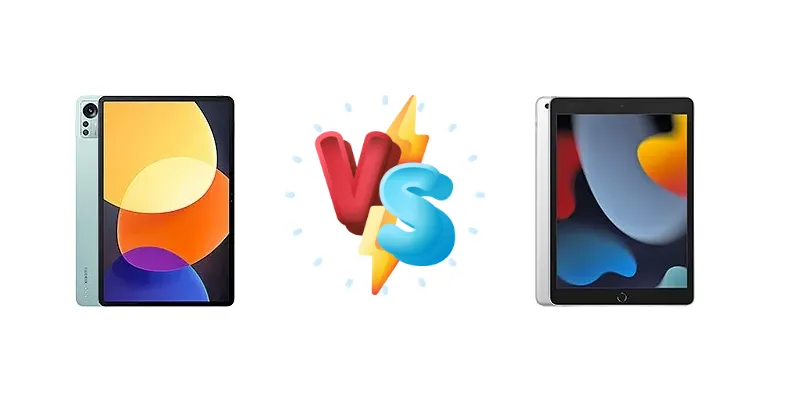
The tablet market is heating up, and these two contenders – the Xiaomi Pad 5 Pro 12.4 and the Apple iPad 10.2 (2021) – are vying for your attention. Both offer compelling features, but cater to different needs and budgets. Let's dive into a detailed comparison to help you decide which one is right for you.
🏆 Quick Verdict
The Xiaomi Pad 5 Pro 12.4 offers significantly more power and a larger, higher-resolution display at a competitive price. However, the iPad 10.2 benefits from Apple's ecosystem, software support, and a generally smoother user experience for casual users. It's a trade-off between raw performance and refined simplicity.
| Network |
|---|
| 2G bands | N/A | GSM 850 / 900 / 1800 / 1900 |
| 3G bands | N/A | HSDPA 800 / 850 / 900 / 1700(AWS) / 1900 / 2100 |
| 4G bands | N/A | 1, 2, 3, 4, 5, 7, 8, 11, 12, 13, 14, 17, 18, 19, 20, 21, 25, 26, 29, 30, 34, 38, 39, 40, 41, 66, 71 - A2603 |
| EDGE | No | - |
| GPRS | No | - |
| Speed | - | HSPA, LTE - cellular model only |
| Technology | No cellular connectivity | GSM / HSPA / LTE |
| | - | 1, 2, 3, 4, 5, 7, 8, 11, 12, 13, 14, 17, 18, 19, 20, 21, 25, 26, 28, 29, 30, 34, 38, 39, 40, 41, 66 - A2604 |
| Launch |
|---|
| Announced | 2022, August 11 | 2021, September 14 |
| Status | Available. Released 2022, August 24 | Available. Released 2021, September 24 |
| Body |
|---|
| Build | Glass front (Gorilla Glass 3), aluminum frame, aluminum back | Glass front, aluminum back, aluminum frame |
| Dimensions | 285 x 185.2 x 6.7 mm (11.22 x 7.29 x 0.26 in) | 250.6 x 174.1 x 7.5 mm (9.87 x 6.85 x 0.30 in) |
| SIM | No | Nano-SIM + eSIM (cellular model only) |
| Weight | 620 g (1.37 lb) | 487 g (Wi-Fi) / 498 g (LTE) (1.07 lb) |
| | Stylus support (magnetic) | Stylus support (1st gen only) |
| Display |
|---|
| Protection | Corning Gorilla Glass 3 | Scratch-resistant glass, oleophobic coating |
| Resolution | 1600 x 2560 pixels, 16:10 ratio (~243 ppi density) | 1620 x 2160 pixels, 4:3 ratio (~265 ppi density) |
| Size | 12.4 inches, 445.8 cm2 (~84.5% screen-to-body ratio) | 10.2 inches, 322.2 cm2 (~73.8% screen-to-body ratio) |
| Type | IPS LCD, 120Hz, HDR10, Dolby Vision, 500 nits | Retina IPS LCD, 500 nits (typ) |
| Platform |
|---|
| CPU | Octa-core (1x3.2 GHz Kryo 585 & 3x2.42 GHz Kryo 585 & 4x1.80 GHz Kryo 585) | Hexa-core (2x2.65 GHz Lightning + 4x1.8 GHz Thunder) |
| Chipset | Qualcomm SM8250-AC Snapdragon 870 5G (7 nm) | Apple A13 Bionic (7 nm+) |
| GPU | Adreno 650 | Apple GPU (4-core graphics) |
| OS | Android 12, MIUI Pad 13 | iPadOS 15, upgradable to iPadOS 26.1 |
| Memory |
|---|
| Card slot | No | No |
| Internal | 128GB 6GB RAM, 256GB 8GB RAM, 512GB 12GB RAM | 64GB 3GB RAM, 256GB 3GB RAM |
| | UFS 3.1 | - |
| Main Camera |
|---|
| Dual | 50 MP, f/1.8, 1/2.76", 0.64µm, PDAF
Auxiliary lens | - |
| Features | Color spectrum sensor, LED flash, panorama, HDR | HDR, panorama |
| Single | - | 8 MP, f/2.4, 31mm (standard), 1.12µm, AF |
| Video | 4K@30fps, 1080p@30/60fps | 1080p@25/30fps, 720p@120fps; gyro-EIS |
| Selfie camera |
|---|
| Features | - | HDR |
| Single | 20 MP, f/2.2, 1/3.4", 0.8µm | 12 MP, f/2.4, 122˚ (ultrawide) |
| Video | 1080p@30/60fps | 1080p@25/30/60fps, gyro-EIS |
| Sound |
|---|
| 3.5mm jack | No | Yes |
| 35mm jack | No | Yes |
| Loudspeaker | Yes, with stereo speakers (4 speakers) | Yes, with stereo speakers |
| Comms |
|---|
| Bluetooth | 5.2, A2DP, LE | 4.2, A2DP, EDR, LE |
| NFC | No | No |
| Positioning | No | GPS, GLONASS - cellular model only |
| Radio | No | No |
| USB | USB Type-C 3.2 video output | Lightning, USB 2.0; magnetic connector |
| WLAN | Wi-Fi 802.11 a/b/g/n/ac/6, dual-band, Wi-Fi Direct | Wi-Fi 802.11 a/b/g/n/ac, dual-band, hotspot |
| Features |
|---|
| Sensors | Accelerometer, gyro, proximity, compass | Fingerprint (front-mounted), accelerometer, gyro, compass, barometer |
| Battery |
|---|
| Charging | 67W wired, PD3.0, QC4, 60% in 36 min, 100% in 68 min | - |
| Type | Li-Po 10000 mAh | Li-Ion 8557 mAh (32.4 Wh) |
| Misc |
|---|
| Colors | Black, Silver, Green | Silver, Space Gray |
| Models | - | A2603, A2604, iPad12,1, iPad12,2 |
| Price | About 400 EUR | About 430 EUR |
| Tests |
|---|
| Camera | - |
Photo / Video |
| Display | - |
Contrast ratio: 1123:1 (nominal) |
| Loudspeaker | - |
-29.4 LUFS (Average)
|
| Performance | - |
AnTuTu: 617292(v9)
GeekBench: 3124 (v5.1)
GFXBench: 44fps (ES 3.1 onscreen) |
Xiaomi Pad 5 Pro 12.4
- Powerful Snapdragon 870 processor
- Large, high-resolution 120Hz display
- Fast 67W charging
- Competitive price
- Good value for money
- MIUI software can be bloated
- Camera performance is average
- Less established app ecosystem compared to iPadOS
Apple iPad 10.2 (2021)
- Smooth and intuitive iPadOS
- Excellent app ecosystem
- Strong resale value
- Good build quality
- Long-term software support
- Less powerful processor than Xiaomi Pad 5 Pro
- Smaller display
- Slower charging
- Higher price
Display Comparison
The Xiaomi Pad 5 Pro 12.4 boasts a larger 12.4-inch 2560x1600 LCD display with a 120Hz refresh rate, offering a smoother visual experience. The iPad 10.2 has a 10.2-inch Retina display, known for its color accuracy and sharpness, but lacks the high refresh rate. Xiaomi wins on size and refresh rate, while Apple excels in color accuracy.
Camera Comparison
Both tablets feature basic camera setups suitable for casual snapshots and video calls. Neither tablet excels in photography. Image quality is adequate in good lighting conditions, but struggles in low light. The iPad's software processing might offer slightly better results in some scenarios.
Performance
The Snapdragon 870 in the Xiaomi Pad 5 Pro 12.4 provides significantly more processing power than the A13 Bionic in the iPad 10.2. This translates to faster app loading, smoother multitasking, and better performance in demanding games. The iPad's A13 is still capable, but the Xiaomi offers a noticeable performance boost.
Battery Life
The Xiaomi Pad 5 Pro 12.4 has a larger battery capacity and supports 67W fast charging, allowing for quicker top-ups. While the iPad 10.2 offers good battery life, it lacks the Xiaomi's charging speed. The Xiaomi's fast charging is a significant advantage.
Buying Guide
The Xiaomi Pad 5 Pro 12.4 is ideal for users who prioritize performance, a large display for media consumption and productivity, and value for money. The Apple iPad 10.2 (2021) is a great choice for students, casual users, and those already invested in the Apple ecosystem who value ease of use and long-term software support.
Frequently Asked Questions
❓ Which tablet is better for gaming?
The Xiaomi Pad 5 Pro 12.4 is the better choice for gaming due to its more powerful processor and 120Hz display.
❓ Is the iPad 10.2 good for students?
Yes, the iPad 10.2 is a great option for students thanks to its ease of use, access to educational apps, and long-term software support.