
Xiaomi Mix Fold 2 vs. Mi Mix Fold: The Ultimate Folding Phone Showdown
| Phones Images | |||||
|---|---|---|---|---|---|
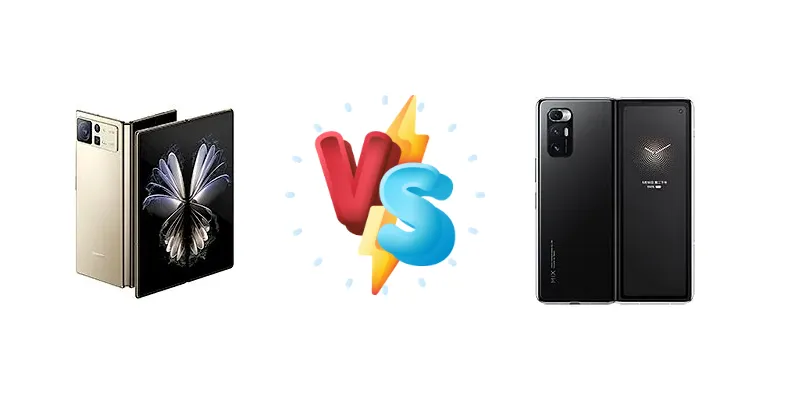
|
🏆 Quick Verdict
The Xiaomi Mix Fold 2 is the clear winner, boasting a significantly faster Snapdragon 8+ Gen 1 chipset, a brighter display, and faster charging. While the Mi Mix Fold remains a capable device, the Fold 2’s upgrades make it the superior choice for most users seeking a premium foldable experience.
| PHONES | ||
|---|---|---|
| Phone Names | Xiaomi Mix Fold 2 | Xiaomi Mi Mix Fold |
| Network | ||
|---|---|---|
| 2G bands | GSM 850 / 900 / 1800 / 1900 | GSM 850 / 900 / 1800 / 1900 |
| 3G bands | HSDPA 850 / 900 / 1700(AWS) / 1900 / 2100 | HSDPA 850 / 900 / 1700(AWS) / 1900 / 2100 |
| 4G bands | 1, 2, 3, 4, 5, 7, 8, 12, 17, 18, 19, 20, 26, 28, 34, 38, 39, 40, 41, 42 | 1, 2, 3, 4, 5, 7, 8, 12, 17, 18, 19, 20, 26, 28, 34, 38, 39, 40, 41, 42 |
| 5G bands | 1, 3, 5, 8, 20, 28, 38, 40, 41, 77, 78, 79 SA/NSA | 1, 3, 28, 41, 77, 78, 79 SA/NSA |
| Speed | HSPA, LTE, 5G | HSPA, LTE, 5G |
| Technology | GSM / CDMA / HSPA / EVDO / LTE / 5G | GSM / CDMA / HSPA / EVDO / LTE / 5G |
| CDMA2000 1xEV-DO | CDMA2000 1xEV-DO | |
| Launch | ||
|---|---|---|
| Announced | 2022, August 11 | 2021, March |
| Status | Available. Released 2022, August 26 | Available. Released 2021, April 16 |
| Body | ||
|---|---|---|
| Build | - | Glass front (folded), plastic front (unfolded), glass back (Gorilla Glass 5) or ceramic back, aluminum frame |
| Dimensions | Unfolded: 161.1 x 144.7 x 5.4 mm Folded: 161.1 x 73.9 x 11.2 mm | Unfolded: 173.3 x 133.4 x 7.6 mm Folded: 173.3 x 69.8 x 17.2 mm |
| SIM | Nano-SIM + Nano-SIM | Nano-SIM + Nano-SIM |
| Weight | 262 g (9.24 oz) | 317 g (Glass)332 g (Ceramic) (11.18 oz) |
| Display | ||
|---|---|---|
| Protection | Schott UTG glass | - |
| Resolution | 1914 x 2160 pixels (~360 ppi density) | 1860 x 2480 pixels, 4:3 ratio (~387 ppi density) |
| Size | 8.02 inches, 206.0 cm2 (~88.4% screen-to-body ratio) | 8.01 inches, 198.7 cm2 (~85.9% screen-to-body ratio) |
| Type | Foldable LTPO2 OLED, 1B colors, 120Hz, HDR10+, Dolby Vision, 1000 nits (HBM), 1300 nits (peak) | Foldable AMOLED, 1B colors, HDR10+, Dolby Vision, 600 nits (typ), 900 nits (peak) |
| Cover display: AMOLED, 120Hz, HDR10+, Dolby Vision, 1000 nits (HBM), 1300 nits (peak) 6.56 inches, 1080 x 2520 pixels, 21:9 ratio Corning Gorilla Glass Victus | Cover display: AMOLED, 90Hz, HDR10+, Dolby Vision, 650 nits (typ), 900 nits (peak) 6.52 inches, 840 x 2520 pixels, 27:9 ratio | |
| Platform | ||
|---|---|---|
| CPU | Octa-core (1x3.19 GHz Cortex-X2 & 3x2.75 GHz Cortex-A710 & 4x1.80 GHz Cortex-A510) | Octa-core (1x2.84 GHz Cortex-X1 & 3x2.42 GHz Cortex-A78 & 4x1.80 GHz Cortex-A55) |
| Chipset | Qualcomm SM8475 Snapdragon 8+ Gen 1 (4 nm) | Qualcomm SM8350 Snapdragon 888 5G (5 nm) |
| GPU | Adreno 730 | Adreno 660 |
| OS | Android 12, MIUI Fold 13 | Android 10, MIUI 12 |
| Memory | ||
|---|---|---|
| Card slot | No | No |
| Internal | 256GB 12GB RAM, 512GB 12GB RAM, 1TB 12GB RAM | 256GB 12GB RAM, 512GB 12GB RAM, 512GB 16GB RAM |
| UFS 3.1 | UFS 3.1 | |
| Main Camera | ||
|---|---|---|
| Features | Color spectrum sensor, Dual-LED flash, HDR, panorama, Leica lenses | Color spectrum sensor, Dual-LED flash, HDR, panorama |
| Single | - | 20 MP, 27mm (wide), 1/3.4", 0.8µm |
| Triple | 50 MP, f/1.8, (wide), 1/1.56", 1.0µm, PDAF, OIS 8 MP, f/2.6, 45mm (telephoto), dual pixel PDAF, 2x optical zoom 13 MP, f/2.4, 15mm, 123˚ (ultrawide), 1.12µm, AF | 108 MP, f/1.8, (wide), 1/1.52", 0.7µm, PDAF 8 MP, 80mm (telephoto/macro), liquid lens, PDAF, 3x optical zoom 13 MP, f/2.4, 123˚ (ultrawide), 1.12µm |
| Video | 8K@24fps, 4K@30/60fps, 1080p@30/60/120/240/960fps, gyro-EIS | 8K@24/30fps, 4K@30/60fps, 1080p@30/60fps, gyro-EIS |
| Selfie camera | ||
|---|---|---|
| Features | HDR, panorama | HDR, panorama |
| Single | 20 MP, f/2.4, 23mm (wide) | 20 MP, (wide) |
| Video | 1080p@30/60fps, 720p@120fps | 1080p@30/60fps, 720p@120fps |
| Sound | ||
|---|---|---|
| 3.5mm jack | No | No |
| 35mm jack | No | No |
| Loudspeaker | Yes, with stereo speakers | Yes, with stereo speakers (4 speakers) |
| 24-bit/192kHz audio Tuned by Harman Kardon | 24-bit/192kHz audio Tuned by Harman Kardon | |
| Comms | ||
|---|---|---|
| Bluetooth | 5.2, A2DP, LE, aptX HD, aptX Adaptive | 5.2, A2DP, LE, aptX HD, aptX Adaptive |
| Infrared port | Yes | Yes |
| NFC | Yes | Yes |
| Positioning | GPS (L1+L5), GLONASS (L1), BDS (B1I+B1c+B2a), GALILEO (E1+E5a), QZSS (L1+L5), NavIC (L5) | GPS (L1+L5), GLONASS (L1), BDS (B1I+B1c+B2a), GALILEO (E1+E5a), QZSS (L1+L5), NavIC (L5) |
| Radio | No | No |
| USB | USB Type-C | USB Type-C |
| WLAN | Wi-Fi 802.11 a/b/g/n/ac/6e, dual-band, Wi-Fi Direct | Wi-Fi 802.11 a/b/g/n/ac/6e, dual-band, Wi-Fi Direct |
| Features | ||
|---|---|---|
| Sensors | Fingerprint (side-mounted), accelerometer, gyro, proximity, compass, barometer | Fingerprint (side-mounted), accelerometer, gyro, proximity, compass, barometer |
| Battery | ||
|---|---|---|
| Charging | 67W wired, PD3.0, QC4, 100% in 40 min | 67W wired, PD3.0, QC4, 100% in 37 min |
| Type | Li-Po 4500 mAh | Li-Po 5020 mAh |
| Misc | ||
|---|---|---|
| Colors | Black, Gold | Black, Ceramic |
| Models | 22061218C | M2011J18C |
| Price | About 1300 EUR | About 1300 EUR |
| Tests | ||
|---|---|---|
| Battery life | Endurance rating 82h | - |
| Camera | Photo / Video | - |
| Display | Contrast ratio: Infinite (nominal) | - |
| Loudspeaker | -26.2 LUFS (Good) | - |
| Performance | AnTuTu: 1050139 (v9) GeekBench: 4368 (v5.1) GFXBench: 52fps (ES 3.1 onscreen) | - |
Xiaomi Mix Fold 2
- Significantly faster Snapdragon 8+ Gen 1 chipset
- Brighter display (1054 nits)
- Faster charging (40 min to 100%)
- Improved battery life (82h endurance rating)
- Potentially improved camera performance
- Likely higher price point
- Potential software quirks common with foldable devices
Xiaomi Mi Mix Fold
- More affordable than the Mix Fold 2
- Capable Snapdragon 888 chipset
- 67W fast charging
- Still a functional foldable experience
- Slower performance compared to the Mix Fold 2
- Lower display brightness
- Shorter battery life
- Older chipset
Display Comparison
The Mix Fold 2 features a noticeable upgrade in display brightness, reaching 1054 nits compared to the Mi Mix Fold. Both offer excellent contrast ratios (effectively infinite for the Fold 2), but the Fold 2’s higher brightness makes it more usable outdoors. Both have similar resolutions and refresh rates, providing a smooth viewing experience.
Camera Comparison
While both phones offer capable camera systems, the Mix Fold 2 is expected to have improvements in image processing and low-light performance due to the newer chipset and potentially updated sensors (specific camera specs are missing in the provided data). Both likely offer versatile camera setups with wide, ultrawide, and telephoto lenses.
Performance
The Snapdragon 8+ Gen 1 in the Mix Fold 2 is a substantial leap over the Snapdragon 888 in the Mi Mix Fold. Expect significantly faster app loading times, smoother multitasking, and better performance in demanding games. The Fold 2’s chipset is more efficient, contributing to improved battery life as well.
Battery Life
The Mix Fold 2 boasts an impressive endurance rating of 82h, suggesting significantly better battery life than the Mi Mix Fold. The faster 67W charging on the Fold 2 (40 minutes to 100%) further enhances its appeal.
Buying Guide
Who should buy the Xiaomi Mix Fold 2? Power users, photography enthusiasts, and those who prioritize a vibrant display and top-tier performance will love the Fold 2. Who should buy the Xiaomi Mi Mix Fold? Budget-conscious buyers looking for a foldable experience without the premium price tag, or those who don't heavily rely on the latest and greatest performance, might find the Mi Mix Fold a suitable option.