
Xiaomi Mix Flip vs. Samsung Galaxy Z Fold5: A Deep Dive into Performance, Battery, and Value
| Phones Images | |||||
|---|---|---|---|---|---|
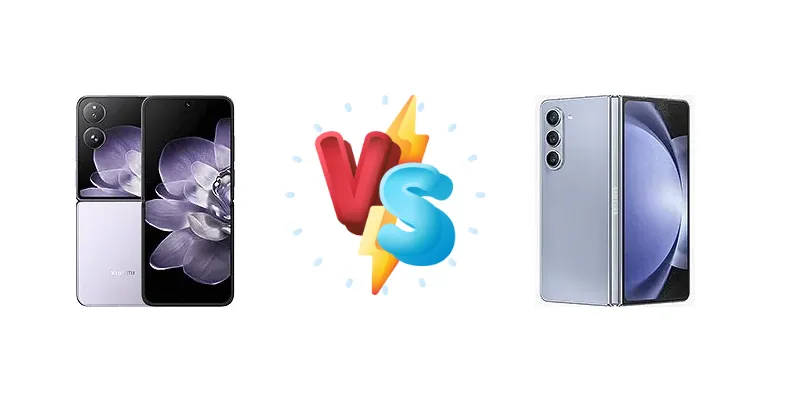
|
🏆 Quick Verdict
For the average user prioritizing sustained performance and rapid charging, the Xiaomi Mix Flip emerges as the winner. Its Snapdragon 8 Gen 3 offers a noticeable performance edge, and the 67W charging significantly reduces downtime. However, the Z Fold5’s software optimization and slightly longer battery life in active use remain compelling advantages.
| PHONES | ||
|---|---|---|
| Phone Names | Xiaomi Mix Flip | Samsung Galaxy Z Fold5 |
| Network | ||
|---|---|---|
| 2G bands | GSM 900 / 1800 / 1900 | GSM 850 / 900 / 1800 / 1900 |
| 3G bands | HSDPA 850 / 900 / 1700(AWS) / 1900 / 2100 | HSDPA 850 / 900 / 1700(AWS) / 1900 / 2100 |
| 4G bands | 1, 2, 3, 4, 5, 7, 8, 12, 17, 18, 19, 20, 26, 28, 34, 38, 39, 40, 41, 42, 48, 66 | 1, 2, 3, 4, 5, 7, 8, 12, 13, 17, 18, 19, 20, 25, 26, 28, 38, 39, 40, 41, 66 - International |
| 5G bands | 1, 2, 3, 5, 7, 8, 12, 20, 26, 28, 38, 40, 41, 48, 66, 77, 78, 79 SA/NSA | 1, 2, 3, 5, 7, 8, 12, 20, 25, 28, 38, 40, 41, 66, 77, 78 SA/NSA/Sub6 - International |
| Speed | HSPA, LTE, 5G | HSPA, LTE, 5G |
| Technology | GSM / CDMA / HSPA / CDMA2000 / LTE / 5G | GSM / CDMA / HSPA / EVDO / LTE / 5G |
| Launch | ||
|---|---|---|
| Announced | 2024, July 19 | 2023, July 26 |
| Status | Available. Released 2024, July 19 | Available. Released 2023, August 11 |
| Body | ||
|---|---|---|
| Build | Plastic front (unfolded), glass front (folded), glass back, aluminum frame, hinge (stainless steel) | Glass front (Gorilla Glass Victus 2) (folded), plastic front (unfolded), glass back (Gorilla Glass Victus 2), aluminum frame |
| Dimensions | Unfolded: 167.5 x 74 x 7.6 mmFolded: 74 x 74 x 16 mm | Unfolded: 154.9 x 129.9 x 6.1 mmFolded: 154.9 x 67.1 x 13.4 mm |
| SIM | Nano-SIM + Nano-SIM | · Nano-SIM + eSIM· Nano-SIM + Nano-SIM + eSIM (max 2 at a time) |
| Weight | 190 g or 192 g (6.70 oz) | 253 g (8.92 oz) |
| Display | ||
|---|---|---|
| Resolution | 1224 x 2912 pixels (~460 ppi density) | 1812 x 2176 pixels (~373 ppi density) |
| Size | 6.86 inches, 108.5 cm2 (~87.5% screen-to-body ratio) | 7.6 inches, 183.2 cm2 (~91.1% screen-to-body ratio) |
| Type | Foldable LTPO AMOLED, 1B colors, Dolby Vision, HDR10+, 120Hz, 3000 nits (peak) | Foldable Dynamic AMOLED 2X, 120Hz, HDR10+ |
| Platform | ||
|---|---|---|
| CPU | Octa-core (1x3.3 GHz Cortex-X4 & 3x3.2 GHz Cortex-A720 & 2x3.0 GHz Cortex-A720 & 2x2.3 GHz Cortex-A520) | Octa-core (1x3.36 GHz Cortex-X3 & 2x2.8 GHz Cortex-A715 & 2x2.8 GHz Cortex-A710 & 3x2.0 GHz Cortex-A510) |
| Chipset | Qualcomm SM8650-AB Snapdragon 8 Gen 3 (4 nm) | Qualcomm SM8550-AC Snapdragon 8 Gen 2 (4 nm) |
| GPU | Adreno 750 | Adreno 740 |
| OS | Android 14, upgradable to Android 16, HyperOS 3 | Android 13, up to 4 major Android upgrades, One UI 6.1.1 |
| Memory | ||
|---|---|---|
| Card slot | No | No |
| Internal | 256GB 12GB RAM, 512GB 12GB RAM, 1TB 16GB RAM | 256GB 12GB RAM, 512GB 12GB RAM, 1TB 12GB RAM |
| Main Camera | ||
|---|---|---|
| Dual | 50 MP, f/1.7, 23mm (wide), 1/1.55", 1.0µm, PDAF, OIS 50 MP, f/2.0, 47mm (telephoto), PDAF (9cm - ∞), 2x optical zoom | - |
| Features | LED flash, panorama, HDR, Leica lenses | LED flash, HDR, panorama |
| Triple | - | 50 MP, f/1.8, 23mm (wide), 1/1.56", 1.0µm, dual pixel PDAF, OIS 10 MP, f/2.4, 66mm (telephoto), 1/3.94", 1.0µm, PDAF, OIS, 3x optical zoom 12 MP, f/2.2, 12mm, 123˚ (ultrawide), 1/3.06", 1.12µm |
| Video | 8K@24fps, 4K@24/30/60fps, 1080p@30/60/120/240/960fps, 720p@1920fps, Dolby Vision HDR | 8K@30fps, 4K@60fps, 1080p@60/240fps (gyro-EIS), HDR10+ |
| Selfie camera | ||
|---|---|---|
| Features | Dolby Vision HDR | HDR |
| Single | 32 MP, f/2.0, 21mm (wide), 0.7µm | 4 MP, f/1.8, 26mm (wide), 1/3.0", 2.0µm, under display Cover camera: 10 MP, f/2.2, 24mm (wide), 1/3.0", 1.22µm |
| Video | 4K@30/60fps, 1080p@30/60fps | 4K@30/60fps, 1080p@30/60fps, gyro-EIS |
| Sound | ||
|---|---|---|
| 35mm jack | No | No |
| Loudspeaker | Yes, with stereo speakers | Yes, with stereo speakers |
| Comms | ||
|---|---|---|
| Bluetooth | 5.4, A2DP, LE, aptX HD, aptX Adaptive, LHDC | 5.3, A2DP, LE, aptX HD |
| Infrared port | Yes | - |
| NFC | Yes | Yes |
| Positioning | GPS (L1+L5), BDS (B1I+B1c+B2a), GALILEO (E1+E5a), QZSS (L1+L5), NavIC (L5), GLONASS | GPS, GLONASS, GALILEO, BDS |
| Radio | No | No |
| USB | USB Type-C 2.0 | USB Type-C 3.2, OTG |
| WLAN | Wi-Fi 802.11 a/b/g/n/ac/6/7, dual-band, Wi-Fi Direct | Wi-Fi 802.11 a/b/g/n/ac/6e, tri-band, Wi-Fi Direct |
| Features | ||
|---|---|---|
| Sensors | Fingerprint (side-mounted), accelerometer, gyro, proximity, compass, barometer | Fingerprint (side-mounted), accelerometer, gyro, proximity, compass, barometer |
| Battery | ||
|---|---|---|
| Charging | 67W wired | 25W wired, 50% in 30 min 15W wireless 4.5W reverse wireless |
| Type | 4780 mAh | Li-Po 4400 mAh |
| Misc | ||
|---|---|---|
| Colors | Black, White, Purple | Icy Blue, Phantom Black, Cream, Gray, Blue |
| Models | 2405CPX3DC, 2405CPX3DG | SM-F946B, SM-F946B/DS, SM-F946U, SM-F946U1, SM-F946N, SM-F946W, SM-F9460 |
| Price | € 1,463.14 / $ 999.99 / £ 579.00 | € 660.00 / $ 607.00 / £ 520.69 / ₹ 86,000 |
| SAR | 1.09 W/kg (head) 1.09 W/kg (body) | 1.16 W/kg (head) |
| SAR EU | 1.00 W/kg (head) 1.00 W/kg (body) | 1.24 W/kg (head) 1.19 W/kg (body) |
Xiaomi Mix Flip
- Significantly faster Snapdragon 8 Gen 3 processor
- 67W wired charging for rapid replenishment
- Higher peak display brightness
- Slightly shorter active use battery life
- Camera performance is currently unknown
Samsung Galaxy Z Fold5
- Polished software experience and ecosystem integration
- Slightly longer active use battery life
- Wireless and reverse wireless charging
- Older Snapdragon 8 Gen 2 processor
- Slower 25W wired charging
Display Comparison
Both the Xiaomi Mix Flip and the Samsung Galaxy Z Fold5 feature impressive foldable displays, with measured peak brightnesses of 1314 nits and 1257 nits respectively. While the Mix Flip edges out the Z Fold5 in peak brightness, the real-world difference is likely minimal. Crucially, neither spec sheet details PWM dimming rates, a critical factor for users sensitive to flicker. Samsung’s experience with foldable displays likely translates to superior durability, though long-term testing is needed to confirm. The Z Fold5’s larger internal display offers a more immersive experience for multitasking and media consumption, a key advantage for productivity-focused users.
Camera Comparison
The provided data lacks detailed camera specifications for both devices. However, given Samsung’s history, the Z Fold5 likely boasts a more versatile camera system with advanced image processing capabilities. The Mix Flip’s camera performance will heavily rely on software optimization. Without sensor size or aperture information, it’s difficult to make a definitive judgment. The Z Fold5’s camera is likely to excel in low-light conditions and offer more refined color science, while the Mix Flip’s camera’s performance is an unknown quantity.
Performance
The Xiaomi Mix Flip’s Snapdragon 8 Gen 3 (4nm) represents a significant leap over the Galaxy Z Fold5’s Snapdragon 8 Gen 2 (4nm). The Gen 3’s Cortex-X4 prime core, clocked at 3.3 GHz, offers a substantial performance boost over the Z Fold5’s Cortex-X3. The architectural improvements in the Gen 3, combined with the 4nm process, also promise better thermal efficiency, potentially mitigating throttling during extended gaming sessions. While the Z Fold5 benefits from Samsung’s software optimizations, the raw processing power of the Mix Flip’s chipset is undeniable. The Z Fold5’s older chipset may show its age in demanding applications.
Battery Life
The Galaxy Z Fold5 boasts a slightly longer active use battery score of 12:01h compared to the Mix Flip’s 11:58h. However, the Mix Flip’s 67W wired charging is a game-changer, offering significantly faster replenishment than the Z Fold5’s 25W charging. The Z Fold5’s inclusion of 15W wireless and 4.5W reverse wireless charging adds convenience, but doesn’t offset the charging speed disparity. The Mix Flip’s faster charging is particularly beneficial for power users who frequently drain their battery.
Buying Guide
Buy the Xiaomi Mix Flip if you demand the absolute fastest performance for demanding tasks like gaming and video editing, and value incredibly fast charging. You’re a power user who wants the latest tech. Buy the Samsung Galaxy Z Fold5 if you prioritize a polished software experience, a larger, more versatile display, and a slightly longer battery life during typical daily use. You value refinement and ecosystem integration.