
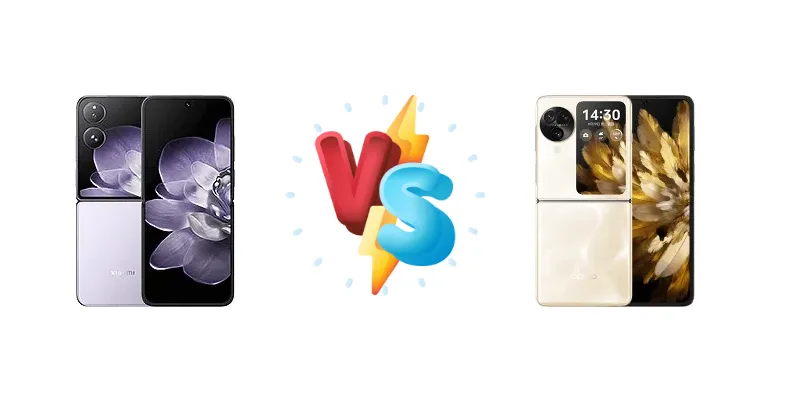
Xiaomi Mix Flip vs Oppo Find N3 Flip: Which Flip Phone Delivers the Best Experience?
| Phones Images | |||||
|---|---|---|---|---|---|
|
🏆 Quick Verdict
For the average user prioritizing all-around performance and battery life, the Oppo Find N3 Flip emerges as the stronger contender. Its superior battery endurance (12:58h active use) and efficient Dimensity 9200 chipset provide a smoother, longer-lasting experience, despite the Xiaomi Mix Flip's raw processing power.
| PHONES | ||
|---|---|---|
| Phone Names | Xiaomi Mix Flip | Oppo Find N3 Flip |
| Network | ||
|---|---|---|
| 2G bands | GSM 900 / 1800 / 1900 | GSM 850 / 900 / 1800 / 1900 |
| 3G bands | HSDPA 850 / 900 / 1700(AWS) / 1900 / 2100 | HSDPA 800 / 850 / 900 / 1700(AWS) / 1900 / 2100 |
| 4G bands | 1, 2, 3, 4, 5, 7, 8, 12, 17, 18, 19, 20, 26, 28, 34, 38, 39, 40, 41, 42, 48, 66 | 1, 2, 3, 4, 5, 7, 8, 12, 17, 18, 19, 20, 26, 28, 38, 39, 40, 41, 66 - International |
| 5G bands | 1, 2, 3, 5, 7, 8, 12, 20, 26, 28, 38, 40, 41, 48, 66, 77, 78, 79 SA/NSA | 1, 2, 3, 5, 7, 8, 12, 20, 28, 38, 40, 41, 66, 77, 78 SA/NSA - International |
| Speed | HSPA, LTE, 5G | HSPA, LTE, 5G |
| Technology | GSM / CDMA / HSPA / CDMA2000 / LTE / 5G | GSM / CDMA / HSPA / LTE / 5G |
| Launch | ||
|---|---|---|
| Announced | 2024, July 19 | 2023, August 29 |
| Status | Available. Released 2024, July 19 | Available. Released 2023, September 08 |
| Body | ||
|---|---|---|
| Build | Plastic front (unfolded), glass front (folded), glass back, aluminum frame, hinge (stainless steel) | Plastic front (unfolded), glass back (unfolded), aluminum frame |
| Dimensions | Unfolded: 167.5 x 74 x 7.6 mmFolded: 74 x 74 x 16 mm | Unfolded: 166.4 x 75.8 x 7.8 mm Folded: 85.5 x 75.8 x 16.5 mm |
| SIM | Nano-SIM + Nano-SIM | Nano-SIM + Nano-SIM |
| Weight | 190 g or 192 g (6.70 oz) | 198 g (6.98 oz) |
| Display | ||
|---|---|---|
| Resolution | 1224 x 2912 pixels (~460 ppi density) | 1080 x 2520 pixels, 21:9 ratio (~403 ppi density) |
| Size | 6.86 inches, 108.5 cm2 (~87.5% screen-to-body ratio) | 6.8 inches, 108.0 cm2 (~85.6% screen-to-body ratio) |
| Type | Foldable LTPO AMOLED, 1B colors, Dolby Vision, HDR10+, 120Hz, 3000 nits (peak) | Foldable LTPO AMOLED, 120Hz, HDR10+, 1200 nits (HBM), 1600 nits (peak) |
| Platform | ||
|---|---|---|
| CPU | Octa-core (1x3.3 GHz Cortex-X4 & 3x3.2 GHz Cortex-A720 & 2x3.0 GHz Cortex-A720 & 2x2.3 GHz Cortex-A520) | Octa-core (1x3.05 GHz Cortex-X3 & 3x2.85 GHz Cortex-A715 & 4x1.80 GHz Cortex-A510) |
| Chipset | Qualcomm SM8650-AB Snapdragon 8 Gen 3 (4 nm) | Mediatek Dimensity 9200 (4 nm) |
| GPU | Adreno 750 | Immortalis-G715 MC11 |
| OS | Android 14, upgradable to Android 16, HyperOS 3 | Android 13, up to 4 major Android upgrades, ColorOS 14 |
| Memory | ||
|---|---|---|
| Card slot | No | No |
| Internal | 256GB 12GB RAM, 512GB 12GB RAM, 1TB 16GB RAM | 256GB 12GB RAM, 512GB 12GB RAM |
| Main Camera | ||
|---|---|---|
| Dual | 50 MP, f/1.7, 23mm (wide), 1/1.55", 1.0µm, PDAF, OIS 50 MP, f/2.0, 47mm (telephoto), PDAF (9cm - ∞), 2x optical zoom | - |
| Features | LED flash, panorama, HDR, Leica lenses | LED flash, HDR, panorama |
| Triple | - | 50 MP, f/1.8, 24mm (wide), 1/1.56", 1.0µm, multi-directional PDAF, OIS 32 MP, f/2.0, 47mm (telephoto), 2x optical zoom, PDAF 48 MP, f/2.2, 14mm, 114˚ (ultrawide), AF |
| Video | 8K@24fps, 4K@24/30/60fps, 1080p@30/60/120/240/960fps, 720p@1920fps, Dolby Vision HDR | 4K@30fps, 1080p@30/60/240fps; gyro-EIS |
| Selfie camera | ||
|---|---|---|
| Features | Dolby Vision HDR | HDR, panorama |
| Single | 32 MP, f/2.0, 21mm (wide), 0.7µm | 32 MP, f/2.4, 21mm (wide), 1/2.74", 0.8µm, AF |
| Video | 4K@30/60fps, 1080p@30/60fps | 4K@30fps, 1080p@30; gyro-EIS |
| Sound | ||
|---|---|---|
| 35mm jack | No | No |
| Loudspeaker | Yes, with stereo speakers | Yes, with stereo speakers |
| Comms | ||
|---|---|---|
| Bluetooth | 5.4, A2DP, LE, aptX HD, aptX Adaptive, LHDC | 5.3, A2DP, LE, aptX HD |
| Infrared port | Yes | - |
| NFC | Yes | Yes (market/region dependent) |
| Positioning | GPS (L1+L5), BDS (B1I+B1c+B2a), GALILEO (E1+E5a), QZSS (L1+L5), NavIC (L5), GLONASS | GPS (L1+L5), GLONASS (L1), BDS (B1I+B1C+B2a+B2b), GALILEO (E1+E5a+E5b), QZSS (L1+L5) |
| Radio | No | No |
| USB | USB Type-C 2.0 | USB Type-C 2.0, OTG |
| WLAN | Wi-Fi 802.11 a/b/g/n/ac/6/7, dual-band, Wi-Fi Direct | Wi-Fi 802.11 a/b/g/n/ac, dual-band, Wi-Fi Direct - InternationalWi-Fi 802.11 a/b/g/n/ac/6/7, tri-band, Wi-Fi Direct - China only |
| Features | ||
|---|---|---|
| Sensors | Fingerprint (side-mounted), accelerometer, gyro, proximity, compass, barometer | Fingerprint (side-mounted), accelerometer, gyro, proximity, compass |
| Battery | ||
|---|---|---|
| Charging | 67W wired | 44W wired, 50% in 23 min Reverse wired |
| Type | 4780 mAh | Li-Po 4300 mAh |
| Misc | ||
|---|---|---|
| Colors | Black, White, Purple | Cream Gold, Misty Pink, Sleek Black |
| Models | 2405CPX3DC, 2405CPX3DG | PHT110, CPH2519 |
| Price | € 1,463.14 / $ 999.99 / £ 579.00 | About 1200 EUR |
| SAR | 1.09 W/kg (head) 1.09 W/kg (body) | - |
| SAR EU | 1.00 W/kg (head) 1.00 W/kg (body) | - |
Xiaomi Mix Flip
- Faster processor (Snapdragon 8 Gen 3)
- Brighter display (1314 nits)
- Faster wired charging (67W)
- Shorter battery life (11:58h active use)
- Potential for thermal throttling
Oppo Find N3 Flip
- Longer battery life (12:58h active use)
- More efficient chipset (Dimensity 9200)
- Reverse wired charging
- Dimmer display (939 nits)
- Less powerful processor
Display Comparison
The Xiaomi Mix Flip boasts a brighter display, reaching a measured peak of 1314 nits, compared to the Oppo Find N3 Flip’s 939 nits. This translates to significantly better visibility in direct sunlight. However, the Oppo’s panel likely benefits from its image processing, and the difference in peak brightness may not be noticeable in typical indoor scenarios. Both utilize foldable OLED technology, but details regarding refresh rate and hinge durability are missing, making a definitive judgment on long-term usability difficult. The higher brightness of the Xiaomi is a clear win for outdoor users.
Camera Comparison
The provided data is insufficient to conduct a detailed camera comparison. Both phones are listed as having 'Photo / Video' capabilities, but lack specifics on sensor size, aperture, or image stabilization. Without this information, it’s impossible to determine which phone offers superior image quality. The absence of details suggests neither phone is heavily focused on camera innovation as a primary selling point. We can assume both will offer competent camera systems for social media and casual photography, but enthusiasts will likely look elsewhere.
Performance
The Xiaomi Mix Flip is equipped with the Qualcomm Snapdragon 8 Gen 3 (4nm), a powerhouse chipset featuring an octa-core CPU with a prime Cortex-X4 core clocked at 3.3 GHz. This architecture promises significant performance gains over the Oppo Find N3 Flip’s MediaTek Dimensity 9200 (4nm). While the Dimensity 9200 is no slouch, with its Cortex-X3 prime core at 3.05 GHz, the Snapdragon 8 Gen 3’s newer architecture and higher clock speeds should translate to faster app loading, smoother multitasking, and superior gaming performance. However, the Dimensity 9200’s efficiency could lead to better sustained performance and less thermal throttling under prolonged load. The Snapdragon's raw power is undeniable, but real-world thermal management will be key.
Battery Life
Battery life is a clear win for the Oppo Find N3 Flip. Its active use score of 12:58h significantly surpasses the Xiaomi Mix Flip’s 11:58h. While the Xiaomi offers faster 67W wired charging, the Oppo’s more efficient chipset and potentially larger battery capacity (implied by the 92h endurance rating, though this is an older metric) provide a more substantial advantage in real-world usage. The Oppo also supports reverse wired charging, adding to its versatility. The Xiaomi’s faster charging is useful, but the Oppo’s longer runtime is more impactful for most users.
Buying Guide
Buy the Xiaomi Mix Flip if you absolutely need the latest and greatest processing power for demanding tasks like mobile gaming or video editing, and are willing to trade some battery life for it. Buy the Oppo Find N3 Flip if you prioritize all-day battery life, a brighter display for outdoor visibility, and a more balanced overall experience, making it ideal for everyday use and content consumption.