
Xiaomi Mix Flip vs. Huawei Mate X3: A Deep Dive into Foldable Flagship Performance
| Phones Images | |||||
|---|---|---|---|---|---|
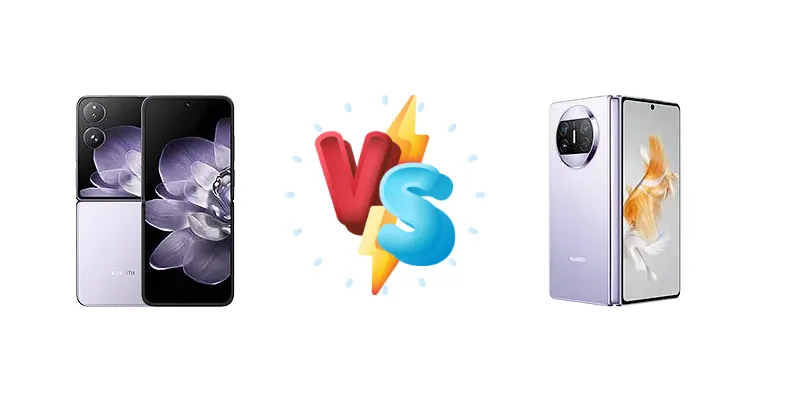
|
🏆 Quick Verdict
For users prioritizing raw processing power and display brightness, the Xiaomi Mix Flip emerges as the winner. Its Snapdragon 8 Gen 3 chipset delivers a significant performance leap. However, the Huawei Mate X3 counters with a potentially longer-lasting battery experience and the convenience of wireless charging, making it a strong contender for power users.
| PHONES | ||
|---|---|---|
| Phone Names | Xiaomi Mix Flip | Huawei Mate X3 |
| Network | ||
|---|---|---|
| 2G bands | GSM 900 / 1800 / 1900 | GSM 850 / 900 / 1800 / 1900 |
| 3G bands | HSDPA 850 / 900 / 1700(AWS) / 1900 / 2100 | HSDPA 800 / 850 / 900 / 1700(AWS) / 1900 / 2100 |
| 4G bands | 1, 2, 3, 4, 5, 7, 8, 12, 17, 18, 19, 20, 26, 28, 34, 38, 39, 40, 41, 42, 48, 66 | 1, 2, 3, 4, 5, 7, 8, 12, 17, 18, 19, 20, 26, 28, 34, 38, 39, 40, 41 |
| 5G bands | 1, 2, 3, 5, 7, 8, 12, 20, 26, 28, 38, 40, 41, 48, 66, 77, 78, 79 SA/NSA | - |
| Speed | HSPA, LTE, 5G | HSPA, LTE |
| Technology | GSM / CDMA / HSPA / CDMA2000 / LTE / 5G | GSM / CDMA / HSPA / EVDO / LTE |
| - | CDMA2000 1xEV-DO | |
| Launch | ||
|---|---|---|
| Announced | 2024, July 19 | 2023, March 23 |
| Status | Available. Released 2024, July 19 | Available. Released 2023, April 08 |
| Body | ||
|---|---|---|
| Build | Plastic front (unfolded), glass front (folded), glass back, aluminum frame, hinge (stainless steel) | Glass front, glass back or eco leather back, aluminum frame |
| Dimensions | Unfolded: 167.5 x 74 x 7.6 mmFolded: 74 x 74 x 16 mm | Unfolded: 156.9 x 141.5 x 5.3 mmFolded: 156.9 x 72.4 x 11.1 mm |
| SIM | Nano-SIM + Nano-SIM | Nano-SIM + Nano-SIM |
| Weight | 190 g or 192 g (6.70 oz) | 239 g or 241 g (8.43 oz) |
| - | IPX8 dust/water resistant (up to 1.5m for 30 min) | |
| Display | ||
|---|---|---|
| Protection | - | Kunlun Glass (cover display only) |
| Resolution | 1224 x 2912 pixels (~460 ppi density) | 2224 x 2496 pixels (~426 ppi density) |
| Size | 6.86 inches, 108.5 cm2 (~87.5% screen-to-body ratio) | 7.85 inches, 197.5 cm2 (~88.9% screen-to-body ratio) |
| Type | Foldable LTPO AMOLED, 1B colors, Dolby Vision, HDR10+, 120Hz, 3000 nits (peak) | Foldable OLED, 1B colors, 120Hz |
| - | Cover display: OLED, 120Hz, 6.4 inches, 1080 x 2504 pixels | |
| Platform | ||
|---|---|---|
| CPU | Octa-core (1x3.3 GHz Cortex-X4 & 3x3.2 GHz Cortex-A720 & 2x3.0 GHz Cortex-A720 & 2x2.3 GHz Cortex-A520) | Octa-core (1x3.19 GHz Cortex-X2 & 3x2.75 GHz Cortex-A710 & 4x2.0 GHz Cortex-A510) |
| Chipset | Qualcomm SM8650-AB Snapdragon 8 Gen 3 (4 nm) | Qualcomm SM8475 Snapdragon 8+ Gen 1 4G (4 nm) |
| GPU | Adreno 750 | Adreno 730 |
| OS | Android 14, upgradable to Android 16, HyperOS 3 | HarmonyOS 3.1 (China), EMUI 13.1 (Europe), no Google Play Services |
| Memory | ||
|---|---|---|
| Card slot | No | Nano Memory (uses shared SIM slot) |
| Internal | 256GB 12GB RAM, 512GB 12GB RAM, 1TB 16GB RAM | 256GB 12GB RAM, 512GB 12GB RAM, 1TB 12GB RAM |
| - | UFS | |
| Main Camera | ||
|---|---|---|
| Dual | 50 MP, f/1.7, 23mm (wide), 1/1.55", 1.0µm, PDAF, OIS 50 MP, f/2.0, 47mm (telephoto), PDAF (9cm - ∞), 2x optical zoom | - |
| Features | LED flash, panorama, HDR, Leica lenses | Laser AF, color spectrum sensor, LED flash, panorama, HDR |
| Triple | - | 50 MP, f/1.8, 23mm (wide), PDAF, OIS 12 MP, f/3.4, 125mm (periscope telephoto), PDAF, OIS, 5x optical zoom 13 MP, f/2.2, 13mm (ultrawide), AF |
| Video | 8K@24fps, 4K@24/30/60fps, 1080p@30/60/120/240/960fps, 720p@1920fps, Dolby Vision HDR | 4K@30/60fps, 1080p@30/60fps, gyro-EIS |
| Selfie camera | ||
|---|---|---|
| Features | Dolby Vision HDR | HDR, panorama |
| Single | 32 MP, f/2.0, 21mm (wide), 0.7µm | 8 MP, f/2.4, (wide) Cover camera: 8 MP, f/2.4, (wide) |
| Video | 4K@30/60fps, 1080p@30/60fps | 4K@30fps, 1080p@30fps |
| Sound | ||
|---|---|---|
| 3.5mm jack | - | No |
| 35mm jack | No | No |
| Loudspeaker | Yes, with stereo speakers | Yes, with stereo speakers |
| Comms | ||
|---|---|---|
| Bluetooth | 5.4, A2DP, LE, aptX HD, aptX Adaptive, LHDC | 5.2, A2DP, LE |
| Infrared port | Yes | Yes |
| NFC | Yes | Yes |
| Positioning | GPS (L1+L5), BDS (B1I+B1c+B2a), GALILEO (E1+E5a), QZSS (L1+L5), NavIC (L5), GLONASS | GPS (L1+L5), GLONASS (B1I+B1c+B2a), BDS (B1I+B1c+B2a), GALILEO (E1+E5a), QZSS (L1+L5), NavIC |
| Radio | No | No |
| USB | USB Type-C 2.0 | USB Type-C 3.1, DisplayPort 1.2, OTG |
| WLAN | Wi-Fi 802.11 a/b/g/n/ac/6/7, dual-band, Wi-Fi Direct | Wi-Fi 802.11 a/b/g/n/ac/6, dual-band, Wi-Fi Direct |
| Features | ||
|---|---|---|
| Sensors | Fingerprint (side-mounted), accelerometer, gyro, proximity, compass, barometer | Fingerprint (side-mounted), accelerometer, gyro, proximity, compass, barometer, altimeter |
| - | BDS Satellite Message | |
| Battery | ||
|---|---|---|
| Charging | 67W wired | 66W wired 50W wireless 7.5W reverse wireless |
| Type | 4780 mAh | Market-dependent versions:· Li-Po 4800 mAh (Global)· Si/C Li-Ion 5060 mAh (China only) |
| Misc | ||
|---|---|---|
| Colors | Black, White, Purple | Black, White, Violet, Dark Green, Gold |
| Models | 2405CPX3DC, 2405CPX3DG | ALT-AL00, ALT-L29 |
| Price | € 1,463.14 / $ 999.99 / £ 579.00 | About 1500 EUR |
| SAR | 1.09 W/kg (head) 1.09 W/kg (body) | - |
| SAR EU | 1.00 W/kg (head) 1.00 W/kg (body) | - |
| Tests | ||
|---|---|---|
| Battery life | - | Endurance rating 81h |
| Camera | - | Photo / Video |
| Display | - | Contrast ratio: Infinite (nominal) |
| Loudspeaker | - | -26.3 LUFS (Good) |
| Performance | - | AnTuTu: 993592 (v9) GeekBench: 4283 (v5.5), 4512 (v6) GFXBench: 41fps (ES 3.1 onscreen) |
Xiaomi Mix Flip
- Significantly faster processor with Snapdragon 8 Gen 3
- Brighter display for better outdoor visibility
- Faster wired charging at 67W
- Shorter battery life based on active use testing
- Lacks wireless charging capabilities
Huawei Mate X3
- Excellent battery endurance (81h rating)
- Convenient wireless and reverse wireless charging
- Mature foldable design and software optimization
- Older Snapdragon 8+ Gen 1 chipset
- Dimmer display compared to the Mix Flip
Display Comparison
The Xiaomi Mix Flip boasts a significantly brighter display, reaching a measured 1314 nits, compared to the Huawei Mate X3’s 926 nits. This translates to superior visibility in direct sunlight. While both feature foldable displays, the Mix Flip’s higher peak brightness is a clear advantage for outdoor use. The Mate X3’s ‘Infinite’ contrast ratio is a marketing term; real-world contrast performance will depend on panel calibration. Neither spec sheet details refresh rate or panel technology (LTPO), but given the flagship positioning, both are likely to employ adaptive refresh rates for power efficiency.
Camera Comparison
Both devices are listed as having 'Photo / Video' capabilities, but lack specific camera details. Given Huawei’s historical strength in mobile photography, the Mate X3 likely prioritizes image processing and computational photography. Without sensor size or aperture information, it’s difficult to make a definitive judgment. The absence of detail suggests neither phone features a groundbreaking camera system, focusing instead on overall package refinement. We can assume both will offer a versatile camera experience, but the Mix Flip’s newer image signal processor (ISP) within the Snapdragon 8 Gen 3 may offer slight improvements in dynamic range and low-light performance.
Performance
The Xiaomi Mix Flip’s Qualcomm SM8650-AB Snapdragon 8 Gen 3 (4nm) represents a substantial upgrade over the Huawei Mate X3’s Snapdragon 8+ Gen 1 (4nm). The Gen 3’s Cortex-X4 prime core, clocked at 3.3 GHz, offers a noticeable performance boost over the Mate X3’s Cortex-X2 at 3.19 GHz. The Mix Flip’s CPU configuration (1+3+2+2) is also more modern, utilizing newer Cortex-A720 cores for improved efficiency. The 4nm process node on both chips is similar, but the architectural improvements in the Gen 3 yield a clear advantage in multi-core and single-core performance, impacting everything from app launch speeds to demanding games.
Battery Life
The Huawei Mate X3’s reported endurance rating of 81 hours suggests significantly better battery life than the Xiaomi Mix Flip’s 11:58h of active use. However, endurance ratings are based on specific usage patterns and may not reflect real-world scenarios. The Mix Flip compensates with faster 67W wired charging, potentially mitigating the smaller battery capacity. The Mate X3 adds the convenience of 50W wireless and 7.5W reverse wireless charging, features absent on the Mix Flip. The trade-off is clear: the Mate X3 prioritizes longevity, while the Mix Flip focuses on quick top-ups.
Buying Guide
Buy the Xiaomi Mix Flip if you demand the absolute fastest performance for demanding tasks like gaming and video editing, and value a brighter, more vibrant display. Buy the Huawei Mate X3 if you prioritize extended battery life, appreciate the flexibility of wireless charging, and prefer a more mature foldable design with a proven track record, even if it means sacrificing some processing speed.