
Xiaomi Mix Flip vs Honor Magic Vs3: A Deep Dive into Foldable Flagship Performance
| Phones Images | |||||
|---|---|---|---|---|---|
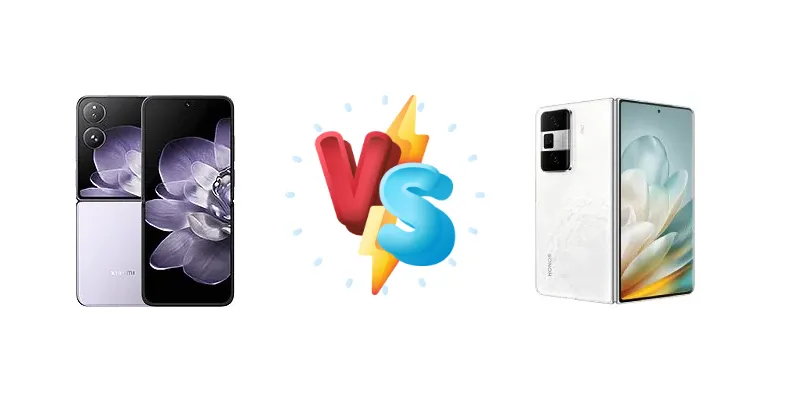
|
🏆 Quick Verdict
For users prioritizing raw processing power and future-proofing, the Xiaomi Mix Flip is the clear winner thanks to its Snapdragon 8 Gen 3. However, the Honor Magic Vs3 offers a more complete package with the convenience of 50W wireless charging and a refined foldable experience, making it ideal for those valuing practicality.
| PHONES | ||
|---|---|---|
| Phone Names | Xiaomi Mix Flip | Honor Magic Vs3 |
| Network | ||
|---|---|---|
| 2G bands | GSM 900 / 1800 / 1900 | GSM 850 / 900 / 1800 / 1900 |
| 3G bands | HSDPA 850 / 900 / 1700(AWS) / 1900 / 2100 | HSDPA 800 / 850 / 900 / 1700(AWS) / 1900 / 2100 |
| 4G bands | 1, 2, 3, 4, 5, 7, 8, 12, 17, 18, 19, 20, 26, 28, 34, 38, 39, 40, 41, 42, 48, 66 | 1, 2, 3, 4, 5, 7, 8, 12, 17, 18, 19, 20, 26, 28, 34, 38, 39, 40, 41, 66 |
| 5G bands | 1, 2, 3, 5, 7, 8, 12, 20, 26, 28, 38, 40, 41, 48, 66, 77, 78, 79 SA/NSA | 1, 3, 5, 8, 28, 38, 41, 77, 78 SA/NSA |
| Speed | HSPA, LTE, 5G | HSPA, LTE, 5G |
| Technology | GSM / CDMA / HSPA / CDMA2000 / LTE / 5G | GSM / CDMA / HSPA / CDMA2000 / LTE / 5G |
| Launch | ||
|---|---|---|
| Announced | 2024, July 19 | 2024, July 12 |
| Status | Available. Released 2024, July 19 | Available. Released 2024, July 19 |
| Body | ||
|---|---|---|
| Build | Plastic front (unfolded), glass front (folded), glass back, aluminum frame, hinge (stainless steel) | - |
| Dimensions | Unfolded: 167.5 x 74 x 7.6 mmFolded: 74 x 74 x 16 mm | Unfolded: 156.8 x 145.2 x 4.65 mm or 4.8 mmFolded: 156.8 x 74.0 x 9.8 mm or 10.1 mm |
| SIM | Nano-SIM + Nano-SIM | · Nano-SIM + eSIM· Nano-SIM + Nano-SIM |
| Weight | 190 g or 192 g (6.70 oz) | 229 g or 231 g (8.08 oz) |
| Display | ||
|---|---|---|
| Protection | - | King Kong Rhinoceros |
| Resolution | 1224 x 2912 pixels (~460 ppi density) | 2156 x 2344 pixels (~402 ppi density) |
| Size | 6.86 inches, 108.5 cm2 (~87.5% screen-to-body ratio) | 7.92 inches, 201.6 cm2 (~88.6% screen-to-body ratio) |
| Type | Foldable LTPO AMOLED, 1B colors, Dolby Vision, HDR10+, 120Hz, 3000 nits (peak) | Foldable LTPO AMOLED, 1B colors, Dolby Vision, 120Hz |
| Platform | ||
|---|---|---|
| CPU | Octa-core (1x3.3 GHz Cortex-X4 & 3x3.2 GHz Cortex-A720 & 2x3.0 GHz Cortex-A720 & 2x2.3 GHz Cortex-A520) | Octa-core (1x3.2 GHz Cortex-X3 & 2x2.8 GHz Cortex-A715 & 2x2.8 GHz Cortex-A710 & 3x2.0 GHz Cortex-A510) |
| Chipset | Qualcomm SM8650-AB Snapdragon 8 Gen 3 (4 nm) | Qualcomm SM8550-AB Snapdragon 8 Gen 2 (4 nm) |
| GPU | Adreno 750 | Adreno 740 |
| OS | Android 14, upgradable to Android 16, HyperOS 3 | Android 14, MagicOS 8.0.1 |
| Memory | ||
|---|---|---|
| Card slot | No | No |
| Internal | 256GB 12GB RAM, 512GB 12GB RAM, 1TB 16GB RAM | 256GB 12GB RAM, 512GB 12GB RAM, 1TB 16GB RAM |
| Main Camera | ||
|---|---|---|
| Dual | 50 MP, f/1.7, 23mm (wide), 1/1.55", 1.0µm, PDAF, OIS 50 MP, f/2.0, 47mm (telephoto), PDAF (9cm - ∞), 2x optical zoom | - |
| Features | LED flash, panorama, HDR, Leica lenses | Laser AF, LED flash, HDR, panorama |
| Triple | - | 50 MP, f/1.9, (wide), 1/1.56", PDAF, OIS 8 MP, f/3.4, (periscope telephoto), PDAF, OIS, 5x optical zoom 40 MP, f/2.2, 112˚, (ultrawide), AF |
| Video | 8K@24fps, 4K@24/30/60fps, 1080p@30/60/120/240/960fps, 720p@1920fps, Dolby Vision HDR | 4K@30/60fps (10-bit), 1080p@30/60fps, gyro-EIS, OIS |
| Selfie camera | ||
|---|---|---|
| Features | Dolby Vision HDR | HDR |
| Single | 32 MP, f/2.0, 21mm (wide), 0.7µm | 16 MP, f/2.2, 90˚, (wide) Cover camera: 16 MP, f/2.2, 90˚, (wide) |
| Video | 4K@30/60fps, 1080p@30/60fps | 4K@30fps, 1080p@30fps, gyro-EIS |
| Sound | ||
|---|---|---|
| 35mm jack | No | No |
| Loudspeaker | Yes, with stereo speakers | Yes, with stereo speakers |
| Comms | ||
|---|---|---|
| Bluetooth | 5.4, A2DP, LE, aptX HD, aptX Adaptive, LHDC | 5.3, A2DP, LE, aptX HD, LDAC |
| Infrared port | Yes | Yes |
| NFC | Yes | Yes |
| Positioning | GPS (L1+L5), BDS (B1I+B1c+B2a), GALILEO (E1+E5a), QZSS (L1+L5), NavIC (L5), GLONASS | GPS (L1+L5), GLONASS (L1), BDS (B1I+B1c+B2a), GALILEO (E1+E5a) |
| Radio | No | No |
| USB | USB Type-C 2.0 | USB Type-C 3.1, OTG, Display Port 1.2 |
| WLAN | Wi-Fi 802.11 a/b/g/n/ac/6/7, dual-band, Wi-Fi Direct | Wi-Fi 802.11 a/b/g/n/ac/6e/7, dual-band, Wi-Fi Direct |
| Features | ||
|---|---|---|
| Sensors | Fingerprint (side-mounted), accelerometer, gyro, proximity, compass, barometer | Fingerprint (side-mounted), accelerometer, gyro, proximity, compass, barometer |
| Battery | ||
|---|---|---|
| Charging | 67W wired | 66W wired 50W wireless 5W reverse wired |
| Type | 4780 mAh | Li-Po 5000 mAh |
| Misc | ||
|---|---|---|
| Colors | Black, White, Purple | Velvet Black, Snow, Tundra Green |
| Models | 2405CPX3DC, 2405CPX3DG | FLC-AN00 |
| Price | € 1,463.14 / $ 999.99 / £ 579.00 | About 980 EUR |
| SAR | 1.09 W/kg (head) 1.09 W/kg (body) | - |
| SAR EU | 1.00 W/kg (head) 1.00 W/kg (body) | - |
Xiaomi Mix Flip
- Latest Snapdragon 8 Gen 3 for unmatched performance
- High peak display brightness (1314 nits)
- Excellent active use battery life (11:58h)
- Lacks wireless charging
- Potential for higher thermal throttling under sustained load
Honor Magic Vs3
- Convenient 50W wireless charging
- Refined foldable design and user experience
- Fast 66W wired charging
- Older Snapdragon 8 Gen 2 chipset
- Potentially lower peak performance compared to Mix Flip
Display Comparison
The Xiaomi Mix Flip boasts a measured peak brightness of 1314 nits, suggesting excellent outdoor visibility. While the Magic Vs3’s display specs aren’t provided, Honor typically prioritizes color accuracy in its flagship devices. The Mix Flip’s newer panel technology likely benefits from improved power efficiency, potentially offsetting the higher brightness. The foldable form factor inherently introduces a crease; the quality of hinge design and panel lamination will be crucial differentiators, but data is unavailable to compare these aspects.
Camera Comparison
Without detailed camera specifications, a direct comparison is limited. However, both phones likely employ high-end image sensors. The Snapdragon 8 Gen 3’s ISP (Image Signal Processor) offers advancements in computational photography, potentially leading to better dynamic range and low-light performance on the Mix Flip. The Magic Vs3, leveraging the Gen 2, will still deliver excellent image quality, but may lack the latest AI-powered enhancements. The absence of information regarding sensor sizes and lens apertures prevents a more granular assessment.
Performance
The core difference lies in the chipsets: the Xiaomi Mix Flip features the Snapdragon 8 Gen 3 (4nm) versus the Honor Magic Vs3’s Snapdragon 8 Gen 2 (4nm). The Gen 3 utilizes a new CPU architecture – Cortex-X4 prime core at 3.3 GHz – compared to the Gen 2’s Cortex-X3 (3.2 GHz). This architectural shift, combined with higher clock speeds across the A720 cores (3.2/3.0 GHz vs 2.8/2.8 GHz in the Gen 2), translates to a noticeable performance uplift in CPU-intensive tasks. The Gen 3 also features an improved GPU, offering a significant advantage in gaming. While both are 4nm chips, the Gen 3’s efficiency improvements should result in better sustained performance under load.
Battery Life
The Xiaomi Mix Flip achieves an impressive 11:58h of active use, a strong indicator of battery life despite the power-hungry Snapdragon 8 Gen 3. The Honor Magic Vs3’s battery capacity is unknown, but its 66W wired charging is comparable to the Mix Flip’s 67W. However, the Magic Vs3 adds 50W wireless charging and 5W reverse wired charging, offering significant convenience. The efficiency gains of the Snapdragon 8 Gen 3 in the Mix Flip may offset the potential capacity difference, but the Magic Vs3’s wireless charging is a compelling advantage for many users.
Buying Guide
Buy the Xiaomi Mix Flip if you demand the absolute best performance for demanding tasks like gaming and video editing, and are willing to trade wireless charging for it. Buy the Honor Magic Vs3 if you prioritize a balanced experience with fast wired charging, the added convenience of wireless charging, and a polished foldable design that’s ready for daily use.