
Xiaomi Mix 4 vs Samsung Galaxy S21 Ultra: A Deep Dive into Flagship Features
| Phones Images | |||||
|---|---|---|---|---|---|
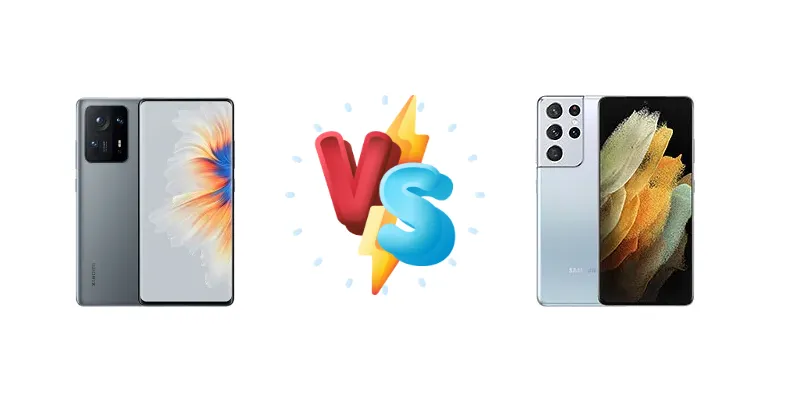
|
🏆 Quick Verdict
For users prioritizing charging speed and potentially slightly better sustained performance, the Xiaomi Mix 4 is the winner. However, the Samsung Galaxy S21 Ultra 5G remains a strong contender, offering a more mature software experience and a consistently excellent camera system, especially for those in regions with the Snapdragon variant.
| PHONES | ||
|---|---|---|
| Phone Names | Xiaomi Mix 4 | Samsung Galaxy S21 Ultra 5G |
| Network | ||
|---|---|---|
| 2G bands | GSM 850 / 900 / 1800 / 1900 | GSM 850 / 900 / 1800 / 1900 |
| 3G bands | HSDPA 850 / 900 / 1700(AWS) / 1900 / 2100 | HSDPA 850 / 900 / 1700(AWS) / 1900 / 2100 |
| 4G bands | 1, 2, 3, 4, 5, 7, 8, 12, 17, 18, 19, 20, 26, 28, 34, 38, 39, 40, 41, 42 | 1, 2, 3, 4, 5, 7, 8, 12, 13, 14, 18, 19, 20, 25, 26, 28, 30, 38, 39, 40, 41, 46, 48, 66, 71 - SM-G998U1 |
| 5G bands | 1, 3, 5, 8, 28, 41, 77, 78, 79 SA/NSA/Sub6 | 2, 5, 25, 41, 66, 71, 260, 261 SA/NSA/Sub6/mmWave - SM-G998U1 |
| Speed | HSPA, LTE, 5G | HSPA 42.2/5.76 Mbps, LTE (7CA) Cat20 2000/200 Mbps, 5G (5+ Gbps DL) |
| Technology | GSM / CDMA / HSPA / EVDO / LTE / 5G | GSM / CDMA / HSPA / EVDO / LTE / 5G |
| CDMA2000 1xEV-DO | 1, 3, 5, 7, 8, 20, 28, 38, 40, 41, 66, 77, 78 SA/NSA/Sub6 - SM-G998B | |
| Launch | ||
|---|---|---|
| Announced | 2021, August 10 | 2021, January 14 |
| Status | Available. Released 2021, August 16 | Available. Released 2021, January 29 |
| Body | ||
|---|---|---|
| Build | Glass front (Gorilla Glass Victus), ceramic back, aluminum frame | Glass front (Gorilla Glass Victus), glass back (Gorilla Glass Victus), aluminum frame |
| Dimensions | 162.6 x 75.4 x 8 mm (6.40 x 2.97 x 0.31 in) | 165.1 x 75.6 x 8.9 mm (6.5 x 2.98 x 0.35 in) |
| SIM | Nano-SIM + Nano-SIM | · Nano-SIM + eSIM· Nano-SIM + Nano-SIM + eSIM (max 2 at a time) |
| Weight | 225 g (7.94 oz) | 227 g (Sub6), 229 g (mmWave) (8.01 oz) |
| IP53, dust and splash resistant | IP68 dust/water resistant (up to 1.5m for 30 min) Stylus support | |
| Display | ||
|---|---|---|
| Protection | Corning Gorilla Glass Victus | Corning Gorilla Glass Victus |
| Resolution | 1080 x 2400 pixels, 20:9 ratio (~395 ppi density) | 1440 x 3200 pixels, 20:9 ratio (~515 ppi density) |
| Size | 6.67 inches, 107.4 cm2 (~87.6% screen-to-body ratio) | 6.8 inches, 112.1 cm2 (~89.8% screen-to-body ratio) |
| Type | AMOLED, 1B colors, 120Hz, HDR10+, Dolby Vision, 800 nits (HBM) | Dynamic AMOLED 2X, 120Hz, HDR10+, 1500 nits (peak) |
| - | Always-on display | |
| Platform | ||
|---|---|---|
| CPU | Octa-core (1x2.99 GHz Cortex-X1 & 3x2.42 GHz Cortex-A78 & 4x1.80 GHz Cortex-A55) | Octa-core (1x2.9 GHz Cortex-X1 & 3x2.80 GHz Cortex-A78 & 4x2.2 GHz Cortex-A55) - InternationalOcta-core (1x2.84 GHz Cortex-X1 & 3x2.42 GHz Cortex-A78 & 4x1.80 GHz Cortex-A55) - USA/China |
| Chipset | Qualcomm SM8350 Snapdragon 888+ 5G (5 nm) | Exynos 2100 (5 nm) - InternationalQualcomm SM8350 Snapdragon 888 5G (5 nm) - USA/China |
| GPU | Adreno 660 | Mali-G78 MP14 - InternationalAdreno 660 - USA/China |
| OS | Android 11, MIUI 12.5 | Android 11, up to 4 major Android upgrades, One UI 6.1 |
| Memory | ||
|---|---|---|
| Card slot | No | No |
| Internal | 128GB 8GB RAM, 256GB 8GB RAM, 256GB 12GB RAM, 512GB 12GB RAM | 128GB 8GB RAM, 128GB 12GB RAM, 256GB 12GB RAM, 256GB 16GB RAM, 512GB 12GB RAM, 512GB 16GB RAM |
| UFS 3.1 | UFS 3.1 | |
| Main Camera | ||
|---|---|---|
| Features | Laser AF, color spectrum sensor, Dual-LED flash, HDR, panorama | Laser AF, LED flash, auto-HDR, panorama |
| Quad | - | 108 MP, f/1.8, 24mm (wide), 1/1.33", 0.8µm, PDAF, OIS 10 MP, f/2.4, 72mm (telephoto), 1/3.24", 1.22µm, dual pixel PDAF, OIS, 3x optical zoom 10 MP, f/4.9, 240mm (periscope telephoto), 1/3.24", 1.22µm, dual pixel PDAF, OIS, 10x optical zoom 12 MP, f/2.2, 13mm (ultrawide), 1/2.55", 1.4µm, dual pixel PDAF, Super Steady video |
| Single | 20 MP, 27mm (wide), 1/3.4", 0.8µm, under display | - |
| Triple | 108 MP, f/1.9, 24mm (wide), 1/1.33", 0.8µm, PDAF, OIS 8 MP, f/4.1, 120mm (periscope telephoto), PDAF, OIS, 5x optical zoom 13 MP, f/2.2, 12mm, 123˚ (ultrawide), 1/3.06", 1.12µm | - |
| Video | 8K@24fps, 4K@30/60fps, 1080p@30/60/120/480fps; gyro-EIS, HDR10+ | 8K@24fps, 4K@30/60fps, 1080p@30/60/120/240fps, HDR10+, stereo sound rec., gyro-EIS |
| Selfie camera | ||
|---|---|---|
| Features | HDR | HDR |
| Single | 20 MP, 27mm (wide), 1/3.4", 0.8µm, under display | 40 MP, f/2.2, 26mm (wide), 1/2.8", 0.7µm, PDAF |
| Video | 1080p@30fps | 4K@30/60fps, 1080p@30fps |
| Sound | ||
|---|---|---|
| 3.5mm jack | No | No |
| 35mm jack | No | No |
| Loudspeaker | Yes, with stereo speakers | Yes, with stereo speakers |
| 24-bit/192kHz audio Tuned by Harman Kardon | 32-bit/384kHz audio Tuned by AKG | |
| Comms | ||
|---|---|---|
| Bluetooth | 5.2, A2DP, LE, aptX HD | 5.2, A2DP, LE |
| Infrared port | Yes | - |
| NFC | Yes | Yes |
| Positioning | GPS (L1+L5), GLONASS (G1), BDS (B1I+B1c+B2a), GALILEO (E1+E5a), QZSS (L1+L5), NavIC (L5) | GPS, GLONASS, BDS, GALILEO |
| Radio | No | FM radio (Snapdragon model only; market/operator dependent) |
| USB | USB Type-C 2.0 | USB Type-C 3.2, OTG |
| WLAN | Wi-Fi 802.11 a/b/g/n/ac/6e, dual-band, Wi-Fi Direct | Wi-Fi 802.11 a/b/g/n/ac/6e, dual-band, Wi-Fi Direct |
| Features | ||
|---|---|---|
| Sensors | Fingerprint (under display, optical), accelerometer, gyro, proximity, compass | Fingerprint (under display, ultrasonic), accelerometer, gyro, proximity, compass, barometer |
| Ultra Wideband (UWB) support | Samsung DeX, Samsung Wireless DeX (desktop experience support) Bixby natural language commands and dictation Samsung Pay (Visa, MasterCard certified) Ultra Wideband (UWB) support | |
| Battery | ||
|---|---|---|
| Charging | 120W wired, PD3.0, QC4, 100% in 15 min 50W wireless, 100% in 28 min | 25W wired, PD3.0 15W wireless (Qi) 4.5W reverse wireless |
| Type | Li-Po 4500 mAh | Li-Ion 5000 mAh |
| Misc | ||
|---|---|---|
| Colors | Ceramic Black, Ceramic White, Shadow Gray | Phantom Black, Phantom Silver, Phantom Titanium, Phantom Navy, Phantom Brown, Navy |
| Models | 2106118C | SM-G998B, SM-G998B/DS, SM-G998U, SM-G998U1, SM-G998W, SM-G998N, SM-G9980 |
| Price | About 660 EUR | $ 240.01 / C$ 353.20 / £ 202.99 / € 264.99 |
| SAR | - | 0.77 W/kg (head) 1.02 W/kg (body) |
| SAR EU | - | 0.71 W/kg (head) 1.58 W/kg (body) |
| Pricing | ||
|---|---|---|
| 128GB 12GB RAM | - | $ 384.99 |
| 256GB 12GB RAM | - | $ 998.00 |
| 512GB 12GB RAM | - | $ 1,179.99 |
| RENEWED | - | $ 459.00 |
| Tests | ||
|---|---|---|
| Battery life | - | Endurance rating 114h |
| Camera | - | Photo / Video |
| Display | - | Contrast ratio: Infinite (nominal) |
| Loudspeaker | - | -25.5 LUFS (Very good) |
| Performance | - | AnTuTu: 657150 (v8) GeekBench: 3518 (v5.1) GFXBench: 33fps (ES 3.1 onscreen) |
Xiaomi Mix 4
- Incredibly fast 120W wired charging
- Potentially higher CPU performance with Snapdragon 888+
- 50W wireless charging is a significant advantage
- Software experience may be less refined than Samsung
- Camera details are currently limited
Samsung Galaxy S21 Ultra 5G
- Excellent camera system with versatile features
- Bright and vibrant display with LTPO technology
- Mature software experience and long-term support
- Significantly slower charging speeds (25W wired)
- Exynos variant may exhibit more thermal throttling
Display Comparison
The Samsung Galaxy S21 Ultra boasts a peak brightness of 1023 nits, ensuring excellent visibility even in direct sunlight. While the Mix 4’s display specs aren’t provided, Xiaomi typically employs high-quality panels. The S21 Ultra’s ‘Infinite’ contrast ratio suggests a superior OLED panel, and its adaptive refresh rate (LTPO) likely contributes to better power efficiency. The S21 Ultra’s larger screen size and established display calibration are likely advantages for media consumption and color-critical work.
Camera Comparison
Both devices are equipped with capable camera systems, but detailed sensor information for the Mix 4 is missing. The S21 Ultra’s camera system is well-documented, featuring a versatile setup optimized for both photo and video. The S21 Ultra’s image processing leans towards vibrant, saturated colors, while Xiaomi often aims for a more natural look. Without specific details on the Mix 4’s sensors and image processing, it’s difficult to make a definitive comparison, but the S21 Ultra’s established reputation and feature set (like 8K video recording) give it an edge.
Performance
Both phones utilize the Qualcomm Snapdragon 888+ 5G (5nm) in some regions, but the S21 Ultra also comes with the Exynos 2100 (5nm) in others. The Mix 4’s Snapdragon 888+ has a slightly higher peak CPU clock speed (2.99 GHz vs 2.9 GHz/2.84 GHz), potentially offering a marginal performance boost in single-core tasks. However, the Exynos 2100’s GPU performance is comparable, and thermal throttling could negate any CPU advantage. The S21 Ultra’s RAM configuration options (12GB) are identical to the Mix 4, but the S21 Ultra’s LPDDR5 RAM is a key component of its performance. The Mix 4’s thermal management will be crucial to maintaining peak performance under sustained load.
Battery Life
The Samsung Galaxy S21 Ultra achieves an endurance rating of 114 hours, indicating solid battery life. However, the Xiaomi Mix 4’s standout feature is its 120W wired charging, capable of a full charge in just 15 minutes. This is a significant advantage over the S21 Ultra’s 25W charging. The Mix 4 also offers 50W wireless charging, dwarfing the S21 Ultra’s 15W Qi wireless charging. While the S21 Ultra’s battery capacity isn’t specified, the Mix 4’s faster charging effectively mitigates any potential capacity disadvantage.
Buying Guide
Buy the Xiaomi Mix 4 if you absolutely need the fastest charging available and frequently find yourself needing to top up quickly. It's ideal for power users who demand peak performance and aren't afraid of a less polished software experience. Buy the Samsung Galaxy S21 Ultra 5G if you prioritize a well-rounded experience with a top-tier camera, a vibrant display, and a more established ecosystem. It's the safer bet for users who value reliability and long-term software support.