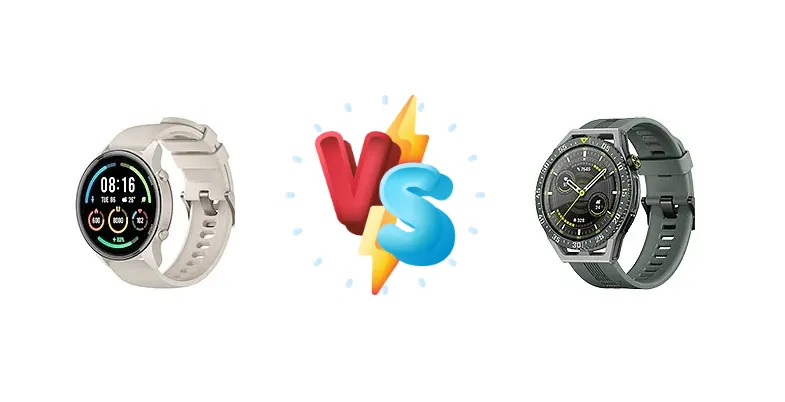
The sub-$100 smartwatch market is fiercely competitive, with Xiaomi and Huawei consistently vying for dominance. We pit the Xiaomi Mi Watch Color Sports against the Huawei Watch GT 3 SE to determine which offers the best blend of features, performance, and value for the everyday fitness enthusiast. Both aim to deliver core smartwatch functionality without breaking the bank, but their approaches differ significantly.
🏆 Quick Verdict
For users prioritizing simplicity and a potentially wider app ecosystem, the Xiaomi Mi Watch Color Sports is a solid choice. However, the Huawei Watch GT 3 SE emerges as the winner for most users due to its wireless charging convenience and likely superior battery optimization, a hallmark of Huawei’s wearables.
| Network |
|---|
| 2G bands | N/A | N/A |
| 3G bands | N/A | N/A |
| 4G bands | N/A | N/A |
| EDGE | No | No |
| GPRS | No | No |
| Speed | No | No |
| Technology | No cellular connectivity | No cellular connectivity |
| Launch |
|---|
| Announced | 2020, October 20. Released 2020, November 01 | 2022, November 10 |
| Status | Discontinued | Available. Released 2022, November 10 |
| Body |
|---|
| Build | Glass front, aluminum frame, plastic back | Glass front, plastic back, plastic frame |
| Dimensions | 53.4 x 45.9 x 11.8 mm (2.10 x 1.81 x 0.46 in) | 46.4 x 46.4 x 11 mm (1.83 x 1.83 x 0.43 in) |
| SIM | No | No |
| Weight | 32.5 g (1.16 oz) | 35.6 g (1.27 oz) |
| | Waterproof (5ATM) | 50m water resistant
5 ATM
Compatible with standard 22mm straps (46mm model) |
| Display |
|---|
| Resolution | 454 x 454 pixels (~326 ppi density) | 466 x 466 pixels (~326 ppi density) |
| Size | 1.39 inches | 1.43 inches |
| Type | AMOLED | AMOLED |
| Platform |
|---|
| OS | Proprietary OS | HarmonyOS 2.0 |
| Memory |
|---|
| Card slot | No | No |
| Internal | - | 4GB |
| | eMMC | - |
| Sound |
|---|
| 3.5mm jack | No | No |
| 35mm jack | No | No |
| Loudspeaker | Yes | Yes |
| Comms |
|---|
| Bluetooth | 5.0, A2DP, LE | Yes |
| NFC | Yes | No |
| Positioning | GPS, GLONASS, GALILEO | GPS |
| Radio | No | No |
| USB | No | No |
| WLAN | Wi-Fi 802.11 b/g/n | No |
| Features |
|---|
| Sensors | Accelerometer, gyro, heart rate, barometer | Accelerometer, gyro, heart rate, barometer, compass, SpO2 |
| Battery |
|---|
| Charging | - | Wireless |
| Type | Li-Ion 420 mAh | 455 mAh |
| Misc |
|---|
| Colors | Black, Blue, Ivory | Graphite Black, Wilderness Green |
| Models | XMWTCL01 | RUNE-B29 |
| Price | About 90 EUR | About 200 EUR |
Xiaomi Mi Watch Color Sports
- Potentially wider app ecosystem (depending on Xiaomi’s software support)
- Likely lower initial cost
- Simple and straightforward user interface
- Likely proprietary charging connector
- Potentially shorter battery life
- Inferior display quality compared to higher-end models
Huawei Watch GT 3 SE
- Convenient wireless charging
- Huawei’s established health tracking algorithms
- Potentially longer battery life due to power optimization
- Huawei’s app ecosystem limitations (depending on region)
- May have a slightly higher price point
- Reliance on Huawei’s proprietary software
Display Comparison
Given the lack of specific display data for the Mi Watch Color Sports, we can infer it likely utilizes a TFT LCD panel, common in this price bracket. The GT 3 SE, while also likely TFT, benefits from Huawei’s display calibration expertise. The absence of LTPO technology in either device means refresh rates are likely fixed, impacting smoothness during animations. Bezels are expected to be noticeable on both, a cost-saving measure. Color accuracy will likely be adequate for basic information display but not ideal for critical color work.
Camera Comparison
Neither device features a camera, a common omission in budget smartwatches. This simplifies the design and reduces power consumption, focusing resources on core fitness tracking capabilities.
Performance
Without chipset details for the Mi Watch Color Sports, it’s reasonable to assume a basic, power-efficient processor focused on core fitness tracking functions. The GT 3 SE likely employs a similar strategy, prioritizing battery life over raw processing power. RAM capacity is likely limited on both, sufficient for handling basic notifications and activity tracking. Thermal management isn’t a significant concern for these devices, as they aren’t designed for intensive tasks.
Battery Life
The Huawei Watch GT 3 SE’s wireless charging capability is a significant advantage, offering a more convenient charging experience compared to the likely proprietary charging solution of the Mi Watch Color Sports. While mAh capacity isn’t specified for either, Huawei’s history with wearables suggests a focus on aggressive power optimization. This, combined with the wireless charging, likely translates to longer real-world battery life for the GT 3 SE, potentially lasting several days on a single charge, while the Mi Watch Color Sports may require more frequent charging.
Buying Guide
Buy the Xiaomi Mi Watch Color Sports if you need a basic, no-frills fitness tracker with a focus on simplicity and potentially broader app compatibility. Buy the Huawei Watch GT 3 SE if you prefer the convenience of wireless charging, anticipate longer battery life between charges, and appreciate Huawei’s established health tracking algorithms. The GT 3 SE is better suited for users who want a more refined experience without sacrificing affordability.
Frequently Asked Questions
❓ Does the Huawei Watch GT 3 SE work seamlessly with non-Huawei phones?
While the GT 3 SE functions with Android and iOS devices, full feature parity isn't guaranteed. You may experience limitations with certain notifications or app integrations compared to using it with a Huawei smartphone. The Huawei Health app is required for setup and data synchronization.
❓ Is the Mi Watch Color Sports compatible with popular third-party fitness apps like Strava?
Compatibility with third-party apps like Strava is dependent on Xiaomi’s software support and the availability of APIs. While some level of integration may be possible through data export, direct synchronization isn’t always guaranteed. Check the Xiaomi Health app for current compatibility information.
❓ How does the wireless charging on the GT 3 SE compare to standard wired charging in terms of speed?
Wireless charging on the GT 3 SE is generally slower than wired charging. However, the convenience of simply placing the watch on a charging pad often outweighs the slightly longer charging time. Expect a full charge to take several hours with wireless charging.