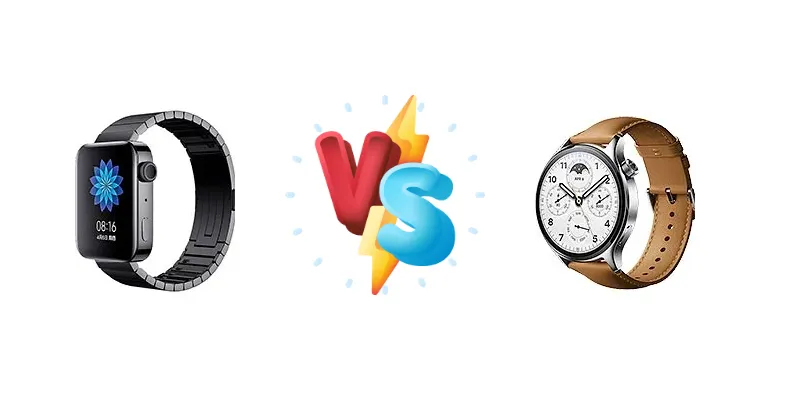
Xiaomi offers a diverse smartwatch lineup, and the Mi Watch (China) and S1 Pro represent distinct approaches. The Mi Watch, powered by the older Snapdragon Wear 3100, aims for affordability, while the S1 Pro focuses on a more refined experience with faster charging. This comparison dissects the core differences to determine which watch best suits your needs.
🏆 Quick Verdict
For most users, the Xiaomi Watch S1 Pro is the superior choice. While both offer wireless charging, the S1 Pro’s significantly faster 85-minute full charge is a major convenience. The Mi Watch’s Snapdragon Wear 3100, while capable, is showing its age, making the S1 Pro a more future-proof investment.
| Network |
|---|
| 2G bands | GSM 850 / 900 / 1800 / 1900 | N/A |
| 3G bands | HSDPA 850 / 900 / 2100 | N/A |
| 4G bands | 1, 3, 5, 7, 8, 18, 19, 20, 26, 39, 40, 41 | N/A |
| EDGE | - | No |
| GPRS | - | No |
| Speed | HSPA, LTE | No |
| Technology | GSM / HSPA / LTE | No cellular connectivity |
| Launch |
|---|
| Announced | 2019, November. Released 2019, November | 2022, August 12 |
| Status | Discontinued | Available. Released 2022, August 12 |
| Body |
|---|
| Build | - | Sapphire crystal front, stainless steel frame, sapphire crystal (heart rate zone), plastic back |
| Dimensions | 44.7 x 36.9 x 12.3 mm (1.76 x 1.45 x 0.48 in) | 46 x 46 x 11.3 mm (1.81 x 1.81 x 0.44 in) |
| SIM | eSIM | No |
| Weight | 44 g / 56 g (1.55 oz) | 48.5 g (1.73 oz) |
| | - | Waterproof (5ATM) |
| Display |
|---|
| Protection | Corning Gorilla Glass 3 or Sapphire crystal glass | - |
| Resolution | 368 x 448 pixels (~326 ppi density) | 480 x 480 pixels (~462 ppi density) |
| Size | 1.78 inches | 1.47 inches |
| Type | Super AMOLED | AMOLED, 600 nits (typ) |
| Platform |
|---|
| CPU | Quad-core 1.2 GHz Cortex-A7 | - |
| Chipset | Qualcomm Snapdragon Wear 3100 (28 nm) | - |
| GPU | Adreno 304 | - |
| OS | Proprietary OS | MIUI Watch OS |
| Memory |
|---|
| Card slot | No | No |
| Internal | 8GB 1GB RAM | Unspecified storage |
| | eMMC 4.5 | - |
| Sound |
|---|
| 3.5mm jack | No | No |
| 35mm jack | No | No |
| Loudspeaker | Yes | Yes |
| Comms |
|---|
| Bluetooth | 4.2, A2DP, LE | 5.2, A2DP, LE |
| NFC | Yes | Yes |
| Positioning | GPS, GLONASS, BDS | GPS (L1+L5), GLONASS, GALILEO, BDS, QZSS |
| Radio | No | No |
| USB | No | No |
| WLAN | Wi-Fi 802.11 b/g/n | Wi-Fi 802.11 b/g/n (China only) |
| Features |
|---|
| Sensors | Accelerometer, gyro, heart rate, barometer | Accelerometer, gyro, compass, barometer, heart rate, SpO2, thermometer (body temperature) |
| Battery |
|---|
| Charging | Wireless | Wireless, 100% in 85 min |
| Type | Li-Ion 570/590 mAh, non-removable | Li-Po 500 mAh |
| Misc |
|---|
| Colors | Black, Silver | Black, Silver |
| Models | - | M2135W1, M2134W1 |
| Price | About 150 EUR | About 220 EUR |
Xiaomi Mi Watch (China)
- Lower initial cost
- Wireless charging capability
- Functional Snapdragon Wear 3100 platform
- Older chipset may exhibit performance limitations
- Slower charging compared to S1 Pro
- Potentially shorter software support lifespan
Xiaomi Watch S1 Pro
- Faster 85-minute wireless charging
- Likely more modern chipset for improved performance
- Potentially longer software support
- Higher price point
- Specific chipset details are unavailable
- May not offer a dramatically different feature set beyond charging speed
Display Comparison
Display specifications are absent from the provided data, but considering the market positioning, the S1 Pro likely features a higher-resolution and brighter display than the Mi Watch. The Mi Watch, being an older model, may utilize an older generation AMOLED panel. The S1 Pro’s potential for improved color accuracy and outdoor visibility would benefit users who frequently use their watch in bright sunlight.
Camera Comparison
Neither device’s camera capabilities are detailed in the provided data. Smartwatches generally prioritize functionality over camera quality, so any camera present on either device is likely limited in resolution and image quality. It’s safe to assume neither watch will rival dedicated smartphone cameras.
Performance
The core difference lies in the chipset. The Xiaomi Mi Watch utilizes the Qualcomm Snapdragon Wear 3100, a 28nm processor with a quad-core 1.2 GHz Cortex-A7 CPU. This chipset, while still functional, is several generations behind current Wear OS offerings. The S1 Pro, while lacking specific chipset details, benefits from a more recent architecture, likely offering improved power efficiency and responsiveness. The 28nm process of the Snapdragon Wear 3100 inherently generates more heat than newer nodes, potentially leading to thermal throttling during sustained use, impacting app performance for users engaging in activities like GPS tracking or extended notifications.
Battery Life
Battery capacity is not specified for either device. However, the S1 Pro’s 100% charge in 85 minutes represents a significant advantage over the Mi Watch, which only specifies wireless charging without a time estimate. Faster charging directly translates to less downtime and greater convenience for users who frequently forget to charge their devices overnight. The S1 Pro’s charging speed suggests a higher wattage wireless charging implementation, potentially offsetting a smaller battery capacity compared to the Mi Watch.
Buying Guide
Buy the Xiaomi Mi Watch (China) if you prioritize a lower initial cost and are comfortable with a slightly older chipset. It’s a viable option for basic smartwatch functionality. Buy the Xiaomi Watch S1 Pro if you value faster charging, a more modern user experience, and are willing to spend a bit more for improved convenience and potentially longer software support.
Frequently Asked Questions
❓ Is the Snapdragon Wear 3100 in the Mi Watch still capable of running modern Wear OS apps?
While the Snapdragon Wear 3100 can run Wear OS, its age means it may struggle with demanding applications or experience slower loading times compared to newer chipsets. Expect a functional, but not necessarily fluid, experience with resource-intensive apps.
❓ How does the wireless charging speed of the S1 Pro compare to standard smartwatch wireless charging?
The S1 Pro’s 85-minute full charge is significantly faster than many other smartwatches that take 2+ hours to fully charge wirelessly. This suggests Xiaomi implemented a higher wattage wireless charging solution, offering a substantial convenience benefit.
❓ Will the Xiaomi Mi Watch continue to receive software updates?
Given the age of the Snapdragon Wear 3100 and the Mi Watch’s release date, long-term software support is uncertain. While it may receive critical security updates, major Wear OS version upgrades are less likely.